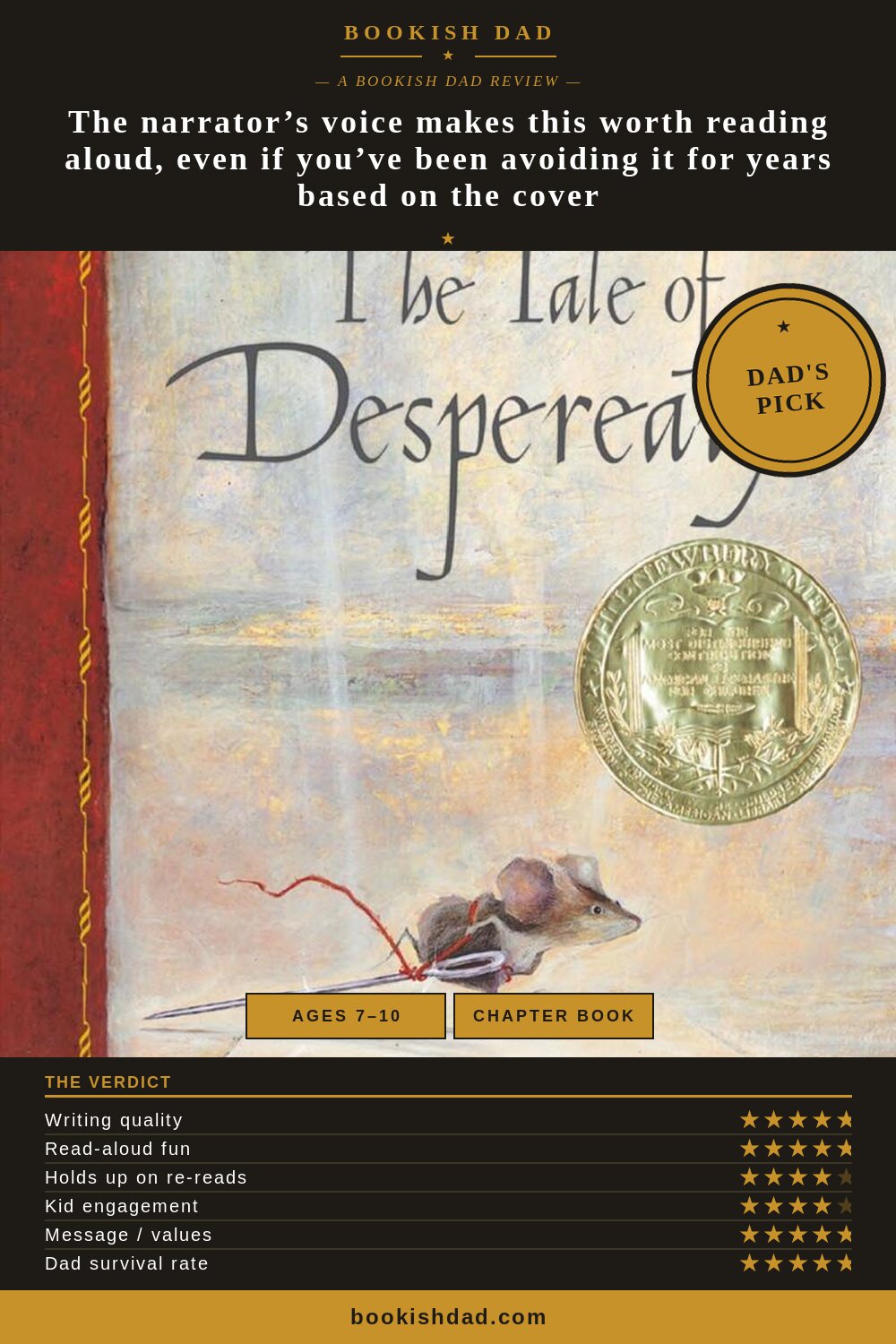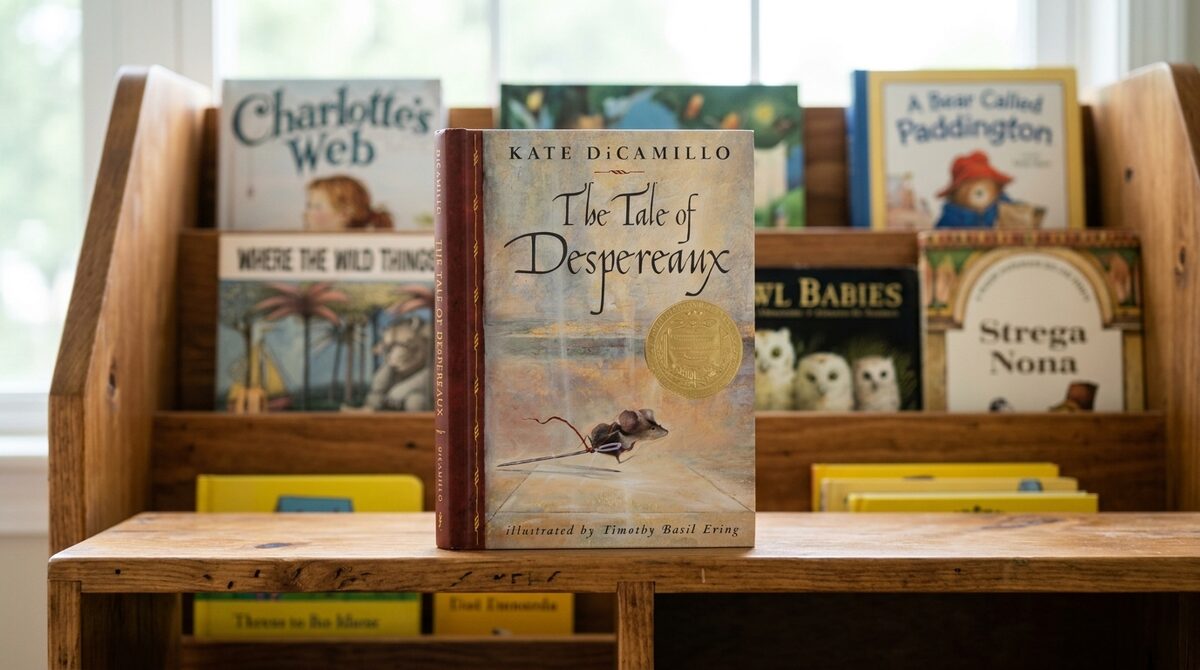

I put off reading this one for years because the cover made me assume it was going to be precious. Big-eared mouse, soft palette, Newbery sticker glinting up at me like a warning that I was about to have my feelings managed. I was wrong in a way that mildly annoys me, because I could have been reading it aloud this whole time. It turns out DiCamillo wrote a book about a mouse who loves stories and a rat who loves light he can never really have, and she wrapped it in a narrator who keeps leaning down to talk straight at the reader. That last part could have been unbearable. It is instead the reason the whole thing lands.
The setup is almost aggressively simple: a small, sickly mouse named Despereaux Tilling is born with his eyes open, which is not how mice are supposed to arrive, and he grows up reading instead of doing the things mice are meant to do. That's the engine. A creature who falls in love with a story about a knight and a princess, and then has the poor judgment to believe the story applies to him too. DiCamillo splits the book into separate movements, handing off to a rat, then to a servant girl, then braiding them together, and I braced for that structure to lose my kids. It didn't. Each thread is short and hot.
The narrator is the whole trick
DiCamillo's sentences are short and plain and she repeats words on purpose, circling back to them like a bell she keeps ringing. Light. Dark. Soup. The repetition should feel like a gimmick and instead it builds a kind of pressure, so that by the time a plain word comes back around the fifth time it has picked up weight it did not have the first time. She also stops the story cold to ask the reader if they know what a word means, or to tell you something is coming that you will not like. I braced for that to be twee. It is the opposite. It gives the book the feeling of being told to you by someone who has done this before and knows exactly where the sad part is.
Out loud, this is a gift. The narrator's asides beg to be performed. I dropped my voice for the direct addresses, sped up for the frantic dungeon stretches, and did an absolutely unlicensed rat voice for Roscuro that I am not proud of and will be doing for the rest of my life. The chapters are short enough that you hit a natural stopping point before anyone's attention frays, which for a read-aloud is worth more than any prose flourish. Fewer than half these chapters run long enough to lose a four-year-old, and the ones that do have the narrator popping in to reset the room.
My son is officially outside the target age, so he got the cliff-notes version most nights and mostly wanted the villain to sound as gross as possible. Fine. That's a legitimate way to experience literature at four. My daughter, though, is exactly who this book is built for. She has recently figured out that a book can be about more than its plot, and I watched her clock what DiCamillo was doing with the light and the dark long before I would have at her age. She didn't announce it. She just went very quiet during one of Roscuro's chapters and, a page later, said the rat wasn't actually a bad guy, he just wanted something he wasn't allowed to have. Then she asked me to keep going. From her, that is a raised eyebrow and a slow clap.
What it's actually about under all the fur
The values here are unfashionably direct and I respect it. This is a book about forgiveness done the hard way, about the specific damage of not being loved and what it turns you into, and about the idea that a story you believe in can be a survival tool. It could have gone syrupy. DiCamillo keeps it honest by refusing to pretend the cruel parts aren't cruel. Real loss, real neglect, a villain the book insists you understand rather than hate. It trusts kids to hold sadness without flinching, which is the highest compliment a children's book can pay.
On re-reads it holds up better than most, and I'd credit the structure for that. Because you already know how the threads connect, the second pass is where you notice how deliberately DiCamillo planted every echo. That's the good kind of re-read, the one where the machinery gets more interesting once you can see it. As for dad survival: this is a rare one where I didn't dread the next night. The bone-tired collapse voice never came out. The narrator does so much of the telling that I could just ride along. I've read The Very Hungry Caterpillar into powder in this house, so believe me when I say I know the difference between a book I tolerate and one I'm glad got requested again.
Five stars, and I'll own that a sliver of that is the relief of being wrong about a cover. Mostly, though, it's that this is a book that respects both the kid it's for and the adult reading it, which is a harder needle to thread than the soft artwork lets on.