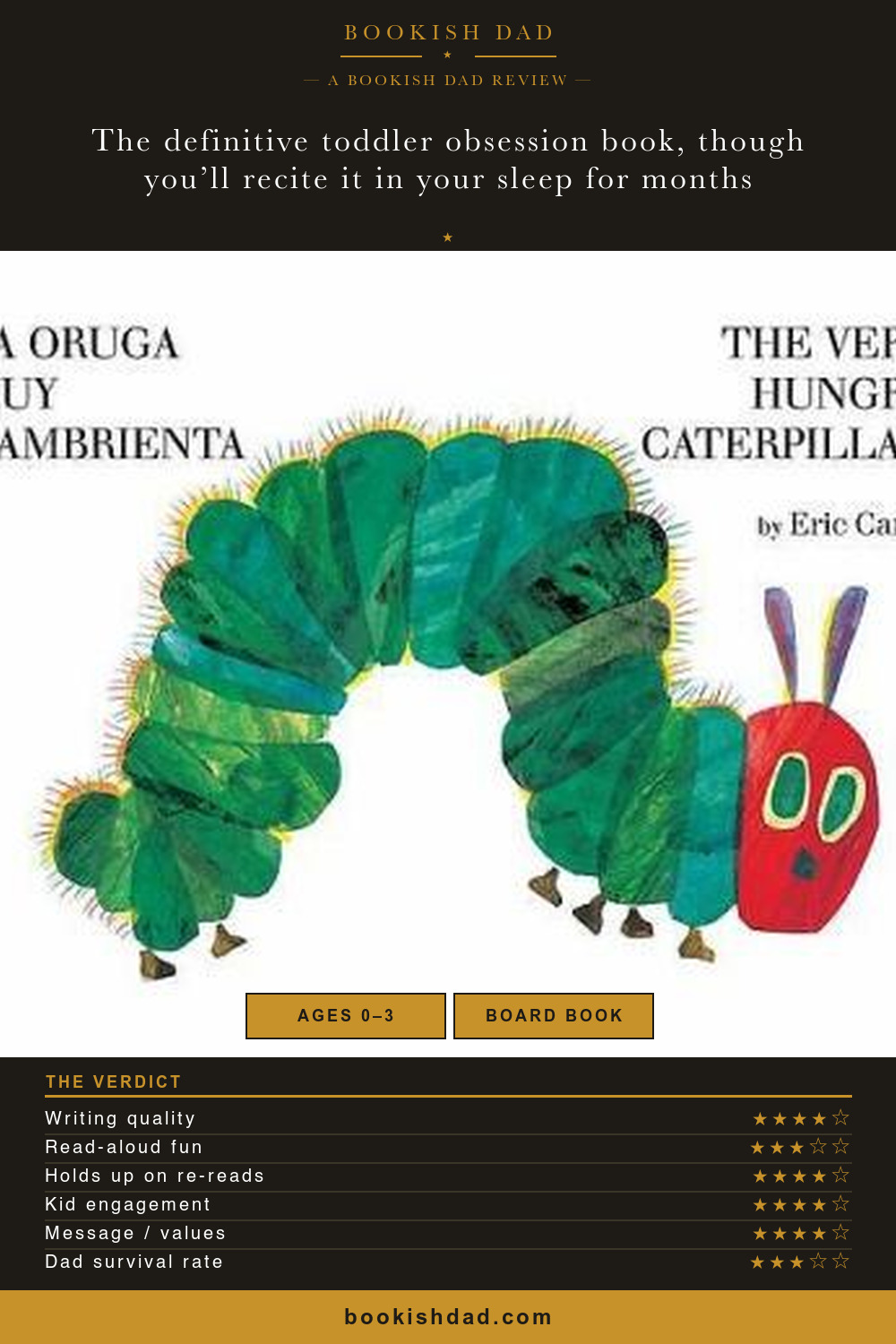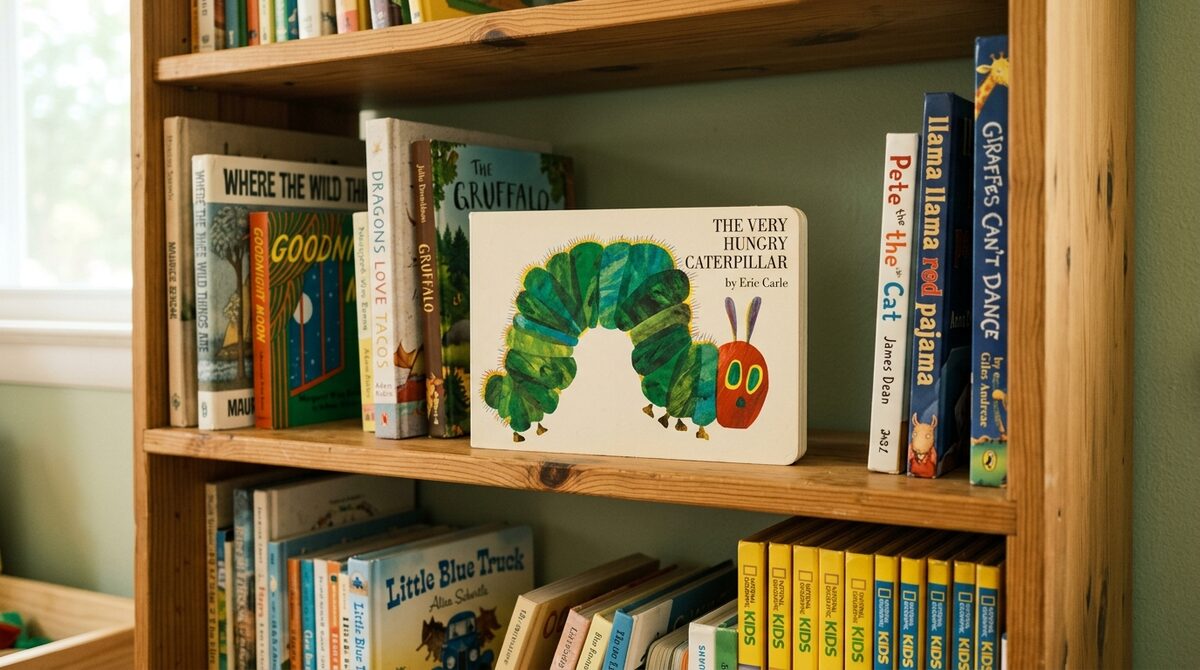

For about three months when my son was around two, this was the only book in the house. We owned two hundred others; as far as he was concerned they were furniture. He requested it daily. DAILY. He would pull out the caterpillar, hand it to me, and lower himself onto my lap like a small dictator settling in for a state briefing. My wife has heard this book approximately one billion times. I am not exaggerating for comedic effect. The math is roughly correct.
So you'll forgive me if my relationship with The Very Hungry Caterpillar is complicated. It's a great book. It's also the book I associate most strongly with the specific lower-back ache of reading on the floor of a nursery at 6:47 a.m.
The thing Carle gets right that nobody else does
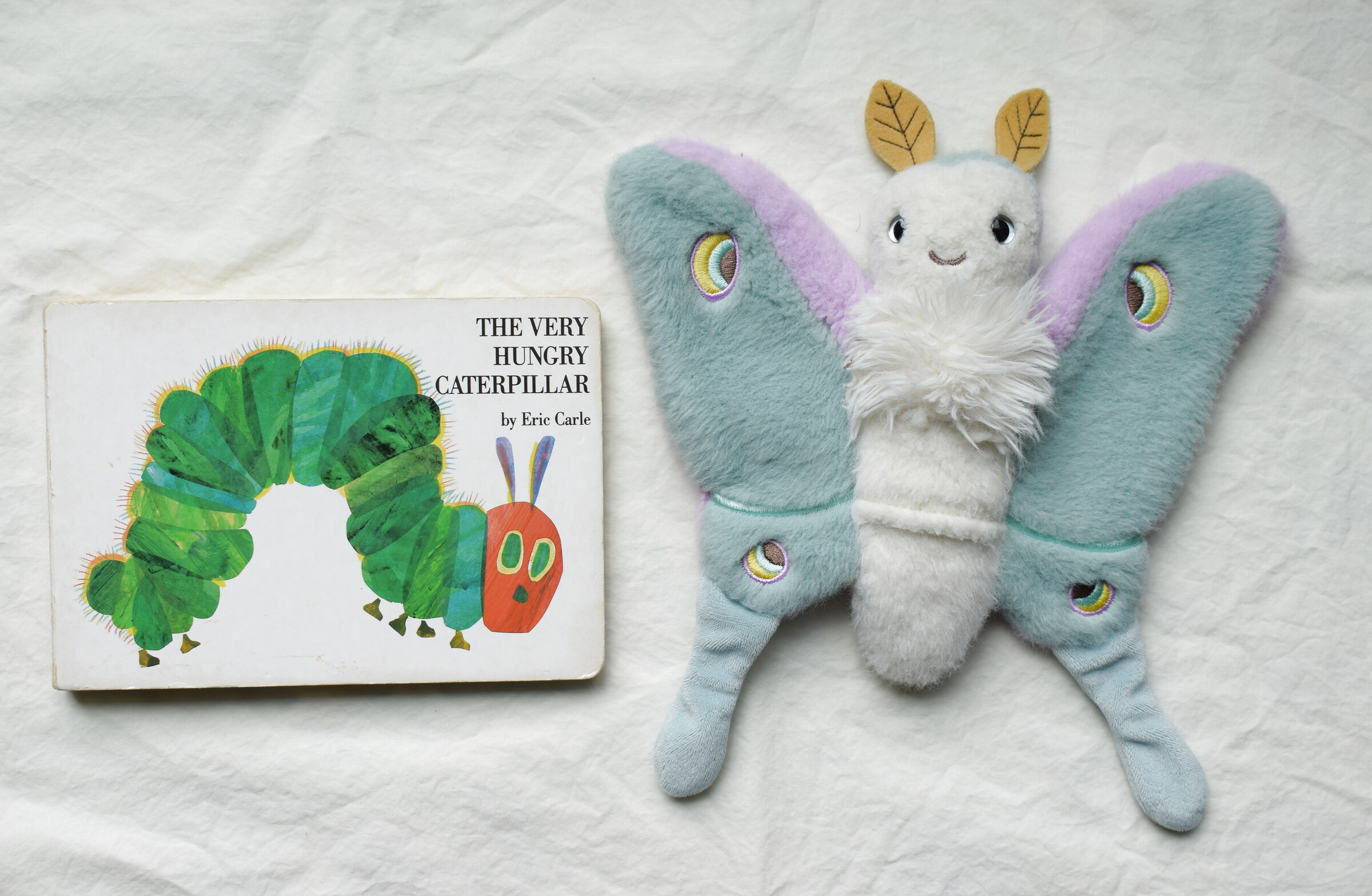
All that confidence about metamorphosis unsettles Moth. She preferred being a moth from day one.
Carle builds a whole arc out of almost no words. There's a tiny egg on a leaf. A caterpillar pops out. He's hungry. He eats. That's the whole engine. Most board books at this length are filler in nice fonts. This one doesn't have a single page you could cut. The sentences have a quiet rhythm. The repetition of the day-of-the-week structure is the trick, and it lets the kid feel the pattern click into place around the third read. By read five, my son was anticipating which fruit came next. By read fifteen, he was correcting me when I deliberately got it wrong, because by then I had started getting it wrong on purpose to entertain myself, which is the dad survival move of last resort.
As a read-aloud, it's not the wildest book on the shelf. There are no big sound-effect pages, no voices to do, no payoff line you can really lean into. I tried for a while to give the caterpillar a voice and quickly realized he doesn't have any dialogue, so I was just doing a small mumbly accent over the narration for no reason. What it does have is rhythm and a list. Lists, it turns out, are extremely good read-aloud material for toddlers. Each item lands like a little bell. The Saturday list in particular is where the energy peaks, because suddenly the caterpillar is eating things a caterpillar would not eat, and your kid figures this out and finds it hilarious.
The holes
The die-cut holes are the secret weapon. I underestimated this for years. My son would poke his finger through every single hole, every single read, with the focused expression of a man defusing a bomb. The book is a toy and a story at the same time, and that double identity is a huge part of why it works for the under-three crowd. The art is its own thing, too. Carle's collages have a texture you can almost feel through the page. The final butterfly spread is genuinely beautiful, and I say that as a guy who has looked at it more times than I have looked at most members of my own family.
Does it hold up on re-reads?
Yes. Frustratingly yes. I have read this book more times than any other book in my house, and it has not gotten worse. It has not gotten better, either. It's just settled into a kind of permanent baseline competence that I find admirable and slightly infuriating. Most picture books die around read thirty. This one doesn't die. It also doesn't sing on read three hundred, but I think that's a fair trade. You're not supposed to find a board book transcendent on read three hundred. You're supposed to find it tolerable, and "tolerable on read three hundred" is the actual gold standard of the format.
My daughter, now eight, has zero memory of this book mattering to her, even though we read it to her constantly. That tracks. She was perceptive about other things. This one was just background radiation for her. My son, on the other hand, would still light up if I pulled it out tonight, even though he's currently more interested in Shel Silverstein and being told the same poem fourteen times.
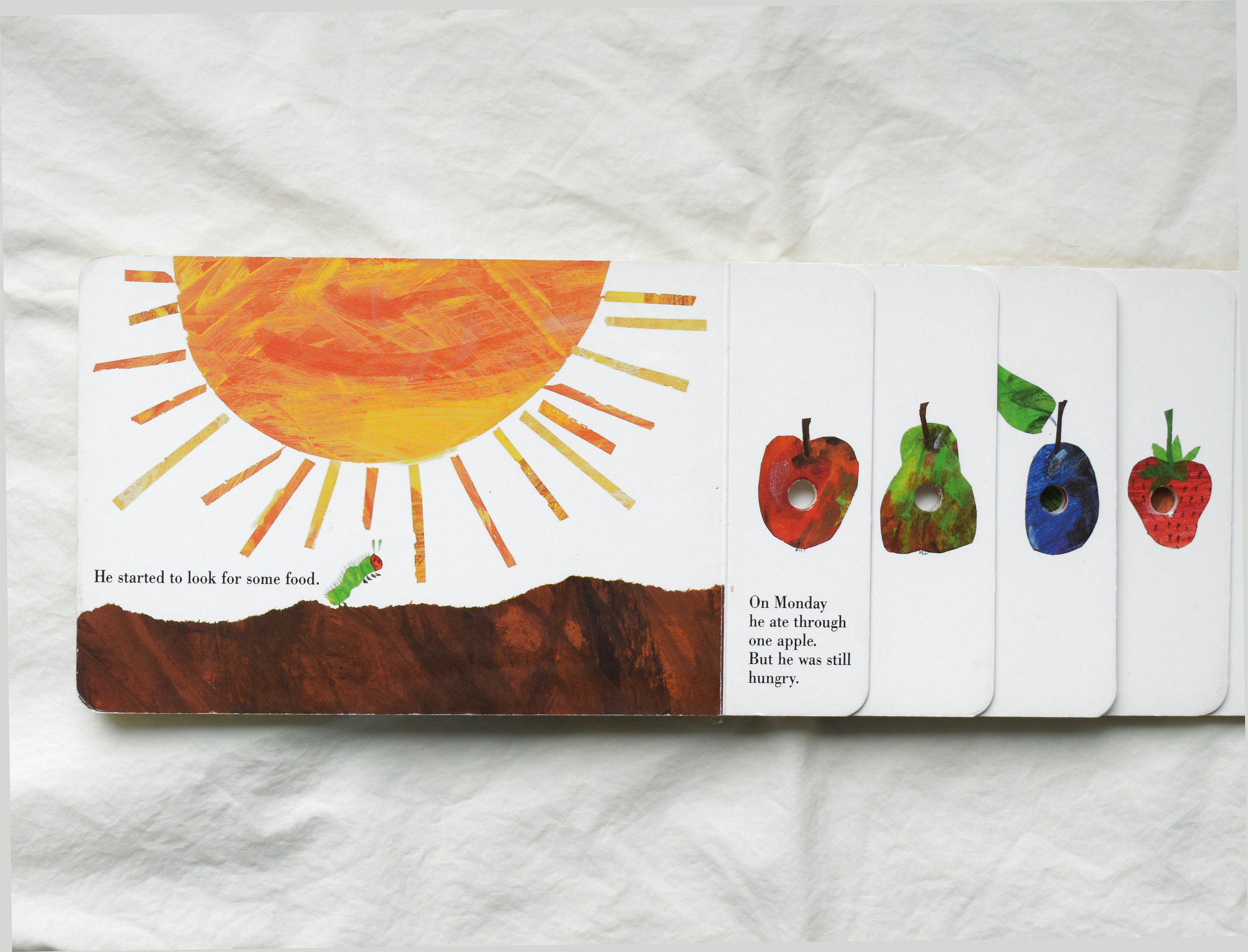
I love the physicality of this spread. The bold collage work, that big warm sun just filling the left side. My son likes flipping through the die-cut pages on the right, poking his finger through the holes while I read. It's a tactile book, which is half the reason it still works.
What it's teaching, and what it isn't
Counting, days of the week, basic food vocabulary, the fact that overeating has consequences, the fact that creatures change. That's a lot of payload for a book this short. The healthy-eating angle is there if you want to lean into it, and various pediatric groups have leaned into it, but I don't think the book is moralizing. The caterpillar isn't being punished for the cake. He just has a stomachache, the way you have a stomachache after a wedding. He eats a leaf, he feels better, he transforms. There's something deeply forgiving in that arc that I appreciate. It isn't really a lesson book. It's a small, generous story that happens to teach you to count to five along the way.
Dad survival rate is honestly the trickiest score here. The book itself is fine. The problem isn't the book. The problem is the volume. If you read it once a week, it's a near-classic. If you read it three times a night for a calendar quarter, you start hearing the days of the week in your dreams. That's not Carle's fault. He didn't know my kid was going to weaponize his book against me.