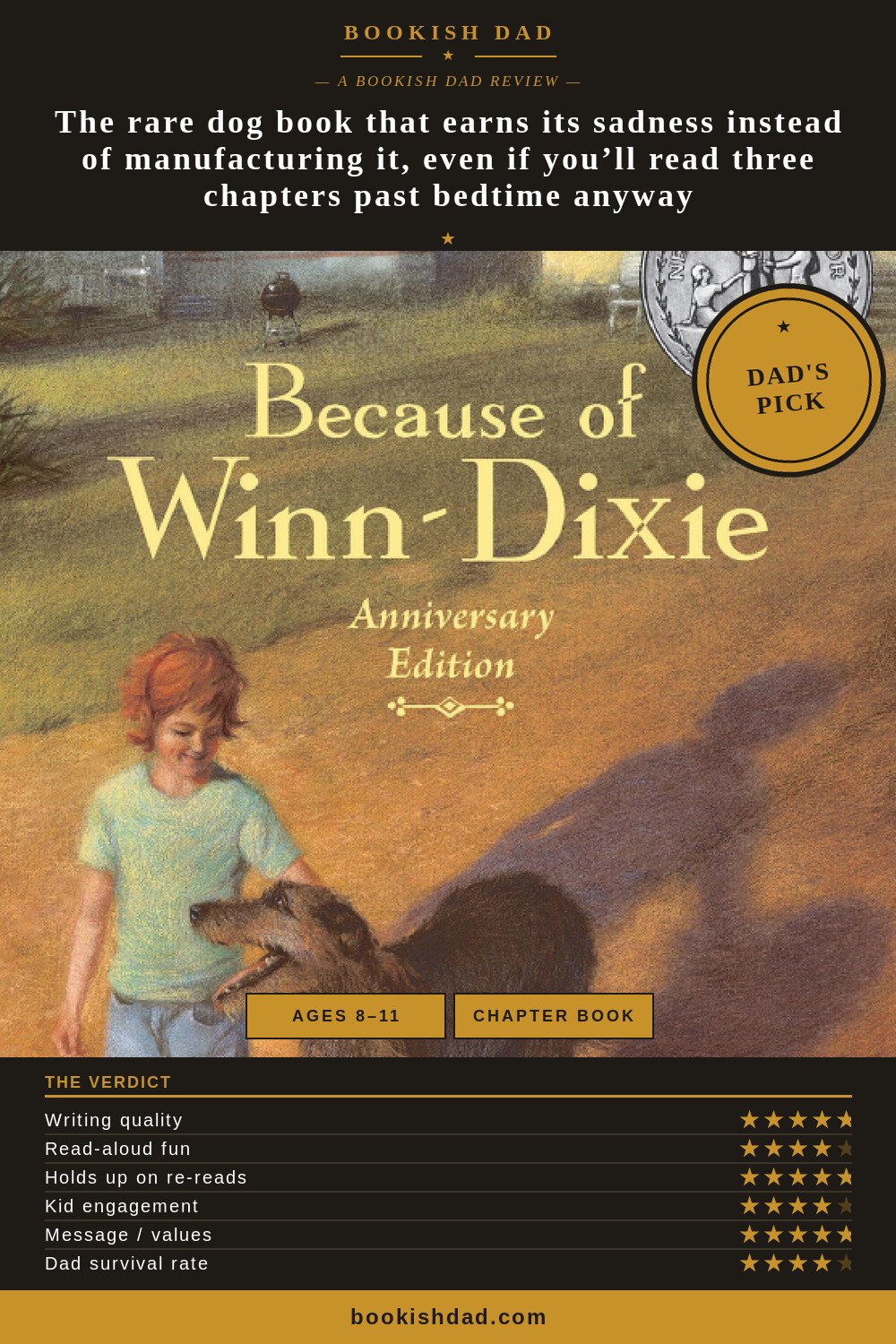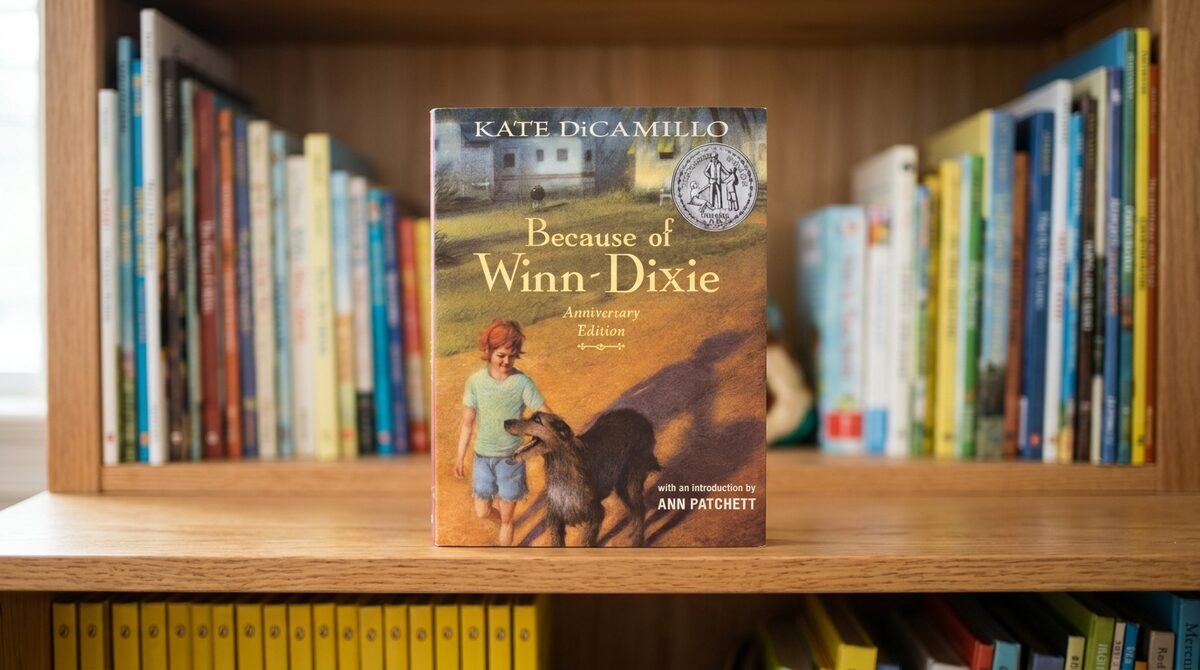

I went in braced for a dog book. You know the genre. The one where you can see the last chapter coming from page nine, where the whole enterprise is a slow machine for making an eleven-year-old cry into a golden retriever. I had my defenses up. I have a cat and a heart condition, metaphorically speaking, and I did not want to be manipulated. Well, I wasn't. That's the whole trick of this book. It never once reaches for your throat, and somehow it ends up holding your entire chest anyway.
The setup is almost embarrassingly plain. Ten-year-old Opal moves to a small town in Florida with her father, who preaches at the local church. She's lonely. She goes to the supermarket. She comes home with a stray dog she names after the store. From there, the dog is basically a key that keeps unlocking people. That's it. That's the engine. And Kate DiCamillo builds something enormous out of it, which is the thing I keep turning over in my head. A dog, a lonely kid, a small town, and by the end it feels like she's told you something true about every sad grown-up you've ever half-noticed and never asked about.
DiCamillo says less and means more
The writing is where I want to plant a flag. Opal narrates in first person, and DiCamillo does this thing where the sentences stay simple and childlike right up until they open a trapdoor under you. She'll set up a plain fact about a person, the librarian, the guy at the pet store, the neighbor lady, and then let the sadness underneath it surface without underlining it. Nobody in this book monologues about their pain. It just leaks out around the edges of ordinary conversation, and Opal, being a kid, mostly reports it without editorializing, which makes it land harder than any adult framing could. There's real restraint here. She trusts a ten-year-old's voice to carry weight most authors would panic and pile adjectives onto.
Out loud, it reads like a dream, and I say that as someone who does voices and is not ashamed. Opal's narration has a gentle Southern cadence to it that wants to be spoken slowly. The chapters are short, which is a gift when you're reading to a kid who's negotiating for one more. And there's genuine warmth in the dialogue, a shaggy, unhurried quality that gives you room to breathe as a reader. I found myself slowing down, not speeding to the finish. That almost never happens to me. My default bedtime mode is efficient.
My daughter, eight, is the target reader here in spirit even if she's a hair young for the page count. She's my stoic one. She does not cry at books, she diagnosed my crying at The Giving Tree by informing me it was raining, and she generally listens to sad stories with the composed expression of a small tax auditor. During one of the quieter chapters, the kind where a character finally admits something they'd been carrying, her hands just stopped moving on the blanket, flat and quiet, like someone listening for a noise downstairs. For her, that's the equivalent of most kids sobbing openly. She didn't say anything. She never does. But she asked me the next night whether we could read the next part before I'd even reached for the book, and I know exactly what that means coming from her.
The re-read question, and my four-year-old
Now, the honest part about the audience. This is an 8-to-11 book, and my four-year-old is neither of those numbers. He's a physical creature, he does the Wild Things roar on command, and he has been requesting the same handful of books for months. A quiet character-driven novel about grief and belonging is not built for him yet, and I'm not going to pretend he sat rapt. He drifted. That's fine. That's the correct outcome. But I'll say this for the re-read durability: this is a book that gets deeper the older the reader gets, not shallower. My daughter will get one thing from it now and something entirely different at eleven, and honestly something else again at forty, when she notices the grown-ups in it are all quietly wrecked people trying to be kind anyway. Books that grow with the kid are rare. This is one.
On values, DiCamillo is teaching plenty, but she's too smart to lecture. The lesson, if you want to name it, is that everybody you meet is carrying something, and the decent move is to stay curious and gentle instead of writing people off. Opal keeps discovering that the person she'd dismissed has a whole sorrow she never guessed at. That's a genuinely useful thing to hand a kid, and it's delivered without a single moment of the story stopping to make sure you got the point. It teaches by example, which is the only way it ever really takes.
Dad survival rate is high, which surprised me for a book with this much feeling in it. Sad books usually cost me something to perform. This one gives back. The short chapters, the pace that wants you to slow down, the fact that DiCamillo never asks you to fake an emotion the text hasn't earned. I could read this one for a week straight without hollowing out. That's the mark of writing that respects both the reader and the person doing the reading aloud at 8:15 on a Tuesday.
A dog, a lonely kid, a small town. She makes it feel like the whole world. Five stars, and I'm not even flagging nostalgia on this one, because I never read it as a kid. This is a fresh, cold-eyed adult verdict, and the verdict is that it's a classic.