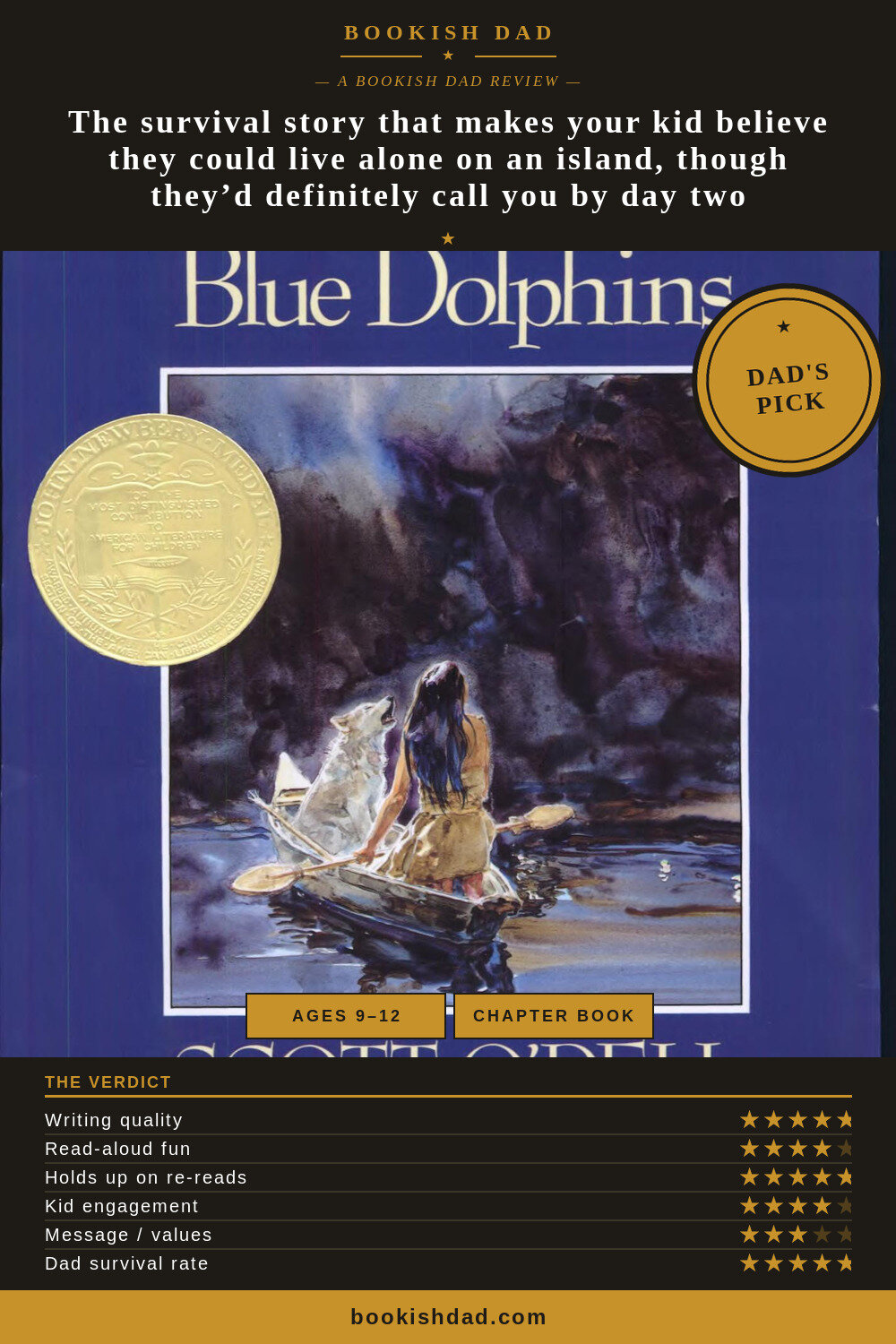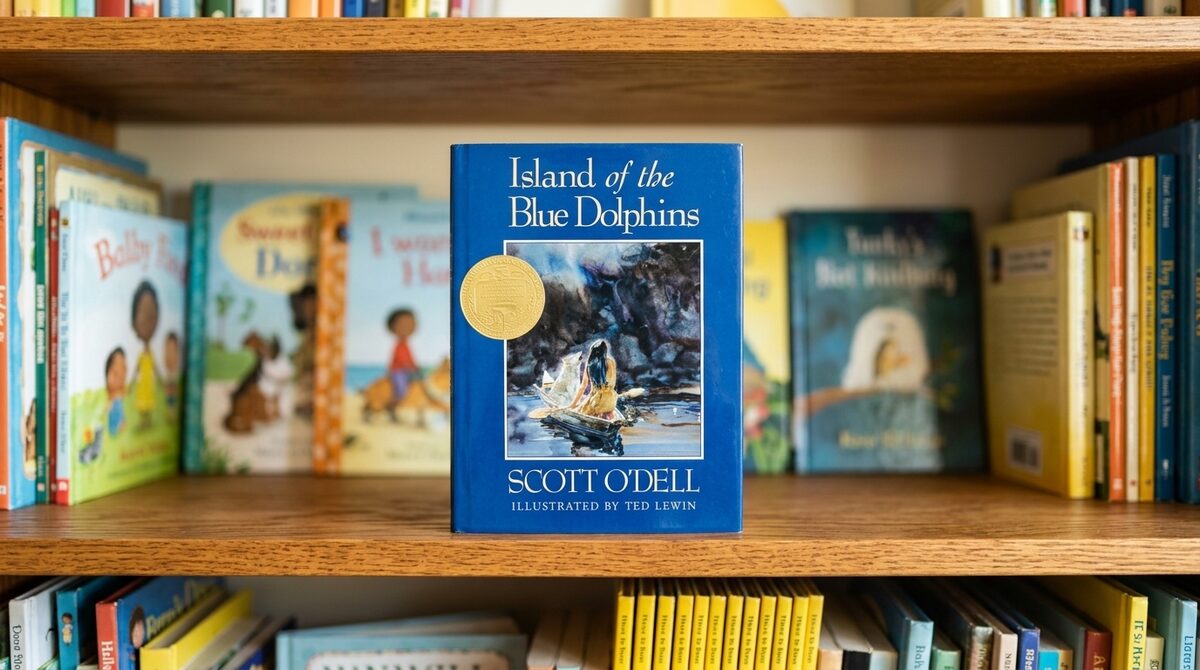

I read Hatchet at ten and decided the most important skill a human could possess was making fire without a match. I never tested this theory. Important context, because what I am about to tell you is that Island of the Blue Dolphins is the book I wish I'd had right next to it on the shelf, because it is doing something Hatchet never tried to do. Brian gets rescued. The whole engine of that book is the promise that the wilderness is temporary. Here, the rescue is not the point, and the years pile up, and a girl named Karana simply keeps living. Eighteen years of it. I went into this reread braced for a dusty assignment and came out genuinely shaken.
This one's pulled from a true story, which I did not flag for my daughter until the end, and I'm glad I waited. A young girl is left behind when her village leaves the island, and she survives alone. That's the spine of it. What O'Dell does with that spine is where the book either grabs you or loses you, and for us it grabbed hard.
Plain on purpose
O'Dell writes plain, and not because he ran out of words. A quiet sentence about catching food or reading the weather beats a pile of adjectives every time, and he clearly knows it. The book is stuffed with the specific mechanics of staying alive, how she gets food, how she prepares it, how she watches the sea and the seasons, and it never once feels like a survival manual because every practical detail is also telling you who she is. She learns to do the things the men of her tribe used to do. The book states that flatly and moves on, which somehow makes it hit harder than any speech would have. There's no showing off anywhere in this thing. He just tells you what she did and lets that be enough.
Reading it aloud is a different animal than your average picture book performance. There aren't punchlines to nail or sounds to make. What there is, instead, is rhythm, long stretches of calm description that genuinely benefit from a steady voice, and then a sudden hard turn that you don't see coming and that you absolutely cannot rush. I found myself slowing way down on certain pages without deciding to. The text sets the pace and you follow it.
The kid in the room
My daughter, who you may know does not perform her feelings, went very quiet during one of the late stretches of this book. Not asleep quiet. Listening quiet, the kind where she stops fidgeting with the blanket entirely. For her that's roughly the equivalent of another kid leaping off the bed. She asked one question near the end, a small one, about why nobody came back, and the way she said it told me the book had gotten under the armor. She caught the loneliness underneath the adventure before I'd even said the word. She usually does.
This is firmly her book, not my four-year-old's. He floated in once, heard a paragraph about the sea, and floated back out to do something destructive to a couch cushion. No notes. He's four. This is built for the older end, nine and up, and honestly it rewards the kid who's a little ready to sit with quiet rather than be entertained every thirty seconds.
The part I won't pretend isn't there
I'm not going to hand this over without saying it: Native critics have pushed back, fairly, on how O'Dell portrays Native people here. The book leans on a nostalgic, stereotyped version rather than an authentic one, and it repeats old clichés, the land-traded-for-beads kind of thing, that deserve a conversation, not a pass. So we had the conversation. With a kid in this age range you can, and you should. The book is strong enough to hold the critique and stay worth reading; pretending the critique isn't there would just teach her the wrong lesson about how to read old books. We talked about who wrote it, when, and whose story it actually was to tell.
On values, then, it's complicated in a productive way. The thing the book genuinely teaches, self-reliance, patience, the slow strength of a person who decides to make a life instead of just wait out a sentence, is real and good. The thing it gets wrong is real too. Both can sit on the page at once, and your kid is old enough to hold both.
The long haul
Does it survive the re-read? It's a chapter book, so the question is whether you want to go back, and I do. I'd hand this to her again in two years and she'd find new things in it, the way I find new things in Charlotte's Web every time it wrecks me. The pacing felt slow to me at first. Somewhere around the middle I stopped noticing, and by the end I was glad for it (a book about eighteen years alone probably shouldn't move fast). As for dad survival, this is the rare chapter book where I never once caught myself reading on autopilot to make bedtime end. I wanted to know what she'd do next, even knowing roughly how it ends. That basically never happens.
Karana is one of the great protagonists in children's literature, full stop. Quiet, capable, alone, and never once asking for your pity. I'd put her up there with the kids I read at her age and loved, and I don't say that lightly.