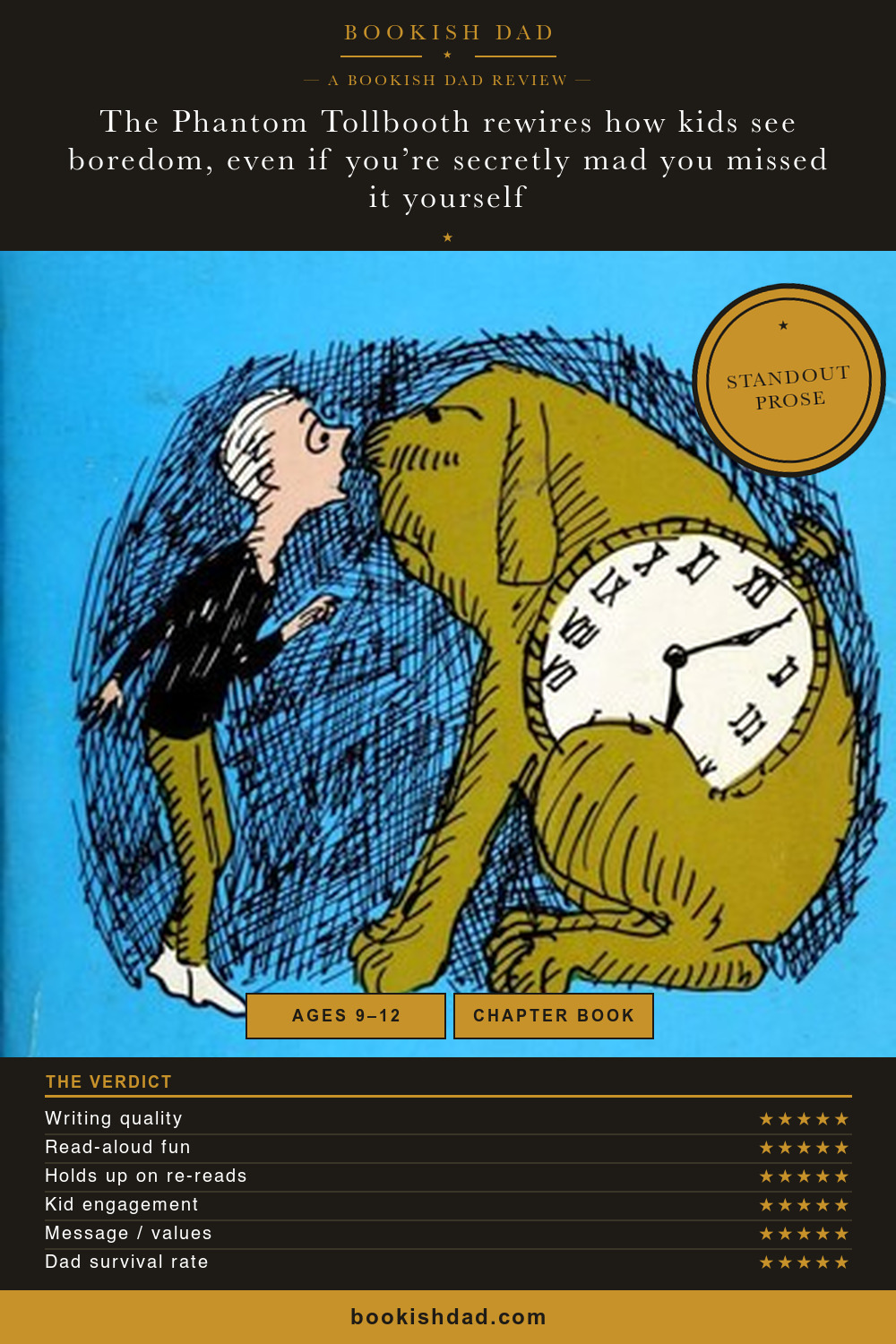

One thing nobody mentions about The Phantom Tollbooth: if you didn't read it as a kid, reading it for the first time as an adult is a slightly humiliating experience. I missed this book. Somehow. In a childhood spent inhaling Dahl and Silverstein and every Choose Your Own Adventure the Multnomah County Library would let me check out, this one slipped past me. I think I confused it with something else and decided I'd already read it. I had not.
So when my daughter brought it home from her school library a few months back, I had to do the thing where you pretend you're revisiting an old favorite while you frantically read ahead two chapters every night so you can do voices. I was caught immediately. By her, who is eight and perceptive in the specific way that makes parenting humbling, and by Norton Juster, who is, it turns out, doing something at the sentence level that is just absurdly good.
The prose is doing aerobics
I want to talk about the writing first because the writing is the whole thing. Juster is using language the way Shel Silverstein uses rhyme, except instead of rhythm he's working with the literal meanings of idioms, the texture of a phrase, the way a word can be picked up and turned around until you see it from a new angle. The book is full of wordplay that operates on multiple levels at once: the surface joke that works for a kid, and the slightly deeper joke that works for the adult reading aloud. I kept stopping mid-sentence to admire what he'd just done, and then my daughter would say "keep going" in the tone of a small parole officer.
What surprised me most is how restrained it is. You'd think a book this committed to puns would feel exhausting, the way some kids' books feel when an author has discovered a Bit and is going to do that Bit until you die. Juster never does this. The wordplay serves the world. The world serves the kid at the center of it. Everything is in service of Milo, who is bored, which is the most accurate portrayal of a certain kind of kid I have ever encountered in fiction.
The read-aloud
This is a chapter book and it reads aloud beautifully, which is not a given. A lot of chapter books are written for the eye and fall apart in the mouth. Juster wrote sentences that want to be spoken. There are characters whose entire purpose, as far as I can tell, is to give a parent something fun to do with their voice. I gave the Humbug a vaguely Wodehousian fop register and committed to it. My daughter rolled her eyes the first night and laughed by the third.
That said, this is not a book to start reading at 8:42 PM on a school night thinking you'll knock out a chapter. The chapters are dense. The jokes require a small beat to land. If you rush this book, you ruin it. Build in time.
What the kids did
My four-year-old is not the target audience and we did not pretend otherwise. He was around for some of the readings, mostly because bedtime in our house is a logistical event rather than a series of discrete bedrooms, and he liked the sound of certain names and would repeat them at dinner the next day with increasing levels of theatrical disdain. That was the extent of his engagement, which is fine. He's four.
My daughter, though. She locked in. This is the kid who recently leveled up from BOB Books to chapter books and who now wakes up at 6 AM to read in bed before anyone else is up, which is a parenting outcome I refuse to feel smug about for fear of jinxing it. She caught a piece of symbolism that I had completely missed and explained it to me with the patient tone of a hospice volunteer. She also asked, halfway through, whether being bored was actually bad, which is the kind of question this book is engineered to make a kid ask.
The message, which is sneakier than it looks
On the surface this is a book about a bored boy who learns to love learning. That's the elevator pitch and it's true and it's also not the whole story. The deeper move Juster is making is about paying attention. About the difference between getting a right answer and asking the right question. About the way the world becomes interesting the second you decide to look at it instead of through it. That is not a small thing to put in front of an eight-year-old in 2026, when paying attention to anything for longer than fifteen seconds is treated as a minor miracle.
And the message is delivered without lecturing, which I respect enormously. Nothing in this book ever stops to explain itself. Juster trusts the kid. He trusts that they'll either get it now or get it later, and either is fine.
Holds up, dad survives
The re-read question with a chapter book is different than with a picture book. You're not doing fifteen reads in a month. You're doing one full read and then maybe revisiting favorite chapters. On that measure this book is bottomless. I already want to read it again. I think my daughter will pick it back up in two years and find a different book inside it. That's the test for a five-star chapter book and this one passes without breaking a sweat.
As for dad survival: I would read this aloud every night for a year. Juster did the work so I don't have to invent enthusiasm. That's the highest compliment I can give a chapter book at bedtime.
I'm aware that I'm now one of those adults who discovered Phantom Tollbooth late and is making it everyone's problem. I accept this. If you have a 9-to-12-year-old in your house and they have not met Milo yet, that is a fixable situation, and you should fix it.