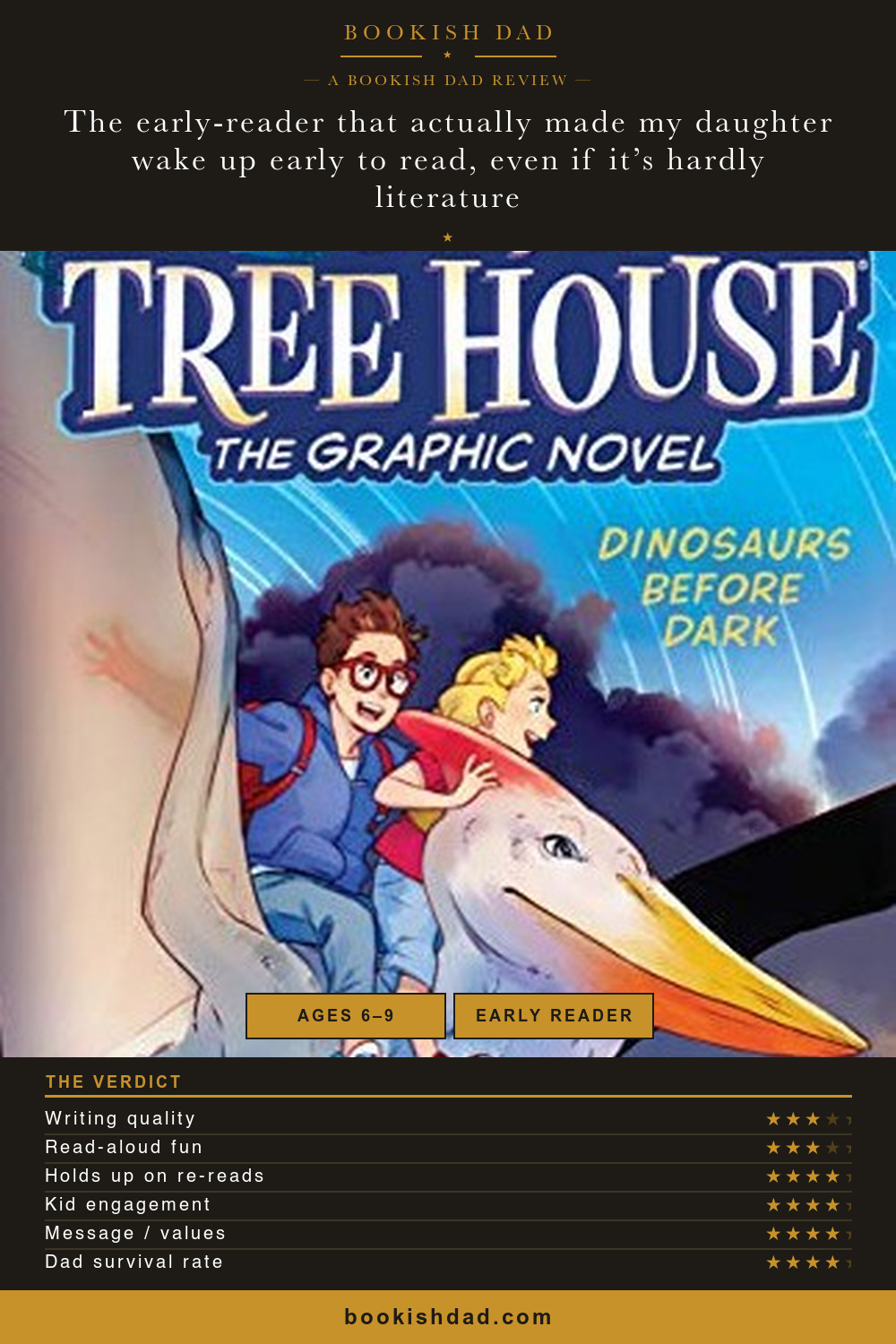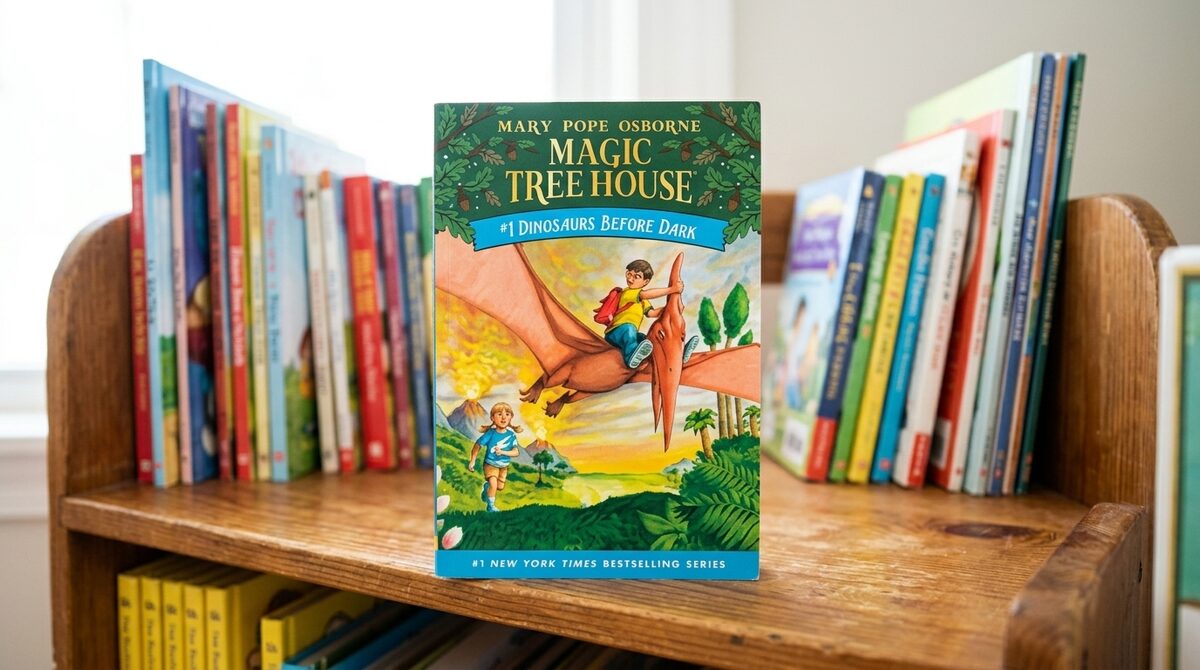

In January my daughter was still grinding through BOB Books like they were tax forms. By February she was reading a Magic Tree House book under the covers with a flashlight at 6:14 a.m. I know it was 6:14 because that's when the cat knocked something off a shelf and gave her away. This is the book that did it. This is the book that flipped the switch.
I'm not going to pretend Mary Pope Osborne is writing prose that will make you weep into your coffee. She isn't. But she's doing something arguably harder, which is writing sentences so clean and so unintimidating that a 7-year-old who has just emerged from phonics can stand up inside them and breathe. The chapters are short. The vocabulary is generous without being condescending. The paragraphs do not loom. Every page communicates the same quiet message to a kid who's nervous about chapter books: you can do this, keep going, the next page is right there.
The actual writing, which I have opinions about
Time travel does not tempt Moth in the slightest. She prefers to stay exactly where she is.
As an adult reading it aloud, the prose is functional. That's the technical term and it's also the honest one. Osborne is not Roald Dahl. She is not E.B. White. Nobody is going to quote a Magic Tree House sentence at a wedding. But there's a craft to writing this plain without being boring, and she has it. The rhythm carries. The chapter cliffhangers actually cliffhang. There's a discipline to her sentences that I appreciate even when no individual line is doing anything fancy.
The premise is the engine: a brother and sister, a tree house full of books, and the books take them places. The sister is the brave impulsive one. The brother is the cautious bookish one who takes notes. As a guy who wears glasses and carries a notebook in his back pocket, I see what Osborne did to me there, and I respect it.
Read-aloud, and what my kids actually did
Reading it aloud is fine. Not transcendent. There aren't a lot of moments where you get to do a big voice or land a punchline; the writing isn't built for performance, it's built for kids reading on their own. My 4-year-old sat in on a couple of chapters and was politely tolerant for about eight minutes before wandering off to do crimes in the other room. This isn't his book yet. It will be. For now he wants the giant voice and the pickle and the caterpillar, and Magic Tree House does not deliver those things.
My daughter, though. My daughter went somewhere different with this one. She doesn't usually broadcast enthusiasm. She's the kid who watched me cry at The Giving Tree and informed me, deadpan, that it was raining. So when I came downstairs one morning and found her on the couch with this book and a small private look on her face, I knew. She has since read the next three. She has opinions about which one is best. She brings them to the breakfast table.
Re-reads and the dad survival question
Here's where things get interesting. I don't actually re-read this one much, because she reads it to herself now. That's kind of the point of the book. It's a launchpad. It exists to make itself obsolete in your nightly rotation, and that's a feature, not a bug. The handful of times I have read it aloud, it holds up fine. I'm not begging for mercy by chapter four. I'm also not crying with joy. It sits in a comfortable middle where my brain stays in the room.
Dad survival rate is genuinely high, partly because the chapters are short and partly because you can feel the kid leveling up in real time while you read. That's its own kind of reward. You don't need the book to be brilliant when the book is making your child brilliant.
What it's teaching, which is sneakier than it looks
There's no Big Message here. Nobody is learning a lesson about feelings in a heavy-handed way. What the series is quietly teaching is that history is interesting, that books take you places, that being curious is good, and that your annoying little sister might actually be braver than you. Those are all fine values. I'll take them. The history-and-magic combo means kids absorb a tiny bit of dinosaurs, knights, Egypt, pirates without anyone making a big deal out of it, which is the only way kids accept information at this age. The minute you announce you're teaching them something, they leave.
Is it a classic? No. Will I be talking about it in twenty years the way I talk about Charlotte's Web? No. Did it do the single most important thing a book at this stage can possibly do? Yes. Four stars, and most of that fourth star is earned by the early morning when I heard a page turn from my daughter's room before the sun was up.