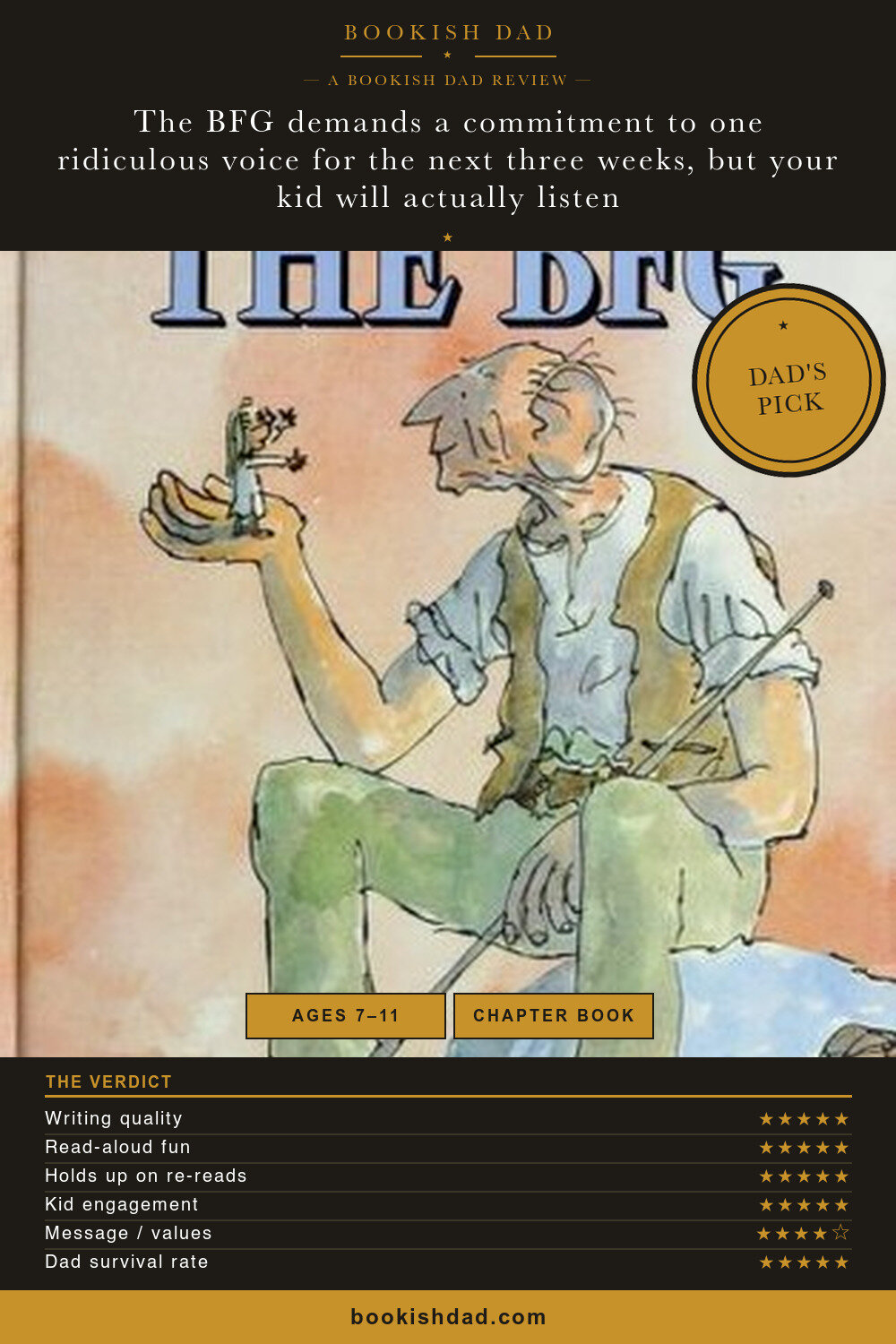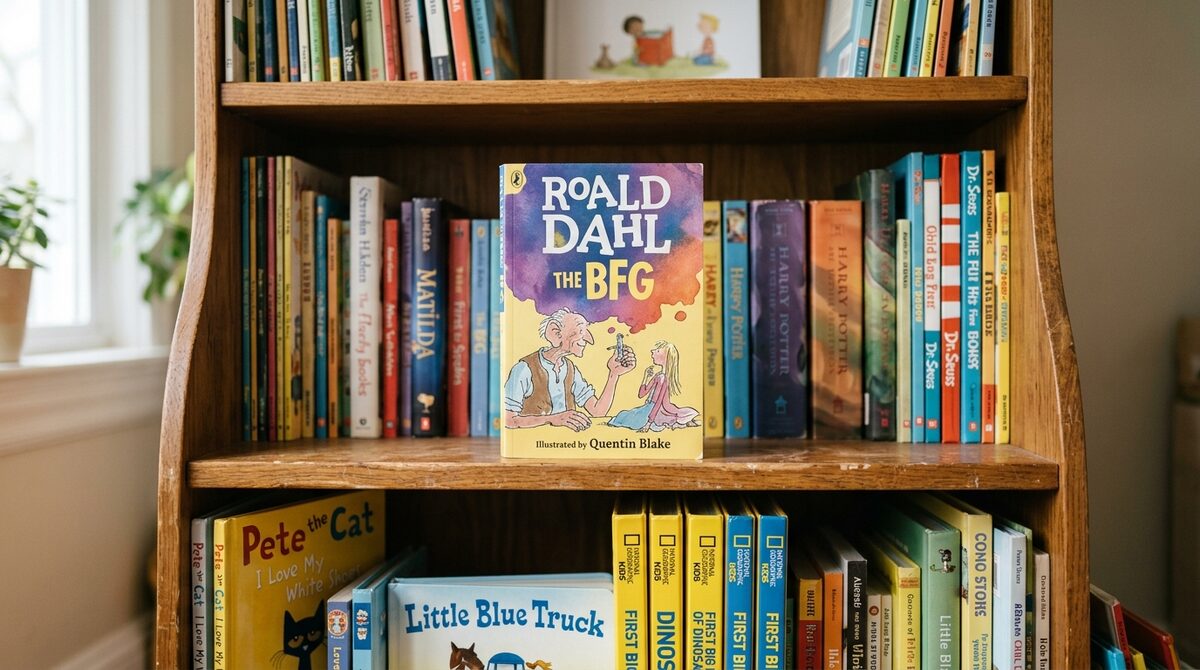

I read this in third grade and I have done The Voice ever since. You know the voice. The big rumbly half-confused gentle one, slightly West Country if you squint, with the consonants in the wrong order half the time. I have been doing The Voice in my head for thirty-three years, waiting for the moment a small person in my house would say "do the giant one again." That moment arrived on a Tuesday in February and reader, I was ready.
My son is four, technically below the age range on the back cover. He sat through a chapter and a half before he understood what was happening, and then he locked in. He now asks for "the giant voice" by name. Not the book. The voice. The book is the delivery mechanism for the voice. My daughter, eight, who has recently graduated from BOB Books to chapter books and has been making her way through Magic Tree House at dawn like a person with a job, sat on the floor and listened with the specific stillness she reserves for things she is taking very seriously. She did not say much. She rarely does. But she didn't leave, and she didn't pick up a different book, and at one point she said, very flatly, "his words are wrong on purpose," and I felt like I had won something.
The language thing is the whole thing
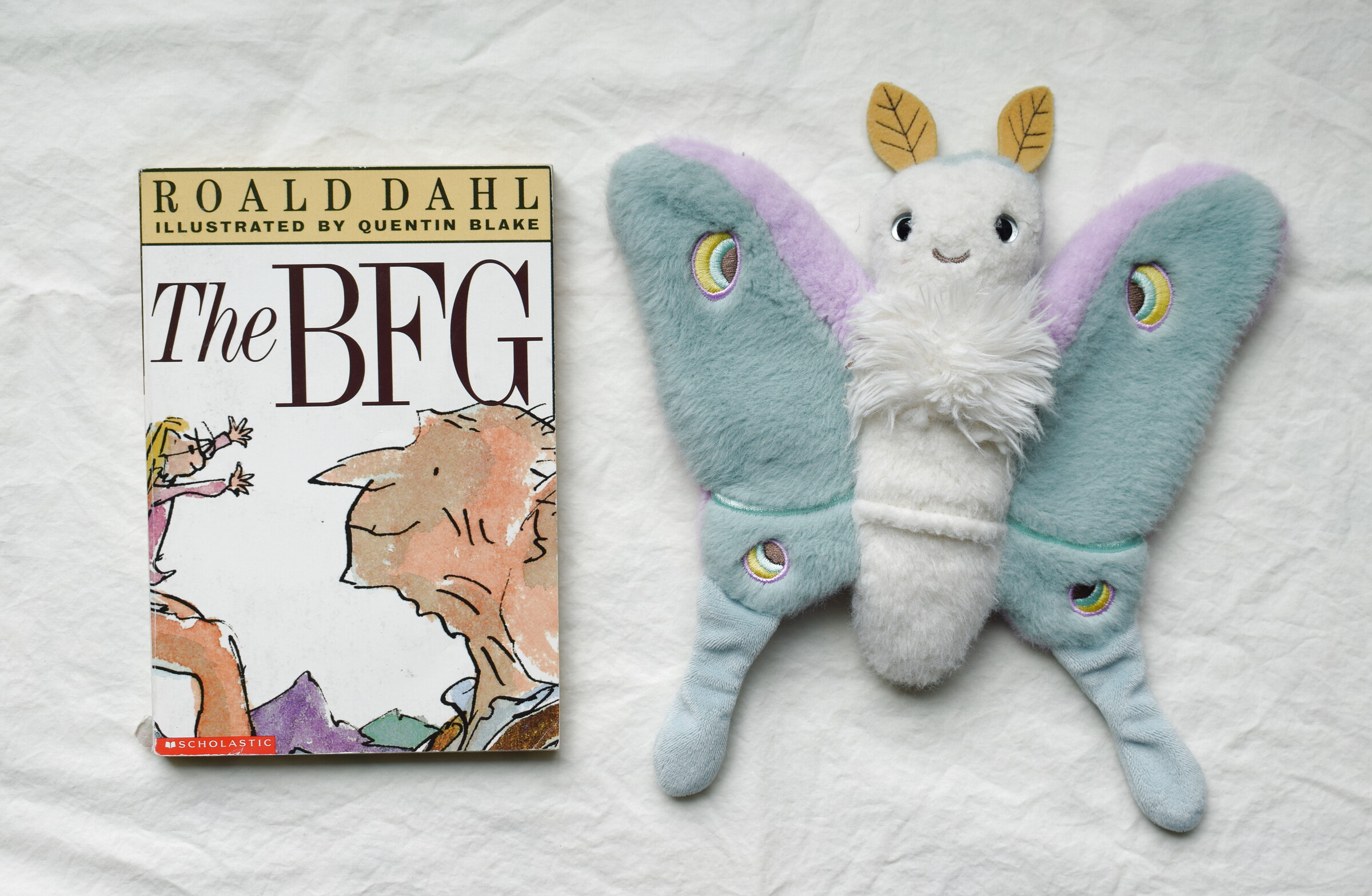
Moth finds the BFG's proportions reassuring. At least someone in children's literature is appropriately sized.
Dahl was a weirdo about words and this is the book where the weirdness is the engine. The giant talks in a kind of cheerful mangle, swapping syllables, inventing nouns, confidently misusing verbs in a way that makes you laugh and then makes you think, hold on, is "babblement" not a real word? It should be. It functionally is now. Reading it out loud, you can feel the sentences being built for performance. The rhythm wants to be spoken. Try it in your head and it's fine. Try it at the foot of a bunk bed with a four-year-old staring at your mouth and it becomes a different art form.
This is the part that surprised me as a grown-up reader: the prose is genuinely crafted. It's not just goofy invented vocabulary thrown at the page. The wrong words land in specific places, and the rhythm of a sentence will sometimes turn on the misplaced one in a way that's genuinely funny rather than just whimsy-coded. I keep waiting for a chapter where the trick wears thin and it doesn't come. Dahl knew when to push it and when to just say the thing straight.
Read-aloud is where it actually lives
The whizzpopping chapter alone has paid for the cover price six times. My son laughed so hard he hiccuped and then got mad at the hiccups. My daughter looked at me the way she looks at me when I sing in the car. The "frobscottle" section is built to be performed. The dream-collecting passages slow the pace down beautifully, and you can drop your voice and your kid will lean in without realizing they're leaning in. It's a master class in pacing a read-aloud, honestly, and I say that as someone who reads a lot of books that are not paced for anything.
The re-read question
I have to be careful here, because nostalgia absolutely has a hand in my rating and I want to name that out loud. I read this at eight or nine and I love it the way you love the song that was on the radio the week you fell in love with someone. So: is it actually re-readable, or am I projecting? I've read it through with my kids twice now, plus probably six chapters in isolation by request, and it has not gotten worse. Some chapters get better. The middle stretch with the other giants is where the book has to do its hardest work, because the giant we love is not the funny part of those pages, and even there it holds. My son asks for specific chapters now. That is the truest re-read test I know.
Engagement, values, and my throat
Kid engagement is at ceiling in this house. Son: locked in for the voice, the gross stuff, the noises. Daughter: locked in for the wordplay, the structural cleverness, and what she described, in her one big literary contribution of the month, as "the giant feeling lonely without saying it." I almost dropped the book. She is going to be the kind of teenager who annotates margins in pencil and I am bracing for it.
On message and values: the book is not standing on a soapbox. It's a book about a small person and a large person becoming friends because they recognize each other as people, in a world that has decided they are not. That's a real thing to teach a kid, and it's done by implication, which is the only way to teach it that works. Dahl had his blind spots and complications as a person, well documented, and the book has the period-typical edges you'd expect, but the moral center of this one is sturdy and kind, and the kind part is the part I needed when I was nine and the part I want my kids to absorb now.
Dad survival rate: my throat is shot. The voice requires a register I do not naturally possess and after four chapters I sound like I've been at a sportsbook all afternoon. But I would read this book a hundred times in a row before I read certain bestsellers I'm not going to name once. The sentences are good. The jokes still hit. There's nothing in here that makes me die a little inside, and there are several passages where I'm honestly enjoying myself more than my kids are, which is the gold standard.
So yes. Five stars, nostalgia tax fully disclosed, no further questions. If you have a kid in the age range and you haven't done this one yet, fix that. If you have a four-year-old who likes silly noises, you can start it early and they'll lock into the parts they understand. And if you can't do voices, learn. This is the book to learn on.