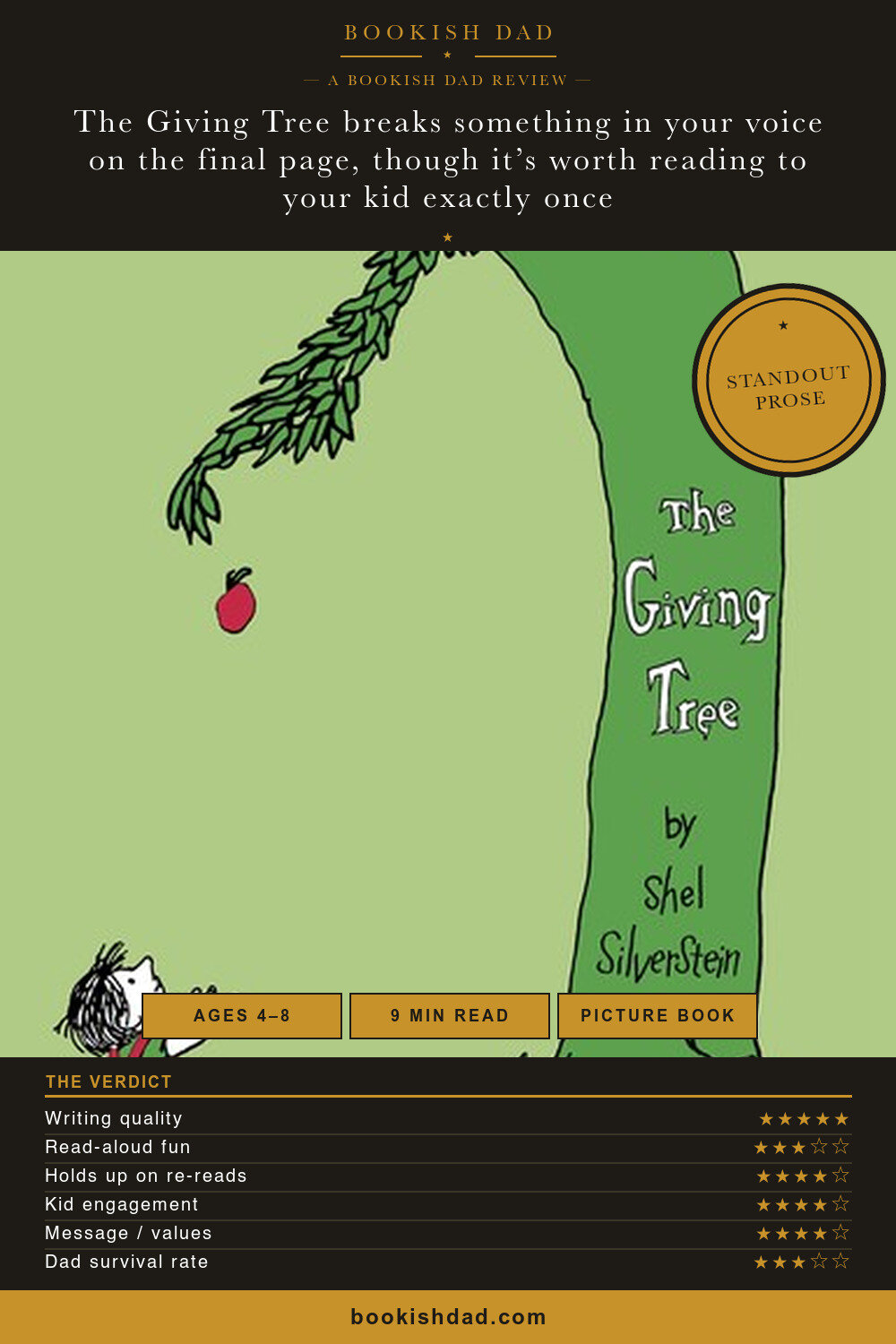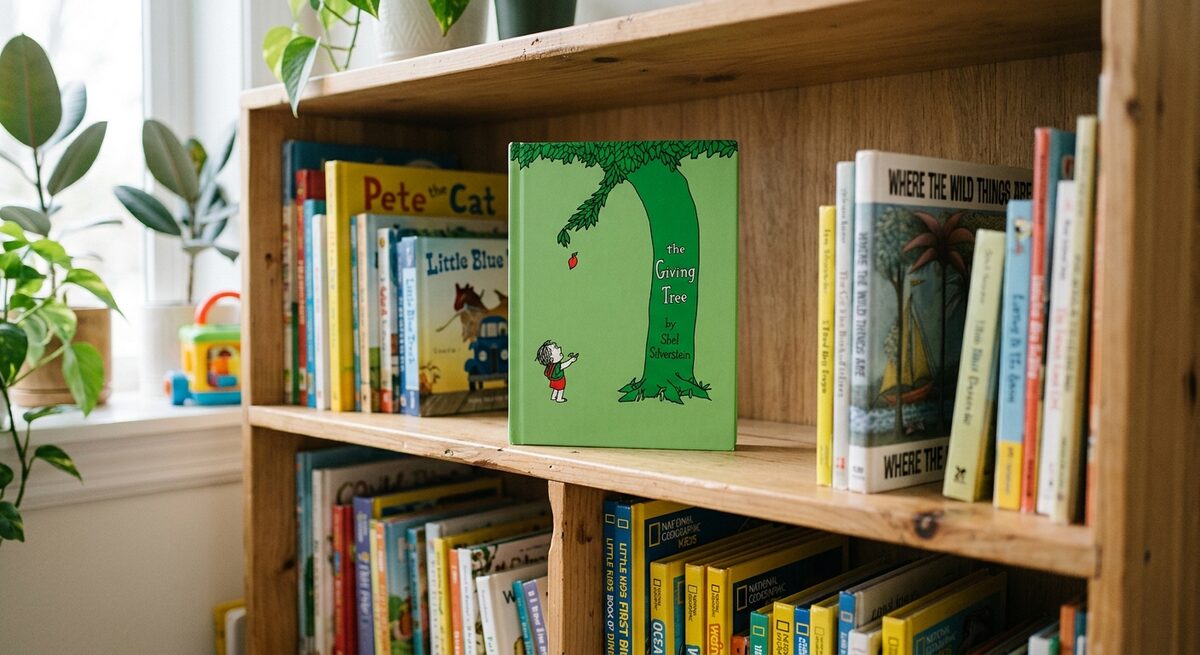

The last time I read this book out loud, I made it to the final page and my voice did that thing where it goes up half an octave and you sound like a man trying to talk through a wet sock. My daughter, eight years old, stoic as a small Quaker, looked over at me, paused, and said, "It's raining." She has done this twice now. She is building a small archive of my public failures and labeling them as weather events. I love her for it. I also think she's going to be a war correspondent.
So yes. I have feelings about The Giving Tree. I have had feelings about The Giving Tree since approximately 1991, and they have not improved with adulthood. They have, in fact, gotten significantly worse, because now I'm the one buying the lumber.
The prose is doing more with less than almost anything on our shelf
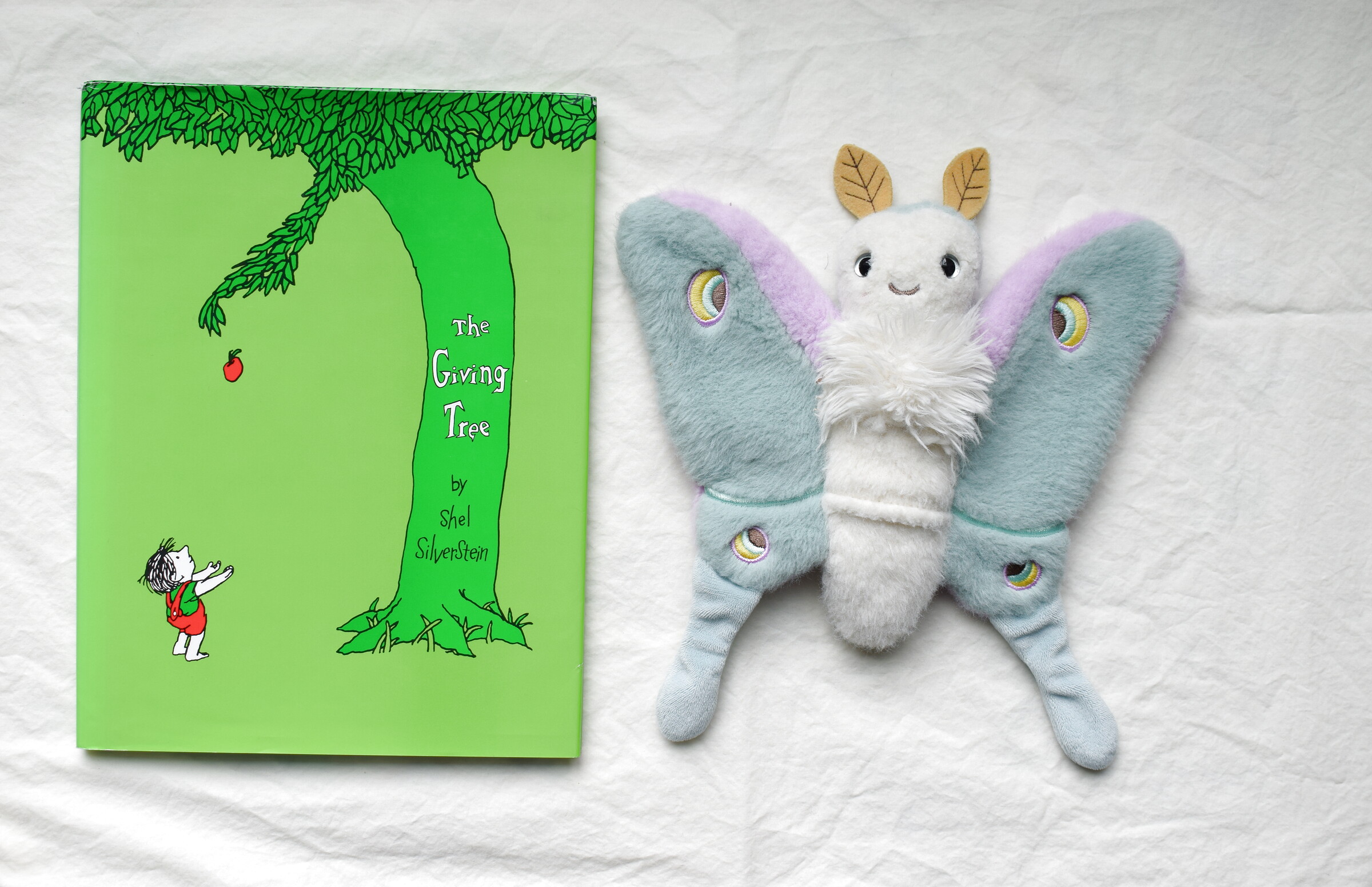
The tree's generosity is admirable; Moth suspects she'd negotiate better terms.
Silverstein writes this book the way someone writes a folk song: short lines, repeated structures, words you could stack on a kitchen table. There are picture books with five times the word count that say a tenth as much. He trusts the reader. He trusts the silence between the lines. There's a refrain that comes back over and over, and each time it returns it means something a little different, and a little worse, until the moment it stops working and you feel the floor drop. That's craft. That's actual writing. A lot of picture books are filler in nice fonts; this one is filler-free in a font that looks like it was scratched onto a piece of bark with a pocket knife.
The line drawings do the same job. They're plain. Almost severe. You could mistake them for sketches if you weren't paying attention. But the negative space around the tree at every stage of the story is doing emotional bookkeeping, and by the end the page itself feels lighter, which is the whole point.
Read-aloud is a hazard zone
Here's the honest truth about reading this one out loud: it is short, it is rhythmic, and it will ambush you. There is no voice work to hide behind. You can't go big and silly. You can't do the booming giant voice my son still requests from BFG nights. It's just you, a quiet line, and the slow horror of recognizing yourself in a story about a tree.
The first read is the worst. The fifteenth is also bad. I have not yet found a read where I didn't get a little dust in my eye on the last spread, and I have been doing this for years. My wife refuses to be in the room when I read it. She heard me do it once and said "absolutely not" and walked into the kitchen.
Does it hold up on re-reads? Yes, and that's the problem
This is the rare book that gets heavier the more times you read it. Most picture books wear out by read seven; you can feel the seams give. This one tightens. Part of it is that you bring more to it every year. At 41 with two kids and a mortgage, I am reading a different book than I was at 7. At 7, the boy was me. At 41, the tree is me. In ten years I'm going to be both, somehow, and I'm going to fall apart on a Tuesday.
The book also invites argument, which is great for re-reads. Is the tree a saint? A doormat? Is the boy a villain? A regular human being doing regular human things? My daughter and I have had a low-grade running disagreement about this for months. She thinks the boy is rude. I think the boy is all of us. She thinks I am being dramatic. She might be right.
What my kids actually do
My daughter leans in. She doesn't cry, because she doesn't cry at books, but she goes very still in the way she goes still when something has caught her. After the last page she usually has a question, and the question is usually sharper than anything I would have asked at her age. She asked me once if the tree had a choice. I'm still working on that one.
My son, four years old and powered by an internal combustion engine, is a different audience. He likes the early pages, when there's stuff happening and the boy is small and physical and doing the things he himself wants to do at all times. He drifts a little in the middle, when the boy becomes a grownup and grownup problems start showing up. He locks back in at the end because something in the rhythm tells him it matters, even if he can't say why. He has not asked for it on repeat the way he asks for the pickle poem, which honestly is a mercy. I'm not sure I could survive nightly Giving Tree the way I survive nightly Ickle Me Pickle Me.
The values question, which is the whole conversation
This book has been argued about for sixty years. People have called it a parable of unconditional love. People have called it a horror story about codependency. Both camps are right and both camps are annoying at parties. What I'll say as a parent is this: it's a book that lets a kid feel a complicated feeling without telling them what to do with it. That's rare. Most picture books arrive with the lesson pre-chewed. This one hands you a feeling and walks away.
I don't read it as a how-to. I read it as a what-if. What if you loved someone this much. What if someone loved you this much. What would you do with that. Those are big questions for a 4-year-old and a real question for an 8-year-old and apparently a devastating question for a 41-year-old in the Pacific Northwest at 8:14 on a Wednesday night.
Dad survival rate: medium, with caveats
I can read this maybe three times in a row before I need to put it down and go look at something stupid on my phone. Not because the book gets boring; the opposite. It accumulates. By the third read in a sitting I am not narrating anymore, I am just experiencing, and that's not a sustainable bedtime mode. Compared to some books that I have read forty times this calendar year and could no longer summarize under oath, three is a respectable number. But this isn't a comfort re-read. This is a once-a-month thing. You don't put this in the nightly rotation. You bring it out, you do the damage, and you put it back on the shelf with the other emotional landmines.
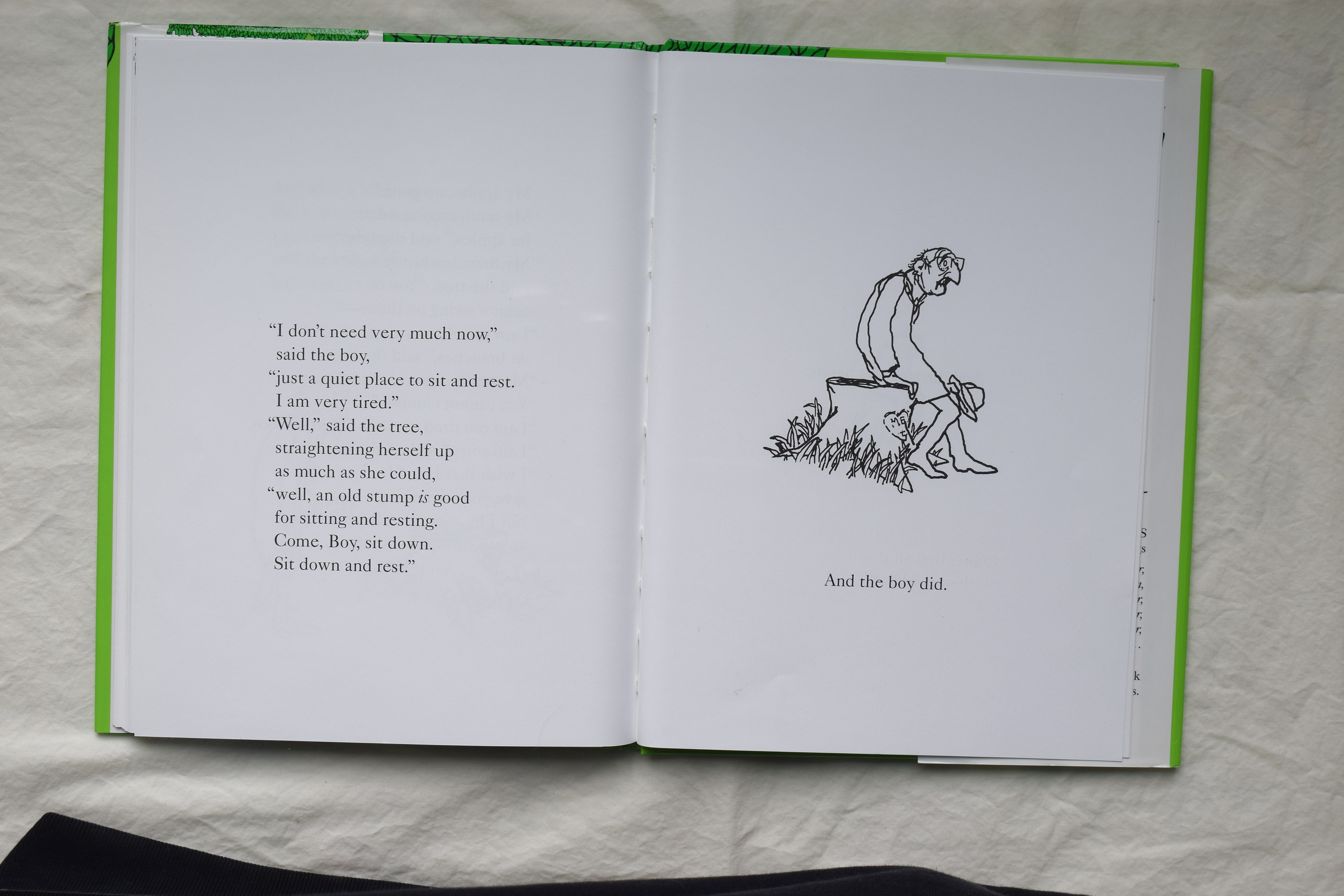
This is the quietest spread in the book: sparse line drawing, tons of white space, and that devastating three-word sentence at the bottom. The tree finally gets what she wanted, but you can feel the cost of it in how empty the page looks.
The nostalgia disclaimer
I'm flagging this because I always flag it: I grew up on Silverstein. Where the Sidewalk Ends was the first poetry book I loved without being told to. A Light in the Attic still lives in my son's bedtime rotation. So when I rate this book, some piece of that rating is a 7-year-old me who didn't fully understand it but knew it was important. I've tried to account for it. I think it's a great book even if you scrub the nostalgia. But I want to be honest: I am not a neutral observer here. Nobody who read Silverstein as a kid is.
It's not a five-star book for me, and that's the nostalgia talking in the other direction, weirdly. I love it, but I don't reach for it. I respect it more than I enjoy it. There are picture books in our house that bring more pure joy. This one brings something else, and something else is also valuable, but it's not the same as joy.