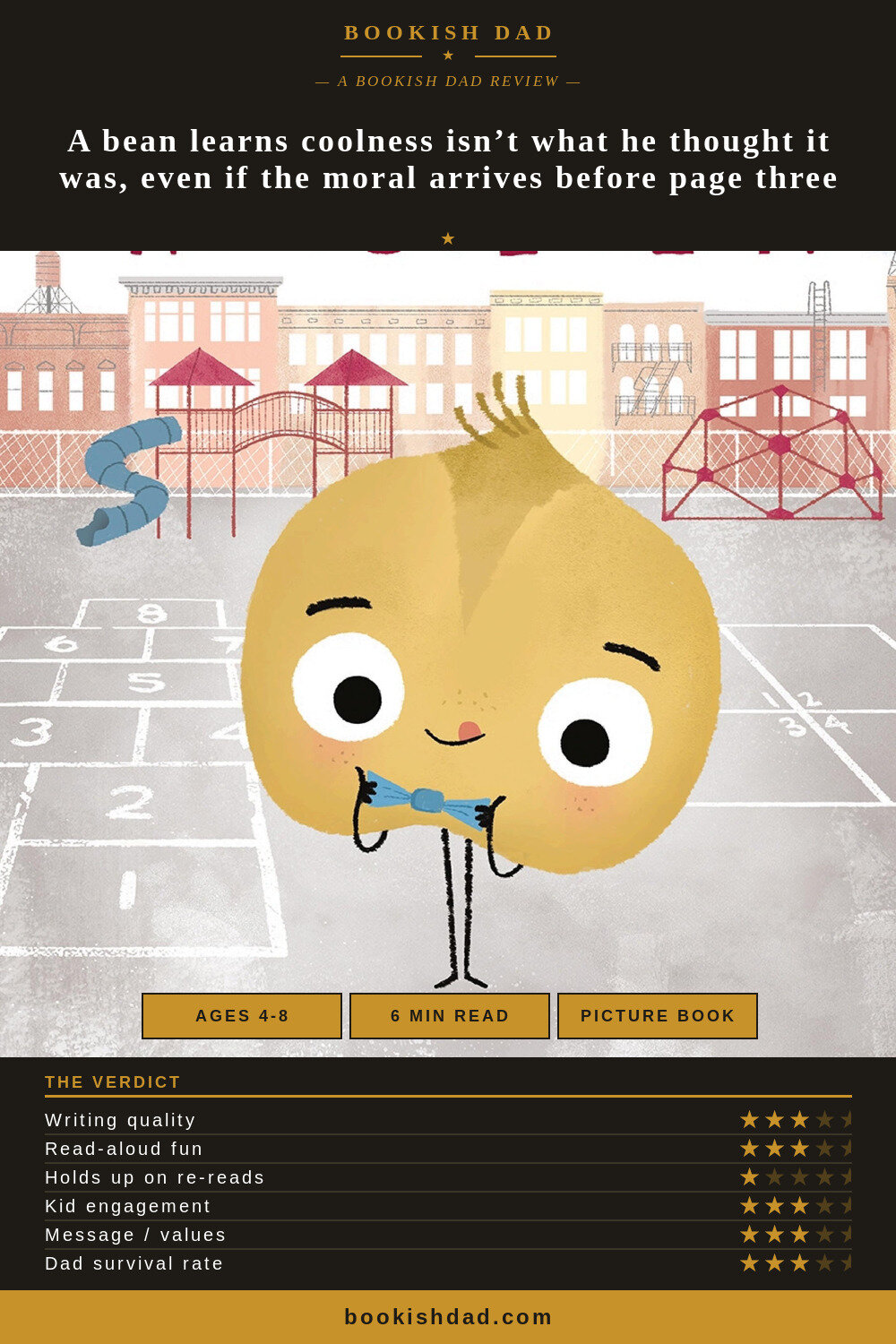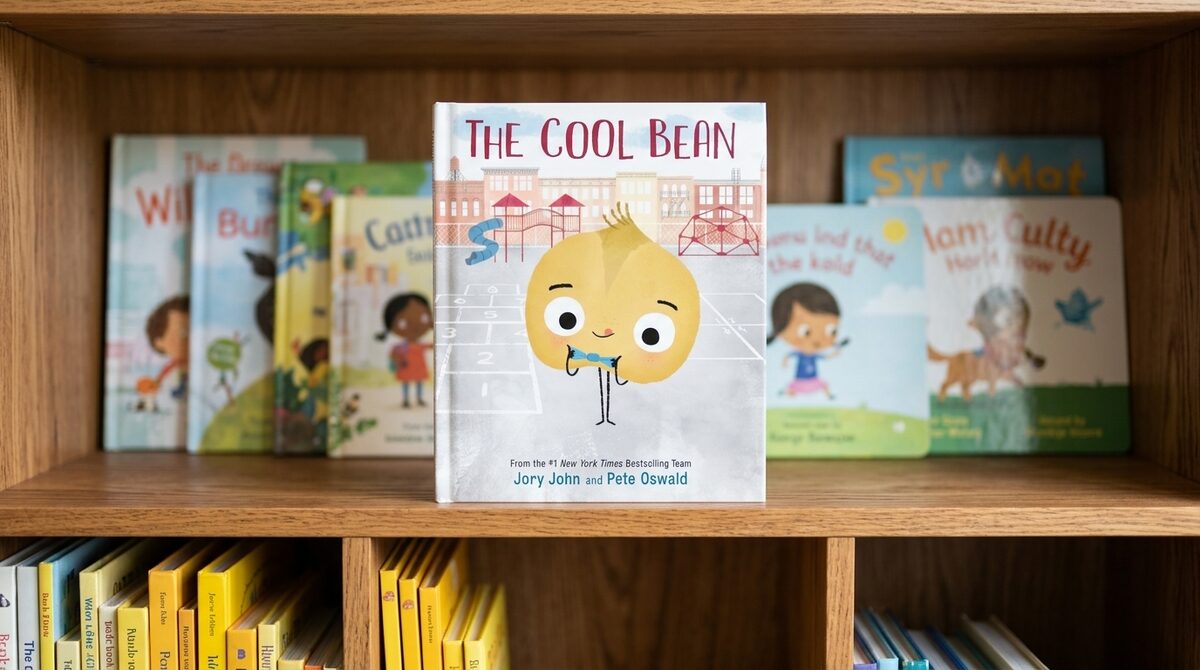

There's a logic problem at the center of this book that I cannot stop poking at, the way you can't stop poking a canker sore. It's a book about a bean who is cool in an unconventional way. Which, now that I think about it, is a contradiction, because wouldn't that make him uncool? Cool is just whatever everyone agrees is cool. That's the entire deal with cool. The book sort of knows this too, because the title is a pun on "has-been," and a has-bean is a bean who used to be cool and isn't anymore. I spent a genuinely irresponsible amount of brainpower on this during a 6-minute bedtime read, and I want that brainpower back.
This is the third entry in the Jory John and Pete Oswald food-with-feelings universe, after The Bad Seed and The Good Egg, and at this point you know the format: a talking grocery item has some feelings, learns a lesson, and gets out before anyone's bored. The Cool Bean follows a bean who tries everything to fit in with the cool beans and can't, until the cool beans turn around and show him kindness. The message is that it's cooler to be kind, which is fine, I don't disagree. I'd just point out that I knew exactly where this was going from the cover, and so will most kids over the age of five.
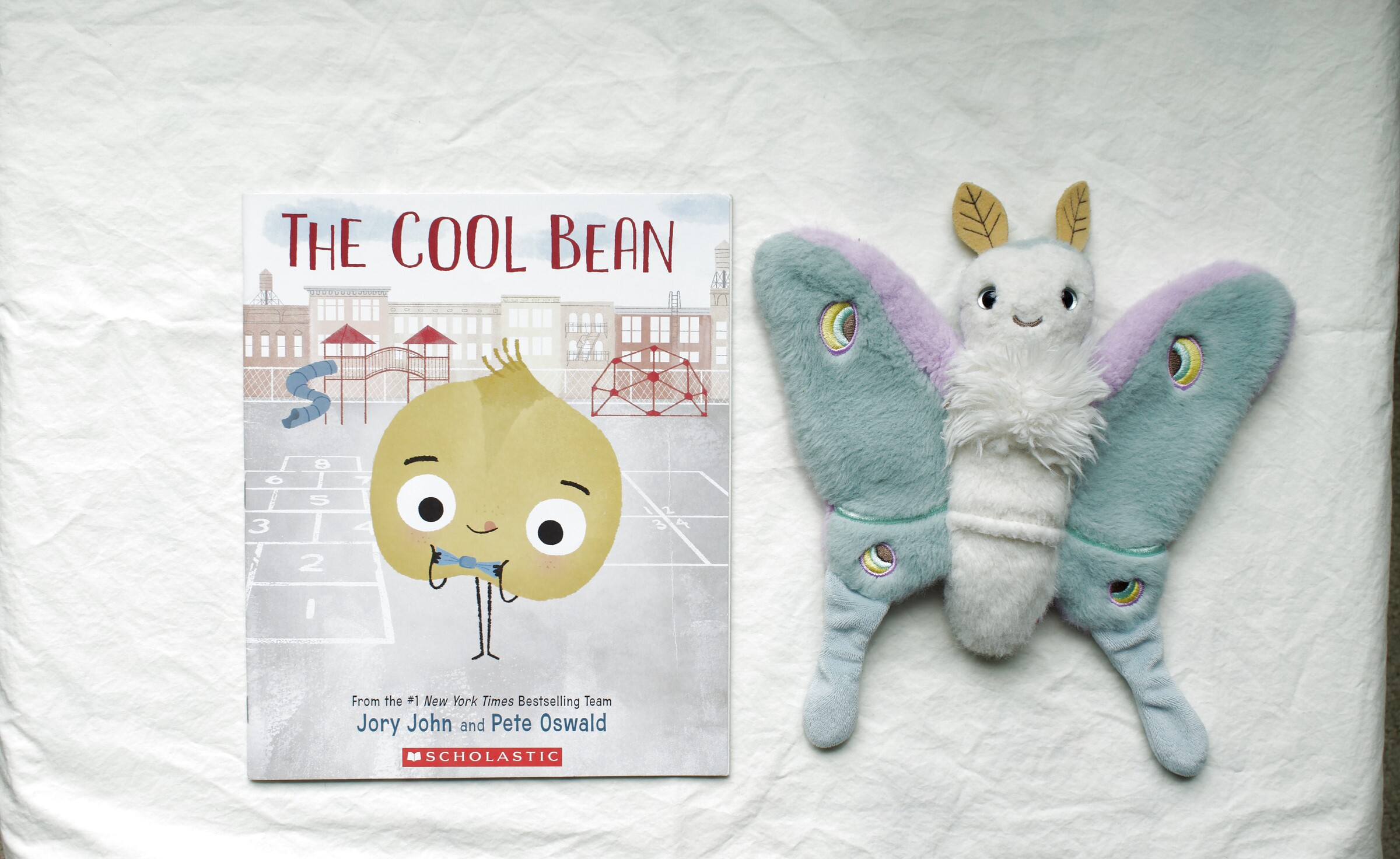
Moth questions the premise entirely. A legume cannot be cool; a legume can only be room temperature or refrigerated.
The art is the strongest thing here by a comfortable margin. Oswald takes objects that are, let's be honest, beans, and gives them real personality with sunglasses and tiny instruments and body language that's funnier than most of the sentences around it. The spreads are surprisingly uncluttered too (a lot of picture book illustrators would have panicked and filled every corner). My favorite stretches are the ones where the joke is entirely visual and John just lets a bean in shades exist on the page.
The writing itself is fine. John has a real ear for read-aloud rhythm when he's locked in, and there are a couple of lines with genuine bounce to them, the kind that snap if you commit to the delivery. But a lot of the text is just getting you from one Oswald gag to the next, and I've read enough of these now that I can feel the formula. I bet John could write one of these in his sleep at this point. Maybe he did.
The read-aloud went okay. I gave the cool beans a kind of laid-back surfer cadence and the narrator a more anxious, eager-to-please register, and that bought me some mileage. My son operates at one of two volumes. He liked the sunglasses beans and pointed at them, which is about his version of a review. My daughter, who's eight, listened politely and then asked a question I couldn't answer, which is that the cool beans suddenly become nice for no stated reason. Common Sense Media flagged the same thing in their review, so it's not just her. The book never explains why this is the day they decide to be kind, and there's no apology for having frozen the kid out in the first place. An eight-year-old notices that. The book just needs them to be nice now, so they are.
Where it really shows its limits is on the re-read. This book has a ceiling, and you hit it fast. Once you know the turn, there's not much left to find (no second layer, no throwaway joke in the corner that finally pays off on read twelve). It doesn't get worse, it just never gets any better. And my kids don't dislike it, either. They're fine with it when it gets chosen. It just doesn't actually get chosen very often.
Dad survival is honestly fine. The book is short and the art gives me enough to point at that I'm not white-knuckling my way to the back cover. I could read this thing a dozen times in a row without resorting to the voice of a sleep-deprived game show host just to stay conscious. A thin book is at least a fast one. Six minutes and you're out.
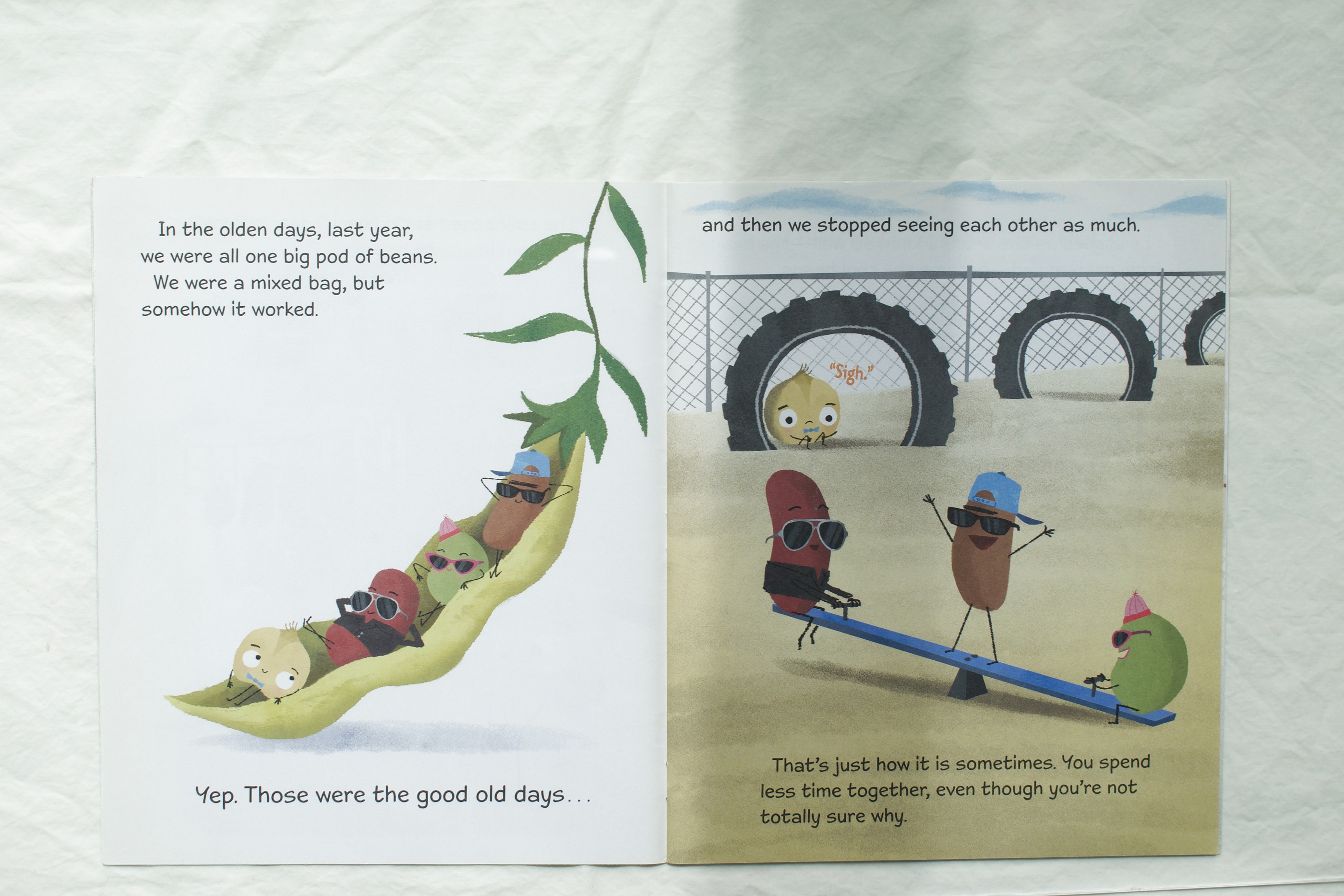
I chose this spread because the story jumps from "we were all together" to "suddenly we weren't" without explaining what actually happened between them. My daughter immediately asked if the other beans got mean or if he just stopped showing up, and honestly I had the same question. I need to know who drifted first.
So here's my real position. The Cool Bean is fine. The art is better than the writing, the message is good if a little easy, and the whole thing sits in that middle zone where nothing's wrong and nothing sticks. If your kid is already deep in the bean cinematic universe and wants every installment, get it. If you're building a shelf of books you'll actually reach for, there are richer beans in the bin.