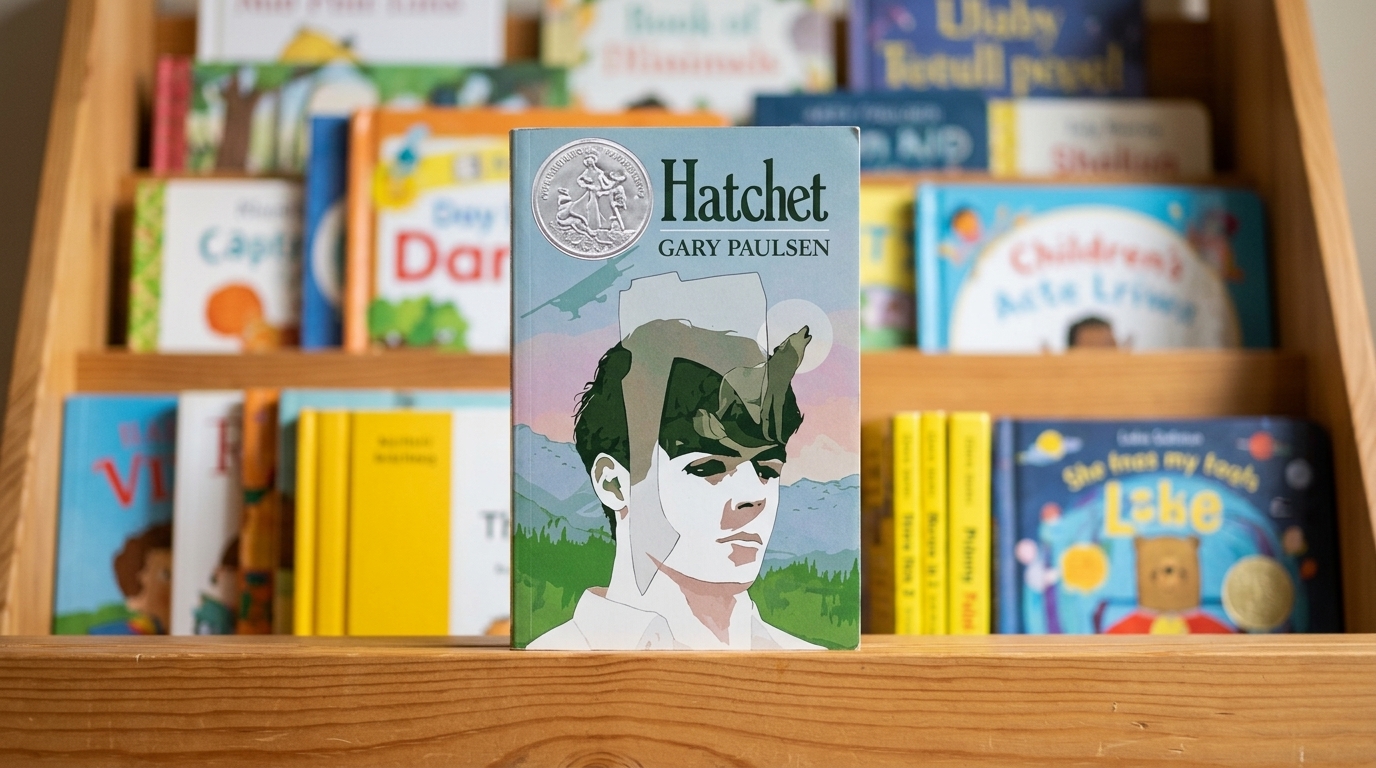

I was ten years old when I first read Hatchet, and within about a week of finishing it I had stolen a chunk of flint from the rock collection at school and was crouched in our backyard banging it against the back of a butter knife trying to make sparks. I did not produce fire. I produced a small amount of metal shavings and a worried look from my mother. But that impulse (the actual physical need to go outside and try to be Brian Robeson) is the highest compliment I can pay a children's book. I finished it and immediately tried to become a different kind of person. With a butter knife.
Coming back to this book as a parent is a strange experience. My daughter is eight, which is a year under the recommended age, and I held off on it for a while because I remembered it being more intense than the cover lets on. We started it a few weeks ago. She is, in her usual way, mostly inscrutable while I read, occasionally looking up to ask a clarifying question that proves she's been tracking the whole thing more carefully than I have. When I read the chapter where Brian is alone in the wilderness and the silence becomes a thing he can actually hear, she put her hand on the comforter and said, "He's going to be okay though, right." She said it like a fact, but there was a little crack in it. That's about as emotionally exposed as she gets.
Paulsen Can Actually Write
Paulsen writes in this stripped, repetitive, almost-broken cadence that I didn't have the vocabulary to admire as a ten-year-old but absolutely felt. Half the sentences are fragments. Thoughts start, get interrupted by a sensation, and restart. It reads like the inside of a panicking brain slowly learning to stop panicking, which is exactly what it is. And he never once stops to describe the Canadian wilderness like he's writing a postcard. Brian notices things because his life depends on noticing them, and that's the only reason anything gets described at all.
The thing I keep coming back to is that Hatchet treats its young reader like a serious person. No winking at the adults, no comic-relief sidekick, just a kid, alone, and the prose staying right there with him the whole time. I think this is why it has stayed in print for almost forty years and why every elementary school librarian in America knows exactly which shelf it lives on. Kids can tell when a book respects them. They pay it back with a flashlight under the covers.
Read-Aloud, And A Confession About Read-Aloud
Reading it out loud is interesting. The fragmented sentences want to be performed a certain way, with pauses where the punctuation tells you to pause, and trusting the silence. I do not always have the discipline for this. I want to rush past the quiet parts and get to the action, and every time I do, the chapter lands worse. The book is not in a hurry, and it reads noticeably better when I stop trying to make it hurry. Took me about four chapters to accept that.
That said, this is also a book that, by the structure of how chapter books work, starts to push past the natural bedtime read-aloud sweet spot. Some nights we read one chapter and stop. Some nights I look up and my daughter is asleep and I'm still reading to myself because I forgot she was even in the room. It's that kind of book. The four-year-old, for the record, is not part of this. The four-year-old is downstairs demanding "Ickle Me Pickle Me" for the eleven thousandth time and would have absolutely no interest in a thirteen-year-old's relationship with a hatchet. This is a daughter book.
Will it survive a second lap?
Here is where Hatchet wins in a category most children's books can't even enter. This book does not get old. I have read it three times in my life and would happily read it a fourth. The reason is that it isn't built on a twist or a joke you can use up. It's built on watching a kid slowly figure out how to keep himself alive, and that doesn't wear out. You catch different things every time. At ten I was reading it for the survival mechanics. As a parent I'm reading it for Brian's interior life, the way he carries the weight of his parents' divorce in his head while his hands learn to do new things. The book is doing two stories at once and the second one only becomes visible later.
Dad survival rate is genuinely high. I will read this book to both kids again in a few years when the boy is old enough. I will probably read it on my own again at some point. There are maybe ten children's books I can say that about, and most of them are by people whose names start with R or E.
What It's Teaching, If Anything
I'm wary of books that announce their lessons, and Hatchet doesn't. If you forced me to extract a moral it would be something about resilience, or about how panic slowly gets replaced by knowing what you're doing. The book never says any of that out loud. It just lets the reader watch a kid figure it out. You can't be careless in the woods, so Brian stops being careless. You can't waste food, so he stops wasting food. Nobody delivers a speech about any of it, and I'd bet my daughter took more from that than from every book that ends with a circle-time talk about feelings.
The one thing I will say to other parents: Brian carries a secret about his mother that the book treats with adult seriousness. It's handled tastefully and not in a way that derails the survival story, but it's there, and your kid may ask about it. My daughter has not yet. When she does, I'll answer her honestly, which is the deal we have about books in general. If she's old enough to read the sentence, she's old enough to ask the question.
I came to this re-read worried that nostalgia was carrying the rating and the actual book would feel thinner than I remembered. If anything it got better. At ten I wanted the fire and the fish spear. At forty-one I'm watching a book take a thirteen-year-old's inner life completely seriously, which almost nothing written for kids bothers to do. Five stars then, five stars now. And no, I still can't start a fire with a rock.