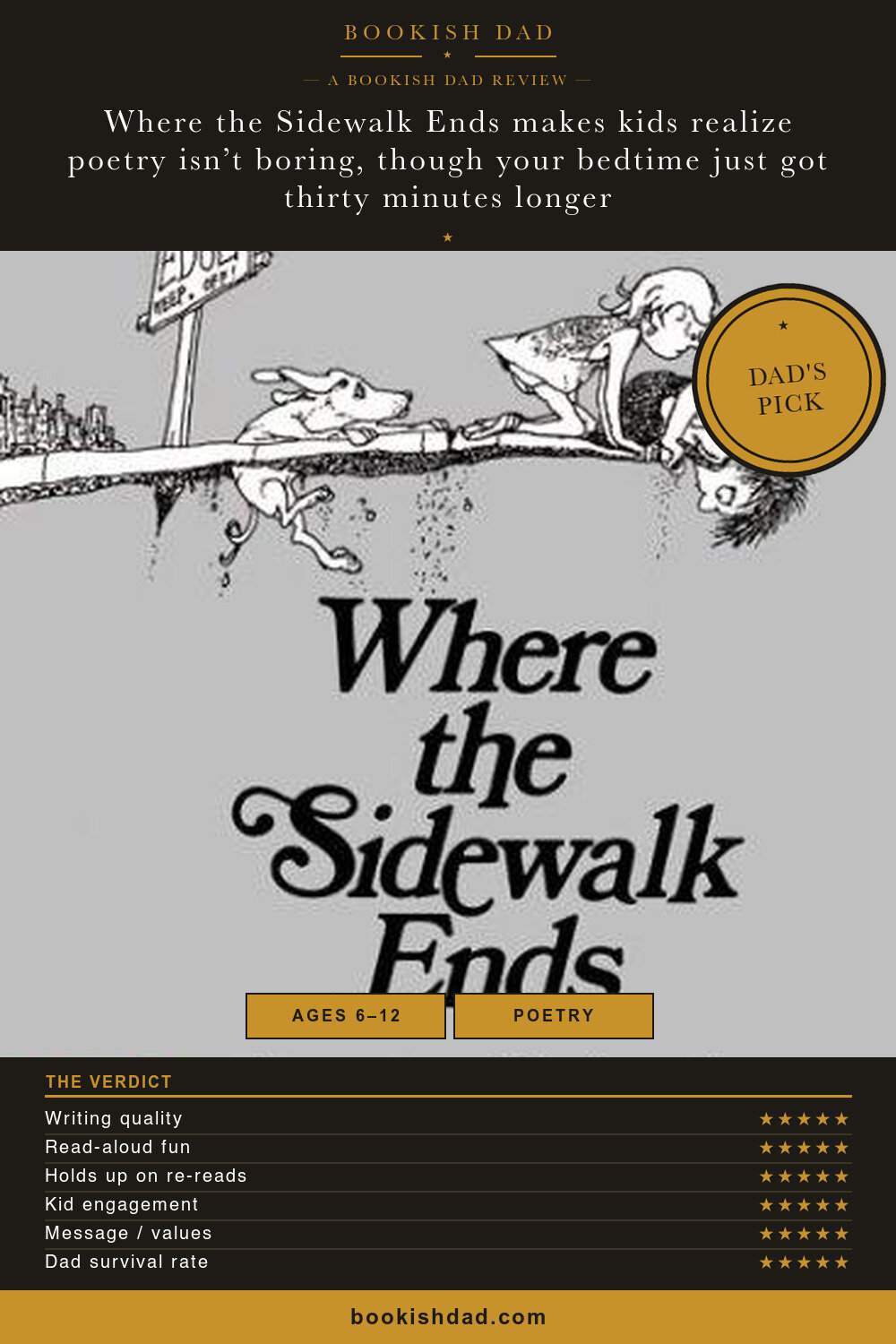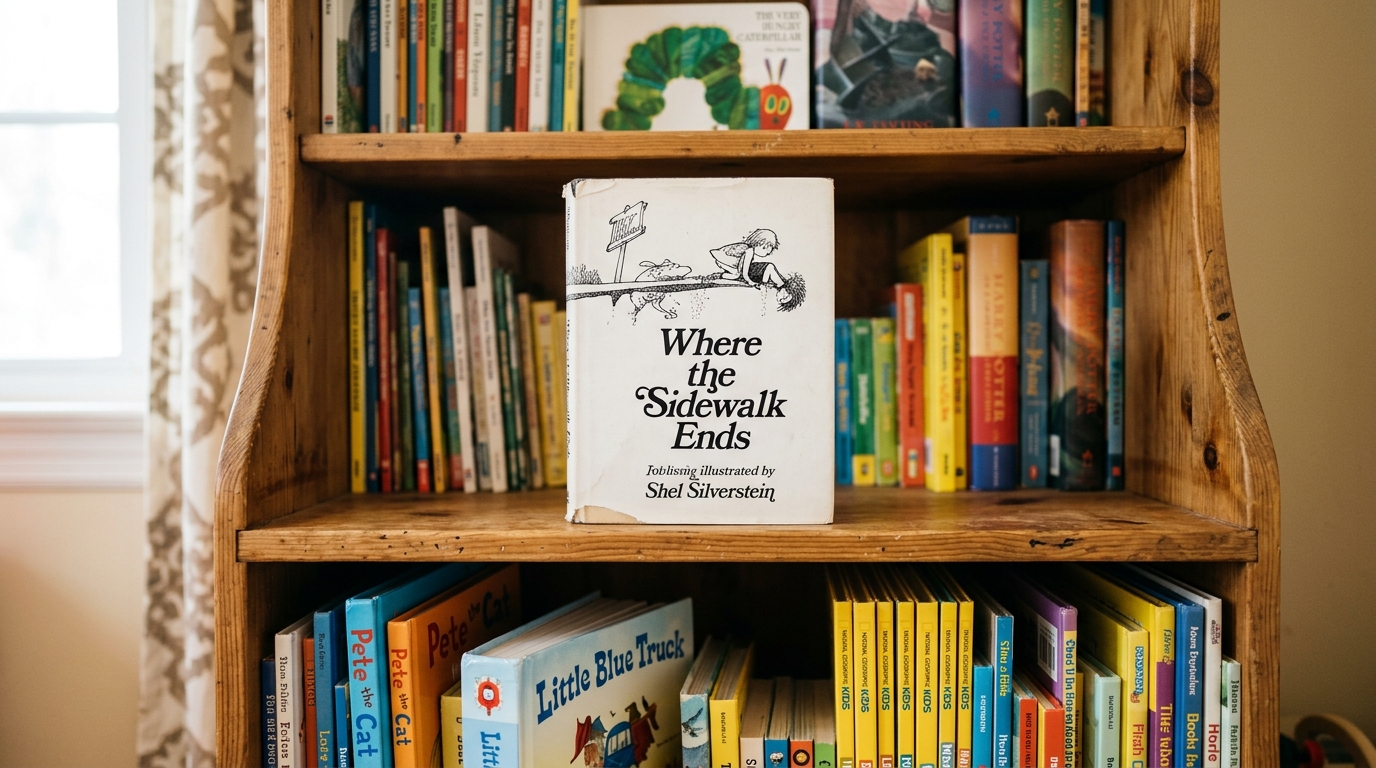

I was seven years old, sitting on the brown carpet of my elementary school library, and I distinctly remember the moment I realized adults had been lying to me about what poetry was. Poetry, I had been told, was a thing where you sat very still and someone read you a sentence about a meadow and then asked how it made you feel. Poetry was for Thursdays. Poetry was punishment dressed up in a cardigan. Then I opened Where the Sidewalk Ends and a girl was getting auctioned off by her brother and I thought, oh. Oh. This is contraband. They let me have this on purpose? They are going to regret this.
Forty years later I am the adult handing the contraband to my own kids, and I am pleased to report that the trick still works.
The voice of a guy who is on your side
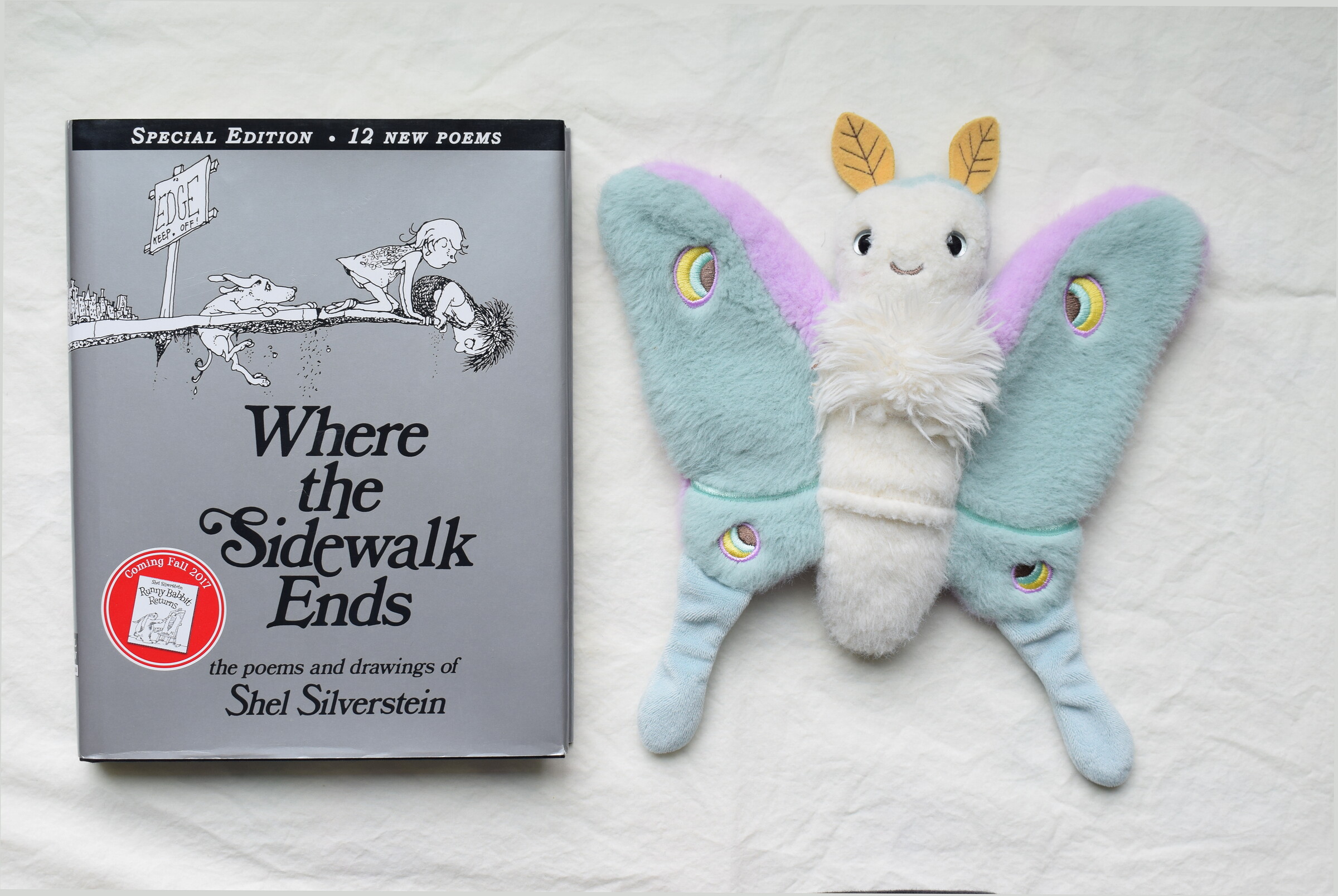
Moth suspects the sidewalk ends precisely where the whimsical creatures begin, which seems like poor urban planning.
What makes Silverstein work, then and now, is that he writes like the cool uncle who is barely tolerated by the rest of the family. He is not trying to teach you a lesson. He is not trying to nourish your developing mind. He is trying to make you laugh, and occasionally he is going to slip something sad in there when you aren't paying attention, and by the time you realize what happened the poem is already over. The craft is hidden inside the silliness. The rhythms are tight. The line breaks are deliberate. You can feel the difference between a Silverstein poem and the imitations, even if you can't always say why. The difference is that he respects the kid he's writing for, which is not as common in children's poetry as you'd think.
Read aloud, the book is a miracle. The rhymes are built for the mouth. The meter is built for the voice. You don't have to perform these poems so much as get out of their way, although I do perform them, because I am incapable of not. My son's current obsession is "Ickle Me, Pickle Me, Tickle Me Too" from A Light in the Attic, which means we are essentially living inside the Silverstein extended universe at bedtime, and the sidewalk poems are the older sibling that keeps wandering in. He doesn't get all the jokes in this one yet. He laughs anyway, because the sounds are funny in his mouth, which is honestly half of what poetry is supposed to do.
What my kids actually do during it
My daughter pretends to be unimpressed by everything. Last week she asked me if she could take this book to her room. That is the highest honor she gives a book. She reads it in the morning before anyone is up. I have caught her reading it on the couch with the cat sitting on the page she was trying to read, and she did not move the cat. That is a five-star reaction in this house. She doesn't tell me which poems she likes. I will find the book left open on the table and try to figure out which one she stopped on, like I'm tracking a small deer through a forest.
My four-year-old wants the funny ones, repeatedly, in the same order, forever. He has a Silverstein rotation now. We are in it. There is no exit.
The re-read problem, which is not a problem here
By all rights this is where I'd warn you the book gets old. It does not get old. A poetry collection is structurally cheat-coded against the bedtime grind, because you can pick three poems instead of suffering through the same thirty-two pages of a tired picture book for the ninth time this week. You can rotate. You can skip. You can land on something you'd forgotten and suddenly it is your favorite again. It is one of maybe six books in our house where I'm not secretly counting pages until the end. The Dad Survival Rate on this one is genuinely high, which I do not say lightly, because I am a man who has read The Very Hungry Caterpillar so many times my wife now flinches when she sees fruit.
The drawings deserve their own paragraph, but I'll spare you and say only this: Silverstein draws like he writes. Loose, confident, willing to be ugly when ugly is funnier than pretty. The art is not decoration. It is the punchline half the time.
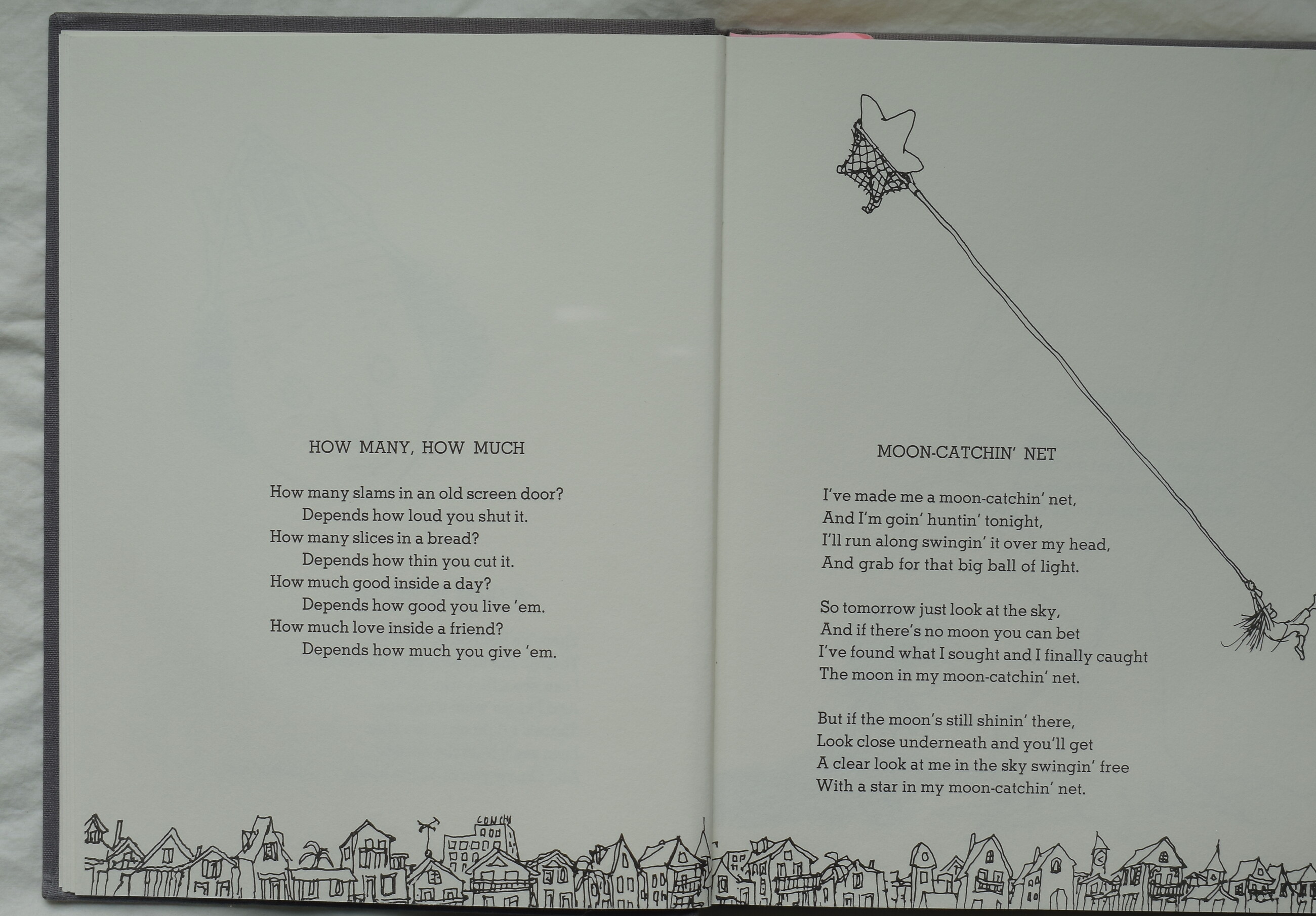
This minimalist spread is peak Silverstein: line drawings, white space, and that's it. The poems sit there with no fuss, no decoration fighting for attention, which is exactly why his stuff still hits harder than most picture books that try too hard.
The "is it teaching anything" question
People who ban this book think it is teaching kids to be disobedient, which is a polite way of saying it is teaching kids to think. There are poems in here that take a kid's complaints seriously, which is a thing adults almost never do. There are poems that are gleefully gross. There are a few that are quietly devastating in a way you don't see coming. Silverstein trusted kids to handle the whole emotional range. He didn't sand off the weird parts. That is the lesson, if there has to be one: your feelings, including the dumb ones and the dark ones, are allowed in the room. I'll take that lesson over a thousand books about sharing.
I have to flag the nostalgia. Some of my love for this book is just love for the seven-year-old I used to be, sitting on that brown carpet. But I checked. I read it cold, as an adult, before my kids ever touched it. The poems still land. The craft is still there. The nostalgia is icing on something that was already a cake.