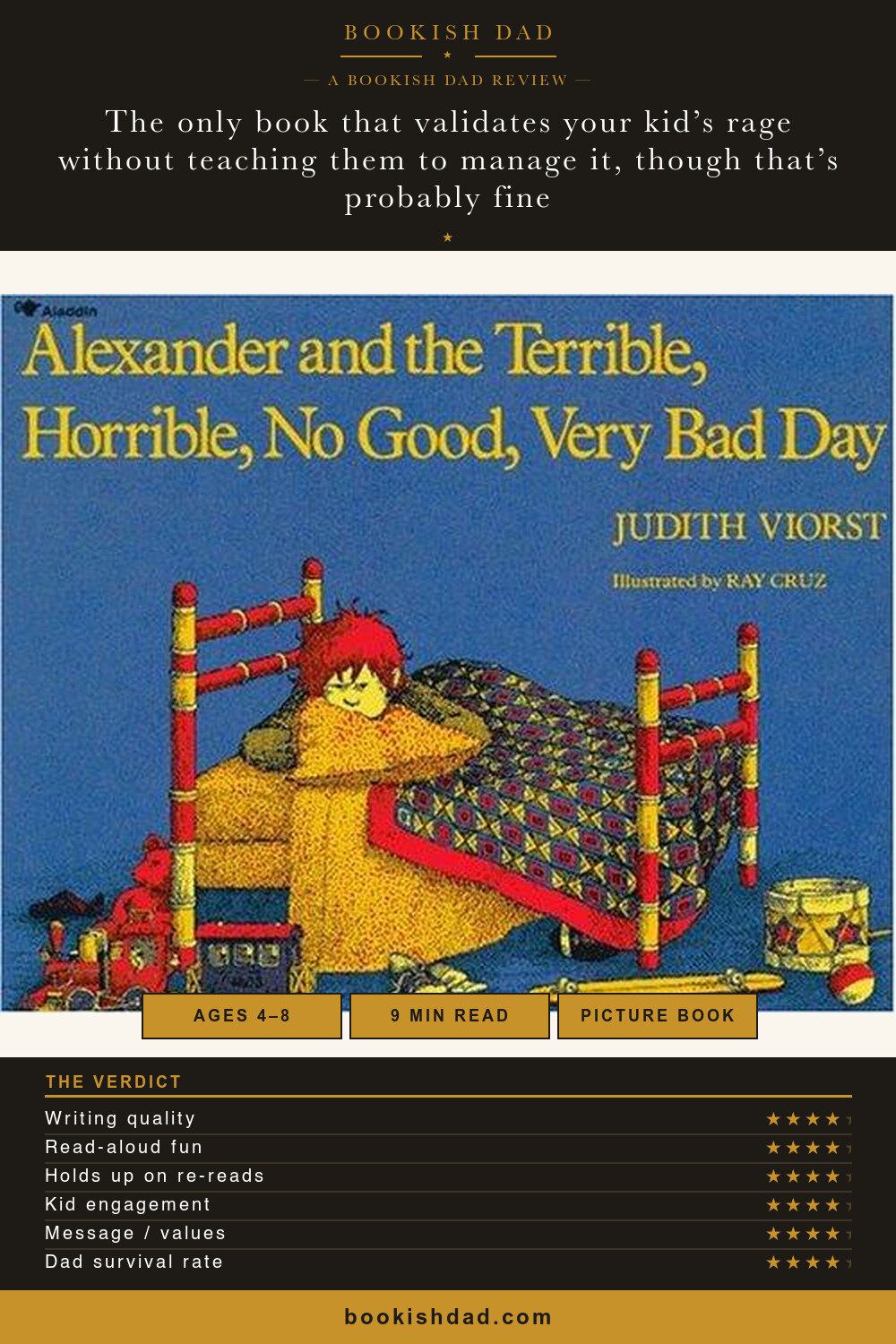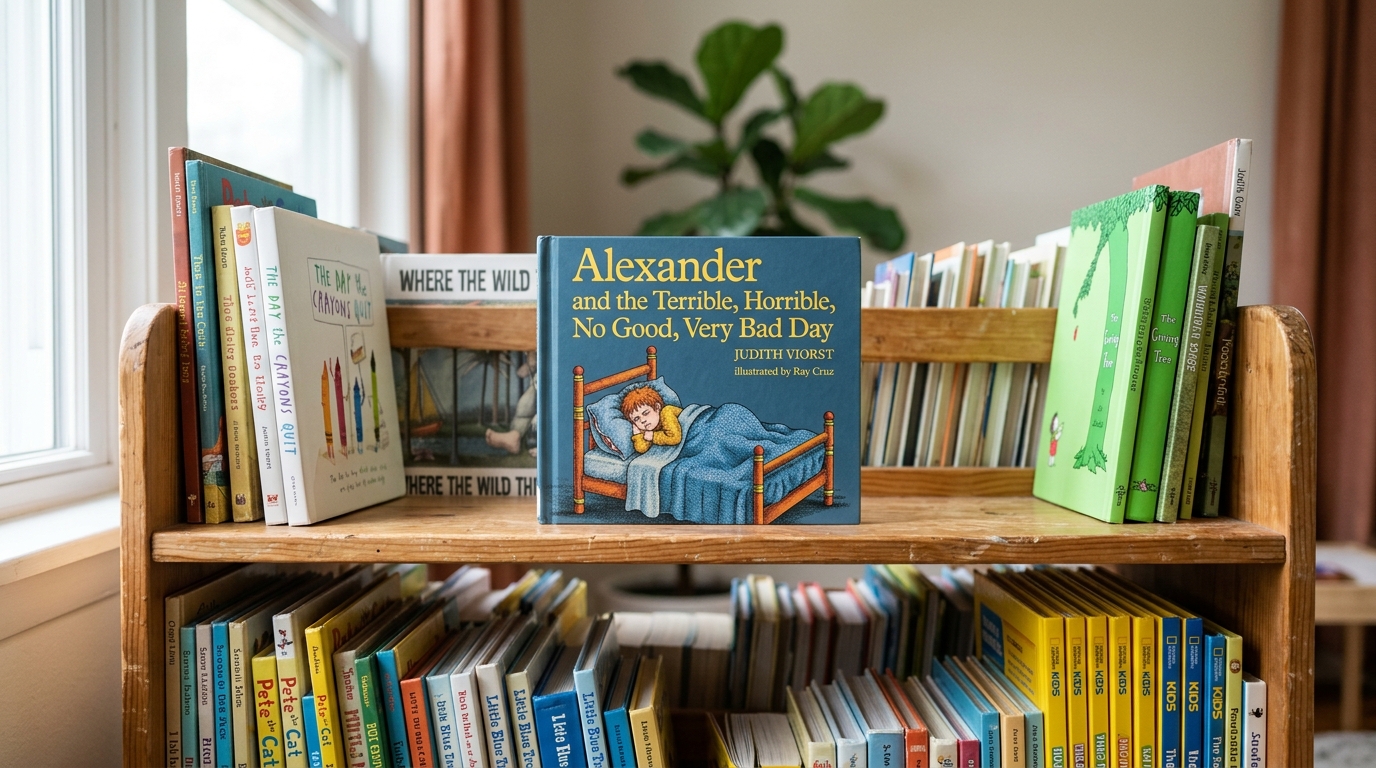

My son spent twenty minutes last Tuesday lying face down on the kitchen floor because his banana broke in half. Not split, not bruised, broke. He had peeled it himself, which is a power he loves to exercise, and somewhere between his fist and the countertop the banana suffered a structural failure, and that was it. He was undone. My wife and I exchanged the look. You know the look. The one that says, neither of us is going to laugh, but one of us is definitely going to write about this later. I read him this book that night.
I love this book. I loved it as a kid, and I love it now, and I want to be clear about the nostalgia component up front because I always try to be honest when nostalgia is propping up a rating. Here, I don't think it is. I think this book is genuinely doing something almost no other picture book of its era does, which is take a child's bad mood at face value and not try to fix it.
The thing it gets right that almost nothing else gets right
Most children's books about feelings end in a lesson. The kid learns a strategy. The kid takes a deep breath. The kid colors in a feelings wheel and emerges enlightened. Viorst does not do this. The whole book is just a kid having a miserable day and complaining about it, in his own voice, at length, with no resolution other than the acknowledgment that some days are like that. Even in Australia. That last line is the entire emotional engine of the book and it lands every time, because it doesn't promise to make tomorrow better. It just says: yeah. This happens. To everyone. Sorry.
For a four-year-old who is convinced his suffering is unique and historic, that is a genuinely powerful message. For an eight-year-old who is starting to be embarrassed by her own big feelings, it's permission. My daughter, who as established does not cry at sad books and once delivered a weather report while I sobbed at The Giving Tree, listened to this one with her arms folded and at the end said, "yeah, that's accurate." High praise from that quarter.
The writing itself
Viorst writes in the voice of a kid who is mad. Not a kid who is sad and processing, a kid who is mad and listing grievances. The sentences pile up. They run on. They use "and" when a more careful writer would use a period, because that's how kids actually complain. The cumulative effect is hilarious if you read it right, which means leaning into the grumble and not trying to make it cute. Do not make it cute. The book is funny because the narrator is not trying to be funny. He is trying to be taken seriously and failing, and that gap is the whole joke.
Ray Cruz's black-and-white line drawings are doing something I underrated as a kid. There's no color to soften the misery. Everything looks a little crowded, a little annoying, a little like the inside of a bad day, which I think is part of why the book ages so well visually. It hasn't tried to be on-trend, so it can't fall off trend.
The read-aloud test, and the re-read test
This book is a layup at bedtime. The rhythm is built for performance. You get to do a put-upon, sighing little voice, and the repeated title phrase becomes a thing your kid will start saying along with you by the third reading. My son does. He chants "terrible, horrible, no good, very bad day" with real feeling, because at four, every day has the potential to be one.
On re-reads, it holds up better than I expected. I've now read it maybe fifteen times in this current run, and the prose still has snap. It doesn't get thinner the way some picture books do, where you start noticing the seams. The grievances stack in a way that has a kind of structural pleasure to them. You know the form, you settle into it, you wait for the next bit. It works like a good blues song.
The dad-survival question
Here's where I'll be honest. By read fifteen, I am no longer doing my best work. The list format means I can autopilot through stretches of it, and my four-year-old has not yet noticed that "Daddy voice" is operating on backup power. That's not the book's fault. That's any book's fate at fifteen reads. What I will say is that I have not yet started narrating it like a hostage reading a prepared statement, which is my personal benchmark for a book I've truly come to resent, and I don't think I will. There's enough texture in the writing to keep finding small things to do with it.
The one thing keeping it from five stars
It's a vibe piece more than a story. There's no arc. The kid is mad at the start, mad in the middle, mad at the end, with a small grace note of acceptance. That's the point, and it's the right point, but it means the book doesn't have the gravitational pull of, say, Where the Wild Things Are, where the mood is just as big but the structure underneath is sturdier. So this lives a notch below the absolute top shelf for me. It's a four. A confident, happy, unashamed four.
Also, fair warning, after a few reads your kid may start describing minor inconveniences using the full four-adjective phrase. My son's banana incident was officially classified by him as terrible, horrible, no good, and very bad. The book did that. I take full responsibility.