
My daughter brought this home from the school library, set it on the kitchen counter face-down like it was contraband, and then read the whole thing in roughly the time it takes me to fold one load of laundry. When I asked her about it she shrugged in that very specific 8-year-old way that means "I have feelings about this but I am not going to give you the satisfaction." Two days later she went back to the library and got the next one. So. That's the review, basically. I could stop here.
But I won't, because I have things to say about Greg Heffley, and I have things to say about the fact that this is the book that finally got a certain kind of kid to read on purpose.
So what is this thing, exactly
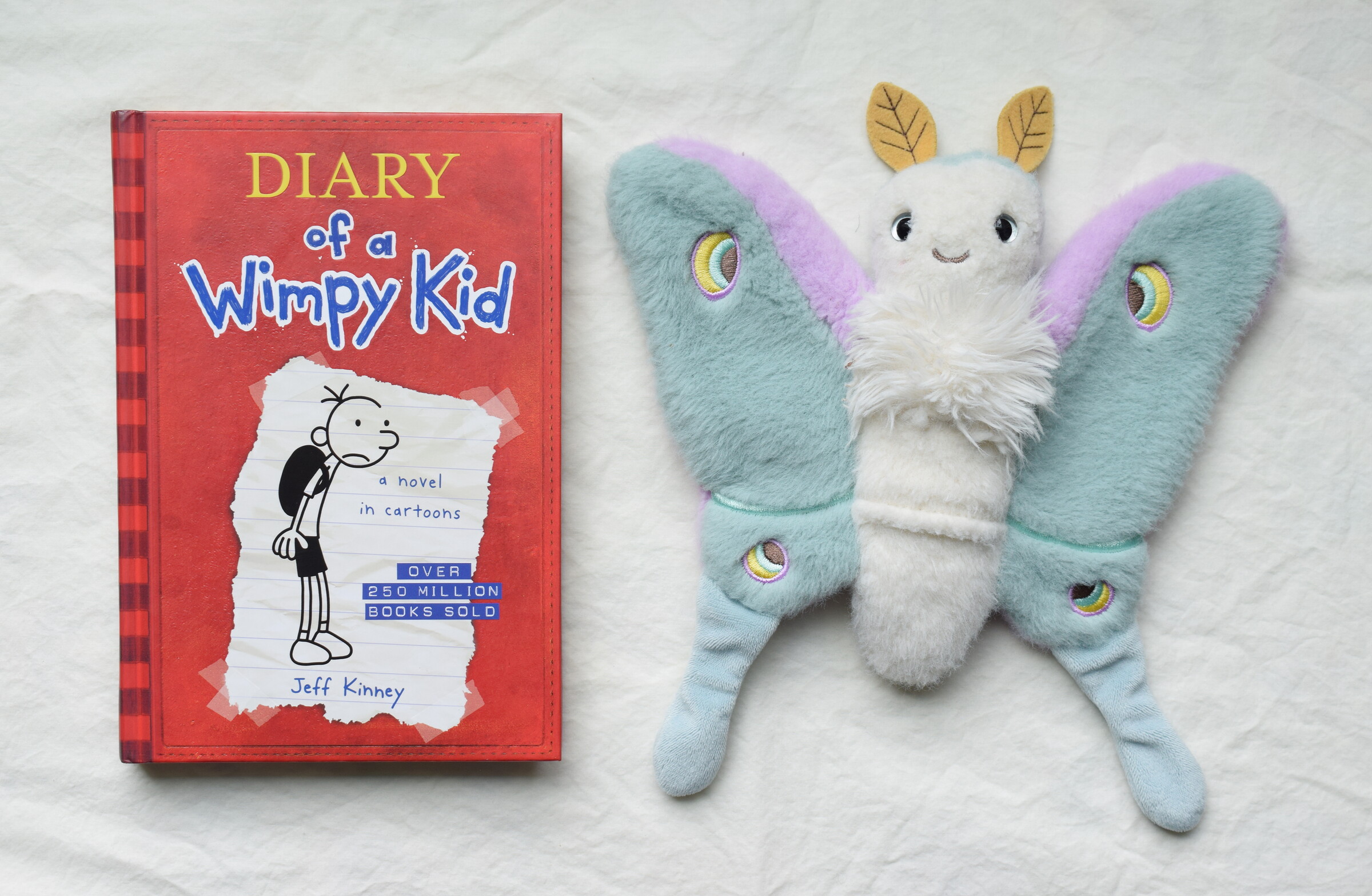
A diary? Moth is mildly suspicious. Surely someone this wimpy would've lost the book by page three.
It's a diary. It's a comic. It's neither. Jeff Kinney built a format that looks like a regular novel had a baby with a doodle in the margins of a math notebook, and the result is something that a kid who "doesn't read" will absolutely read, because their brain never has to commit to either reading a paragraph or looking at a picture for very long. The eye keeps moving. There's always a drawing on the next page. The handwriting font does something psychological that I can't fully articulate but I respect.
Greg himself is a middle schooler trying very hard to be popular and failing in ways that are funny because they are exactly, painfully recognizable. He has a best friend named Rowley. He has an older brother named Rodrick who exists to make his life harder. He has a toddler brother named Manny. He has parents who don't get it. There is a piece of moldy cheese on the blacktop at school that nobody touches, for reasons. That's the texture of the book.
The writing is sneakier than it looks
What most people miss about Jeff Kinney: this looks like a kid wrote it, and it absolutely was not written like a kid wrote it. The sentences are short and dry and have a rhythm to them, and the gap between what Greg thinks is happening and what is actually happening is the entire engine of the book. Greg is convinced he's the protagonist of a story about an underappreciated genius. The reader can see he is the protagonist of a story about a kid who is sort of a jerk to his best friend. That irony is the whole show, and it's handled with a really light touch. Kinney never makes Greg's obliviousness too on-the-nose. He just lets it sit there.
As a read-aloud, though, this one isn't built for performance. I tried a couple of pages with my son just to see, and he was confused. The format requires the eye. The jokes are partly visual. Greg's voice on the page is dry and deadpan, which is hard to land out loud without it sounding like you're doing a bit. This is a book for a kid to read silently and snort at, not for a parent to perform at bedtime. Which is actually a feature, not a bug, because at some point our kids need to fall in love with reading on their own, without us doing voices.
Will she actually pick it up twice
I asked my daughter if she'd read it again and she said "probably" with the casualness of a person who has already decided the answer is yes. That's the magic. The episodic, diary-entry structure means a kid can flip to any page and find a complete joke. You don't need to remember where you were. You don't need to track an arc. You just need to land on a page where something embarrassing is about to happen to Greg. The cartoons are also re-read fuel; she keeps showing me ones I already saw two days ago.
Is Greg a terrible influence, and do I care
No way around it: Greg is not a good guy. He's not a bad guy either, but he is selfish and shortsighted and he treats Rowley poorly throughout the book, and the book mostly lets him get away with it. There are consequences, but they're not the kind of clean lesson-learned moments you'd find in a more sanitized middle-grade book. Greg does something kind of crummy and then the next chapter starts. Some parents hate this. I get it. My take: kids can tell. My daughter doesn't think Greg is a role model. She thinks Greg is funny because he's wrong, and the ability to read a book about a character who is wrong and still enjoy it is a literary muscle I'd like her to build. Books where every kid behaves correctly are not the only books, and frankly they tend to be the boring ones.
That said, I do think this is an 8-and-up book, not a 6-and-up book. My 4-year-old has zero business with Greg Heffley. The humor relies on a kid being old enough to understand social dynamics and recognize the gap between what Greg says and what's actually happening. Without that, it's just a confusing book where a boy is mean to his friend.
The bedtime labor I get to skip
I don't have to read this one out loud, which means my Dad Survival Rate on Wimpy Kid is essentially infinite, because it isn't my job. She reads it alone. She laughs alone. She comes back and tells me about one (1) drawing and then leaves the room. This is the dream. This is what we've been training for. After eight years of reading The Very Hungry Caterpillar aloud until the words lost meaning, I have earned a book my kid reads to herself while I drink coffee that is still warm.
The reason this isn't five stars, for me, is that Wimpy Kid is a stepping-stone book more than a destination. It's a doorway. My daughter will read ten of these and then, hopefully, she'll wander off into something with more weight, and Wimpy Kid will have done its job. That's a real and important thing for a book to do, and I'm not knocking it. But I'm not putting it on the same shelf as Charlotte's Web, and I think Jeff Kinney would agree.
Four stars. She'll be on book six by June.