
My son has requested "Ickle Me, Pickle Me, Tickle Me Too" every single night since the second week of February. I am writing this in late April. You do the math, and then sit with what that math means for me as a human being who used to have hobbies. He doesn't want a different Silverstein poem. He doesn't want a different book. He wants that one poem, and he wants it in what he calls "the silly voice," which started as a kind of Muppet-adjacent thing and has, over two months, drifted into a register I can only describe as a chipmunk who has had a stroke.
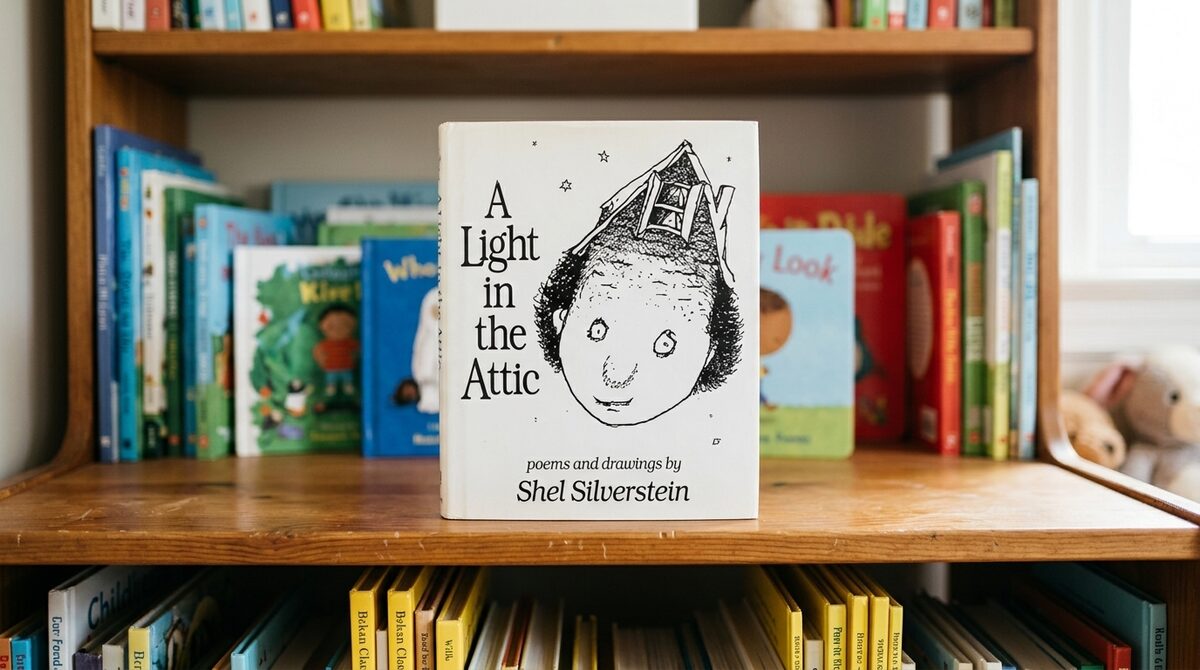
I want to put this on the record before we go further: I love it. I love this book. I loved it in 1991 lying on the floor of a public library in a town nobody has heard of, and I love it now reading it to a four-year-old who throws himself sideways off the bed every time we hit a punchline. A Light in the Attic is one of maybe six books I would grab if the house were on fire, after the kids and the cat and probably my wife.
The poems do something almost nothing else does
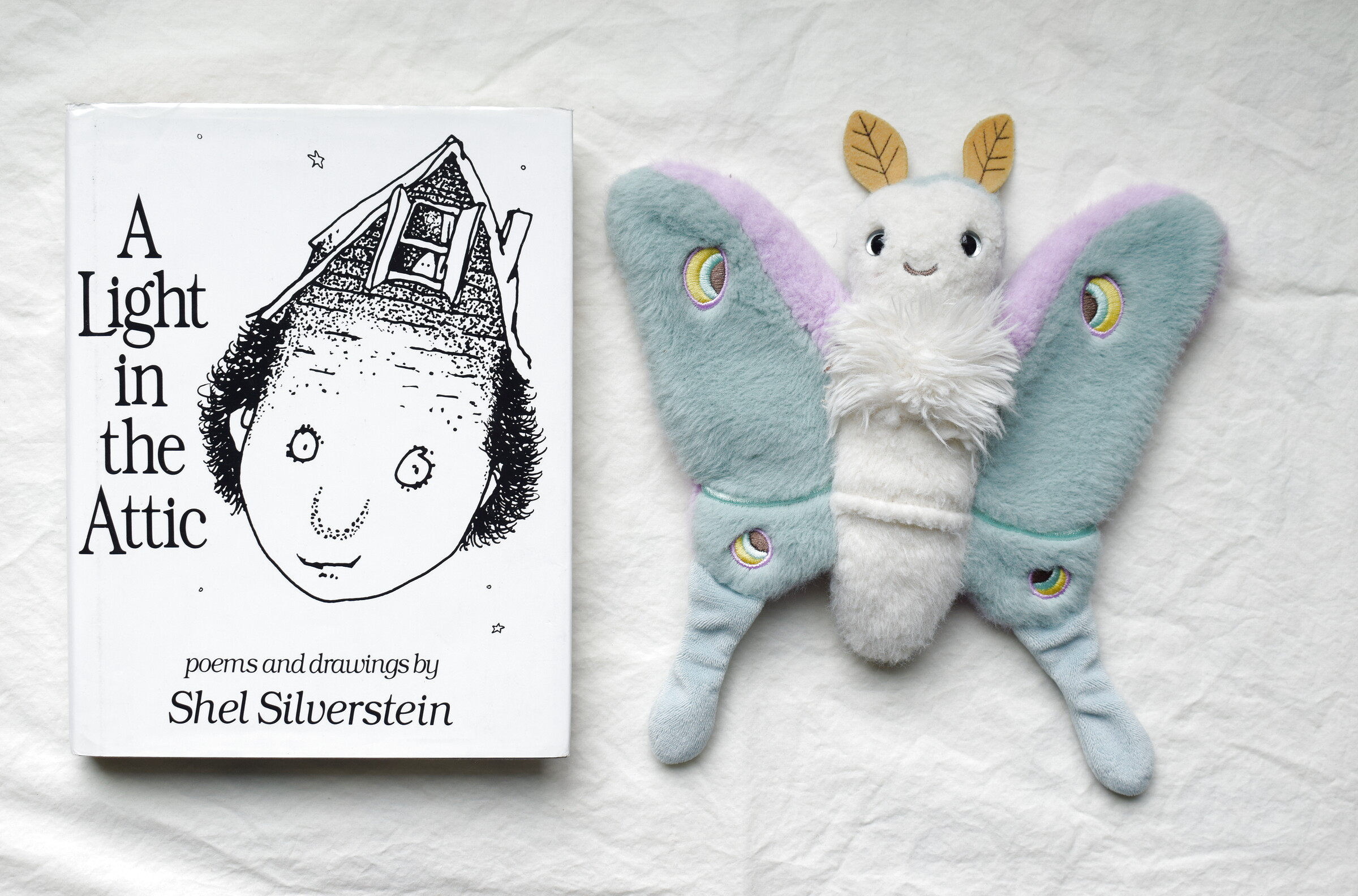
The attic reference has Moth on edge. She prefers her own dark corners, thank you.
Silverstein's whole trick, the one I didn't have words for as a kid and barely have words for now, is that he writes poems that take a child's interior life completely seriously while also being deeply, stupidly funny. The Whatifs poem alone does more emotional labor than half of the children's market combined. My daughter, who as established does not emote, came down the stairs one morning and said, "I had Whatifs last night." That was the whole sentence. Then she ate cereal. Reader, I had to leave the kitchen.
The writing is real writing. Not "good for kids" writing. Real writing. The meter actually works. The line breaks do work. The endings either snap shut like a mousetrap or trail off in a way that leaves a kid staring at the page going, wait. There is no filler. There is no poem that exists because the page count needed it. With 135 poems in a single volume that is, frankly, mathematically improbable, and yet here we are.
On reading it aloud
Read-aloud-wise this is the gold standard. Silverstein wrote for the mouth. The poems want to be performed, and they reward voices, pauses, eyebrow work, the whole circus. I do a different voice for almost every poem, which my wife finds embarrassing in a loving way and my son finds essential. If I try to read one in my normal voice he physically corrects me. He puts a hand on my arm. "No. Silly."
The drawings deserve their own paragraph. Pen and ink, weird, spindly, sometimes alarming, sometimes just a single line that ends the poem better than the poem did. My daughter spends an enormous amount of time examining the illustrations after we finish reading, the way a person examines a painting in a museum if they were eight and also a little judgmental. She has opinions about which drawings are funnier than their poems. She is sometimes correct.
Holding up on re-reads, which, again, sixty plus and counting
I owe you some honesty about nostalgia here, because it absolutely has its thumb on the scale, and I don't want to pretend otherwise. I came to this book pre-loved. But the re-read test is not "do I still like it." The re-read test is "does the four-year-old still light up on read forty." He does. The eight-year-old, who could be reading it independently and sometimes does, still slides into the room when she hears me start a poem from the other side of the house. That's the test. The book passes the test.
The message question is a funny one for Silverstein because on the surface he isn't teaching anything. He's not handing out morals. He's not telling kids to share or be brave or eat vegetables. But underneath, in the architecture, the book is teaching one enormous lesson, which is that your inner life, the weird parts, the worrying parts, the parts that want to put a brassiere on a camel just to see what happens, all of that is legitimate material. It is worth a poem. Adults wrote it down. Adults drew pictures of it. That is a message, and it is the right one.
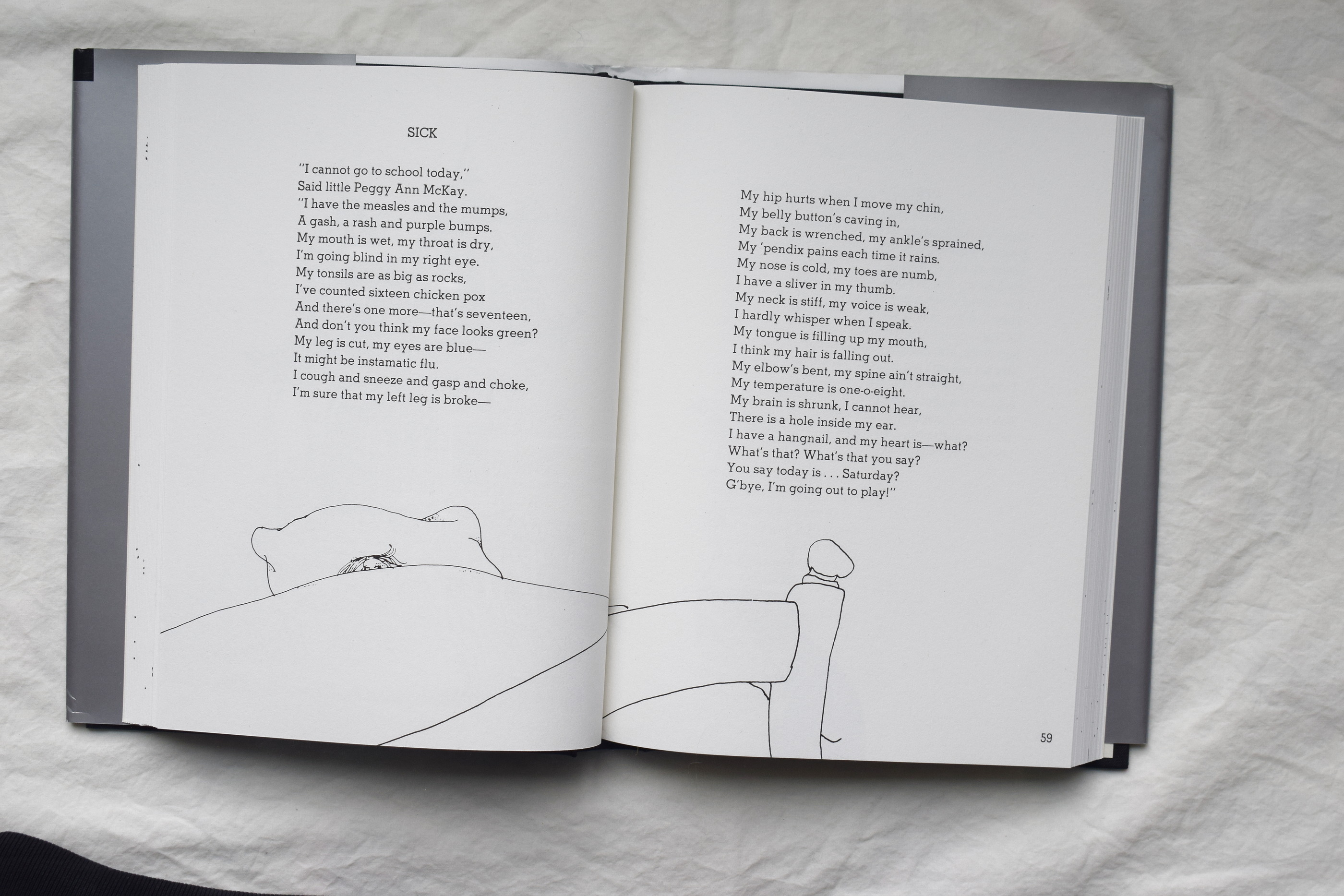
This spread captures exactly why Silverstein still works: a full page of hypochondria spiraling into absurdity, paired with the simplest possible line drawing. My daughter reads both poems in one anxious breath and then looks at me like she just got away with something.
The Ickle Me, Pickle Me stress test
Infinite. Genuinely. I have been reading "Ickle Me, Pickle Me" nightly for over two months and I am not yet doing the dying Victorian clergyman voice. That is the highest praise this blog can give a book. Most of the books in our rotation hit clergyman by read twelve. Silverstein doesn't, because every time you read one of these poems you notice a different beat, a different rhyme that does a tiny little flip, a drawing detail you missed. The book has more in it than you have patience to mine, even on the fortieth pass.
If your kid has not been handed this book yet, that is a thing you can fix tonight. It is genuinely one of the two or three books I would say belongs in every house with a kid in it, no qualifications, no asterisks, no "if your child enjoys poetry." Every kid enjoys this poetry. That's the whole point.