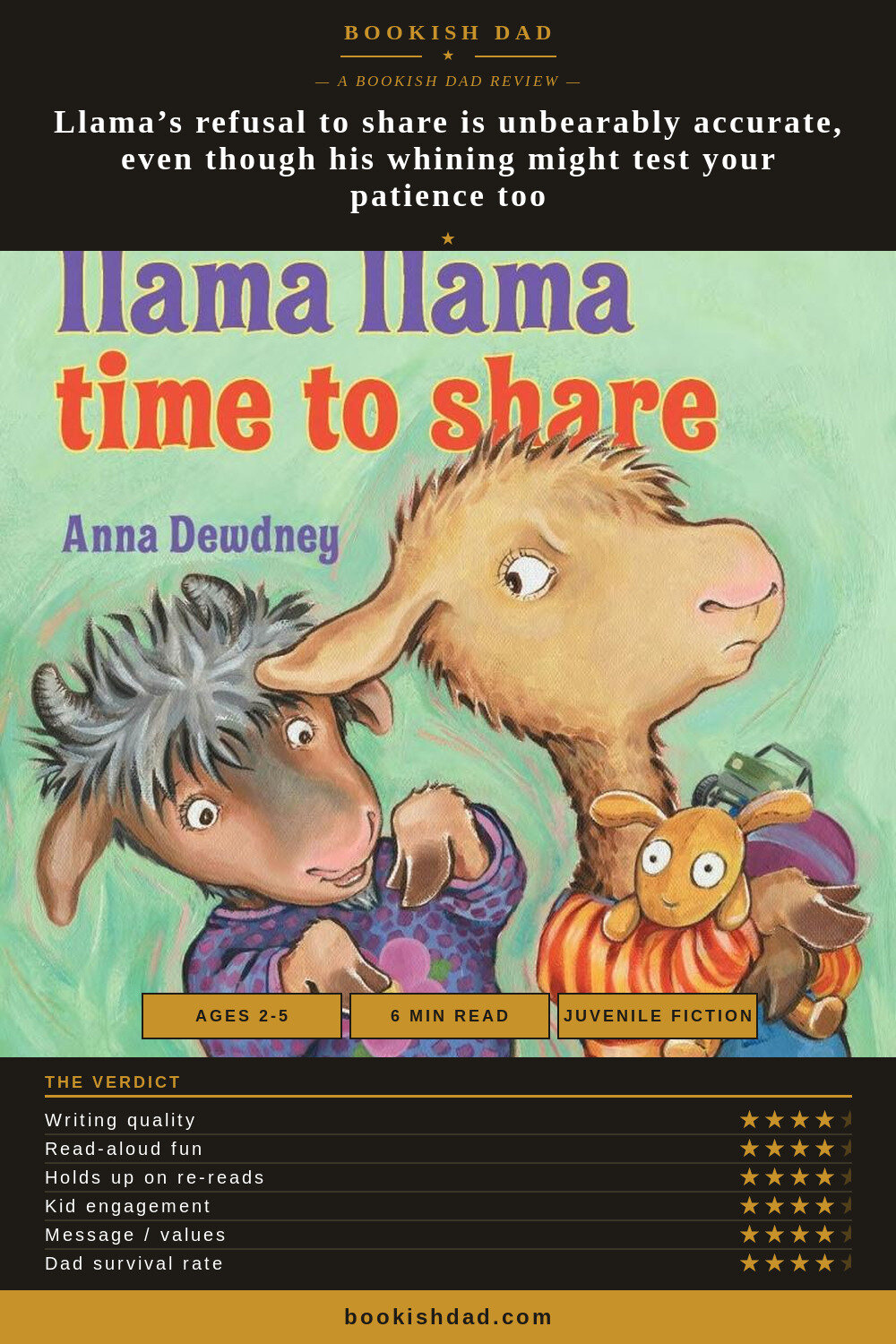

I will say the quiet thing out loud: Llama is kind of annoying. Not in a way that ruins the book. In a way that is, honestly, the entire point. He whines, he stalls, he doesn't want to give an inch, and when something finally goes sideways for him you get the distinct sense he had it coming a little. And every night I read about this whiny little guy, I feel a quiet, ungrateful gratitude that he is not my actual child. That, more than anything, is the engine of these books. They are extremely accurate.
This is the one where Nelly Gnu and her mama come over for a play date, and Llama is not at all sure he wants to share his toys. The publisher copy lays out the shape of it plainly: build a tower, make a moat, maybe share the blocks, maybe make a castle, and then the whole thing tips into tears when Llama's little Fuzzy Llama gets ripped in two. Mama steps in, fixes Fuzzy, and sets a boundary about whether Llama can actually handle having friends over. As setups go for a two-to-five crowd, it is dead on. Sharing is the single hardest thing my four-year-old does in a given day, and he does roughly four hard things before breakfast.
Nelly Gnu is the friend Llama needed
Moth is deeply skeptical that anyone actually wants to share their stuff with anyone else, llama or otherwise.
Here's my soft spot in the whole thing. Nelly is exactly the kind of kid who can stand next to a guy like Llama and not absorb his whining. She just sort of... shows up and plays. There's something I genuinely like about that, because it's true to how friendship works at that age. The mopey kid doesn't get less mopey through a lecture. He gets less mopey because somebody fun is in the room and the toys are right there and being precious about a tower starts to feel dumb. Dewdney never spells that out, which I respect. She lets the play do the persuading.
The rhymes, which are the actual reason to own this
Dewdney's couplets land with a thunk you can feel in your teeth, and I mean that as the highest compliment. The meter is tight enough that when you hit a line wrong, you know instantly, and the kids know too. The word choices are economical. There's no padding, no filler syllable jammed in to make a rhyme limp across the finish line. That restraint is why these read aloud so cleanly. You can perform it without rehearsing it, and after a few nights you start anticipating the beats the way you'd hum a song you didn't mean to memorize.
On read-aloud specifically, this is where the book earns its money. The rhythm gives you natural places to drop your voice for the gloomy parts and crank it back up when the play starts. My son leans into the buildup before the Fuzzy disaster every time, like he can feel the wobble coming. He cannot hear a rhyming couplet without trying to shout the second half before I get there, which slows the whole operation down and is also the best part of my evening.
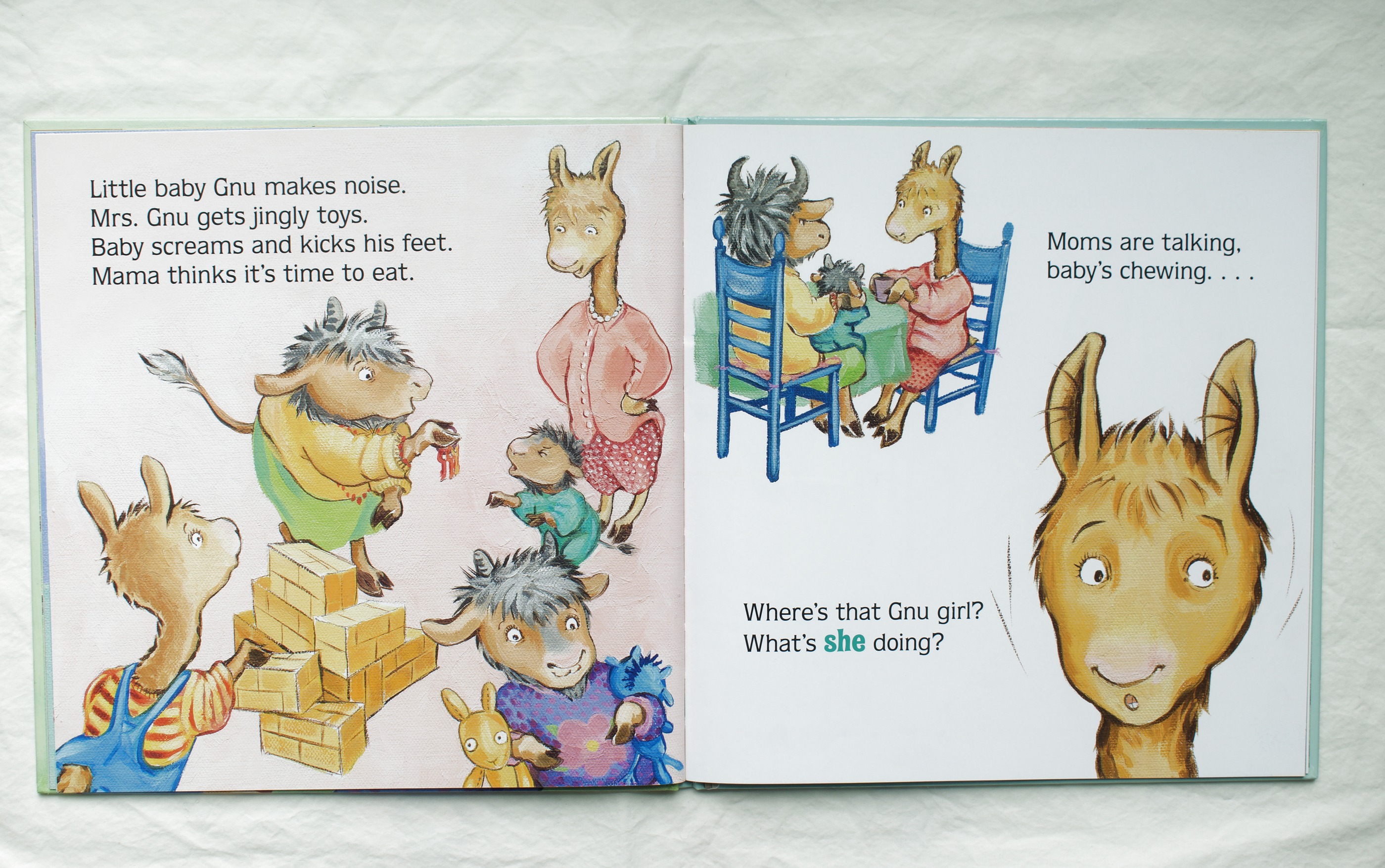
There are puns that are lame, then there are puns that are honestly impressive. I also get way too much enjoyment out of seeing a little troublemaker casually walk off with someone else's toy. I've watched my four-year-old do that exact move.
Does it hold up on read fifteen?
Mostly, yes. There's a ceiling here that the genuinely transcendent picture books clear and this one doesn't quite. After enough nights, the tidiness of the lesson starts to show its seams to the adult in the room. But the rhyme scheme keeps it from going stale the way flatter books die at read three, and the emotional arc is short and well-built enough that it doesn't overstay. My daughter, at eight, has aged out of needing it, but she'll still drift toward the doorway when she hears the meter start up. She won't admit she's listening. She doesn't have to.
On message, this is where Dewdney is at her best. The lesson is sharing, which could be insufferable, and somehow it isn't. The book trusts the kid to draw the conclusion instead of standing on a chair and announcing it. Mama's boundary at the end is the part I appreciate most as a parent, because it models a calm consequence rather than a punishment, and it does it in two lines. That's hard to write. It looks easy because Dewdney makes it look easy.
Dad survival rate is solid. The rhyme carries you, so you're never just dragging your voice across dead pages. I've done back-to-back-to-back readings of this without my soul leaving my body, which, in this genre, is a real endorsement. It's not the book I'd grab if I were running on three hours of sleep and a single cold coffee, but it's far from the bottom of the rotation. Llama may be a pill, but Dewdney knew exactly what she was doing with him.