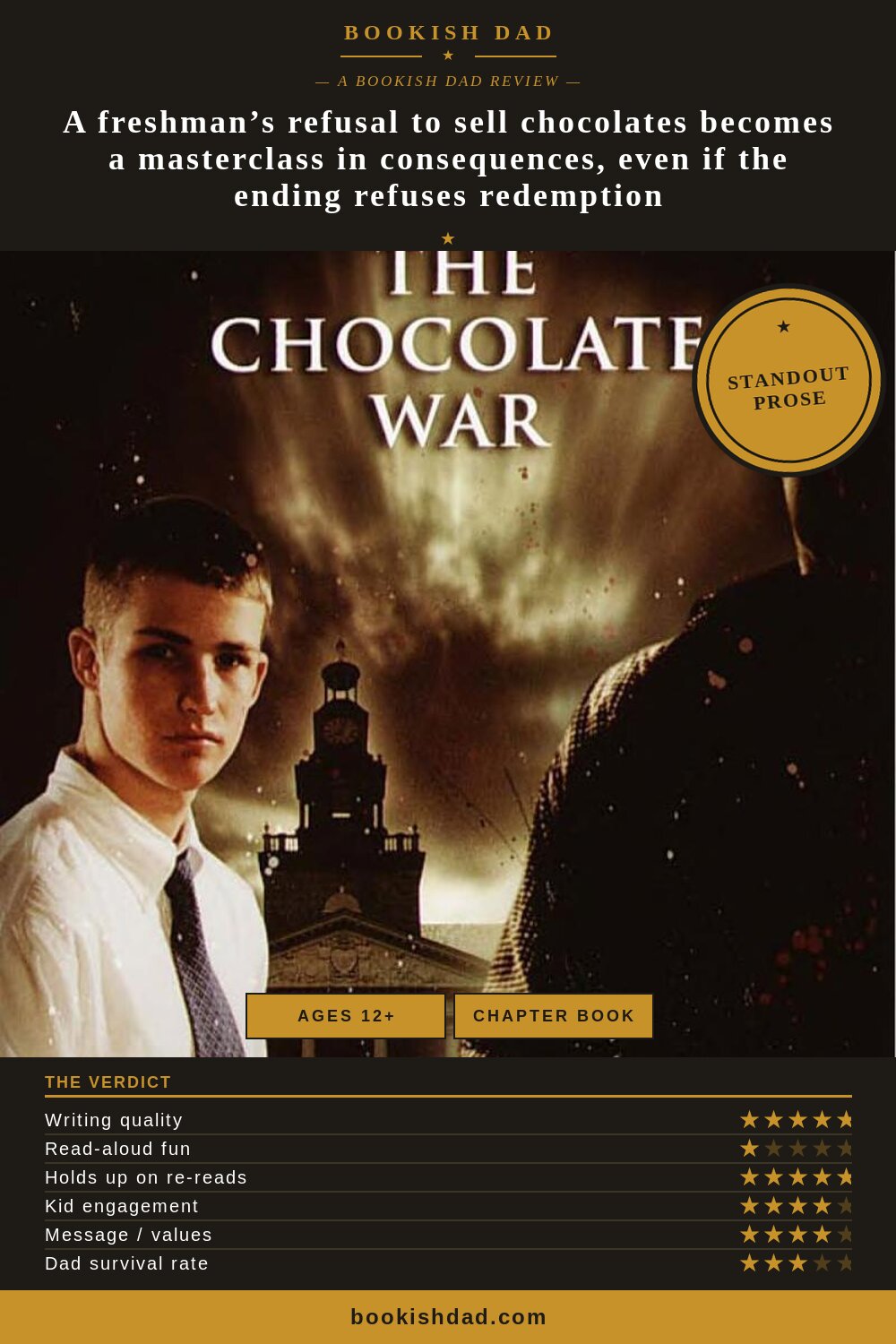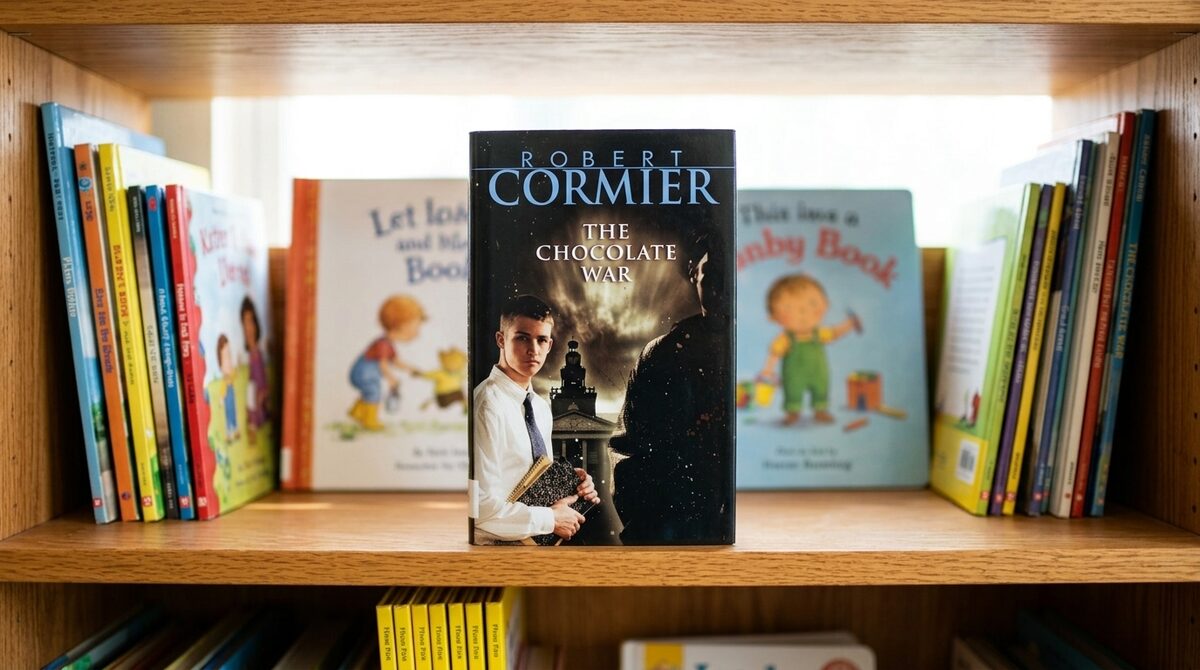

I read this at maybe thirteen, in a beanbag chair in a friend's basement, and I remember closing it and feeling like someone had taken something away from me and refused to give it back. Not a bad feeling. A real one. I'd spent my whole reading life up to that point on books where the kid who stands up gets rewarded for standing up, where being brave and being right eventually pay off, and this book looked me dead in the eye and said: not always, kid. Sometimes not at all. I've reread a lot of childhood books as a 41-year-old with a cat asleep on my forearm and a coffee I let go cold. This is the first one that scared me more the second time.
Neither of my kids is old enough for this. My daughter is eight and my son is four, and I want to say that up front because the whole point of this review is a warning wrapped around a recommendation. So this is a review of the book, and of me, and of the kid I'm going to hand it to in five or six years while trying very hard not to hover.
What Cormier actually does with a sentence
The writing is lean and cold in a way that took me by surprise on the reread. Cormier doesn't warm anything up. He'll hand you a boy's private grief, drop the temperature a few more degrees, and move on before you've had time to feel comforted. There's a fundraiser at a Catholic school, a manipulative administrator, a secret student society that hands out "assignments," and a freshman named Jerry who is asked to refuse to sell chocolates for ten days. The engine of the whole thing is that Jerry keeps refusing after the ten days are up. That's it. That's the plot. And Cormier writes it like a slow-motion car crash you can see from three blocks away and cannot stop.
The prose is doing something I don't usually see in books shelved for kids. It withholds. It refuses to editorialize about the cruelty it's showing you, which somehow makes it land harder, because you're not being told how to feel, you're just watching it happen and doing all the feeling yourself. There's a T.S. Eliot line taped inside Jerry's locker, "Do I dare disturb the universe," and Cormier lets that quiet little question carry the moral weight of the entire book without ever underlining it. He trusts the reader. That trust is the thing I'd forgotten.
This is not a book you perform
Read-aloud fun is the wrong lens here, so I'll be honest instead of clever. I do voices for everything. I have a rat voice I'm proud of and a giant voice my son requests by name. There are no voices in this book for me. It's not built to be performed across a mattress at 8:40pm; it's built to be absorbed in silence by one person who then can't sleep. If you tried to read it aloud to a room, the flatness that makes it work on the page would just feel like you'd gone bone-tired and stopped acting. So I'm not scoring the theatrical value high, because that's not the instrument the book is playing.
On re-reads it holds up brutally well, and I mean that as praise and as a small complaint. I clocked things at 41 I sailed straight past at thirteen. The administrator character is scarier now that I've sat in enough meetings to recognize the type. The kid who runs the secret society is scarier now that I understand power for its own sake is a thing adults chase too. It rewards a reread the way few kids' books do. It also doesn't get easier, which is either the highest compliment I can pay a book or a reason to keep it on a high shelf, depending on the day.
Reviewers have compared this to Lord of the Flies and A Separate Peace, and for once the comparison isn't marketing. It earns the company.
The kid I'm saving this for
My daughter is the reader in my house who catches the thing I missed and states it like she's reading a weather report off her arm. She figured out the point of one book two days after we finished it and reported it to me at breakfast like old news. I already know what she'll do with this book, roughly, because she doesn't cry at sad things, she interrogates them. She'll finish it, sit with it, and eventually ask me a question that reframes the whole thing and makes me feel dumb for missing it. I'm looking forward to that fight in five years. I'm also a little afraid of it, because this is a book that could genuinely upset a kid who isn't ready, and readiness isn't about reading level. It's about whether a kid can hold "the good guy lost and nobody fixed it" without it curdling into something bleak. That's a parent's judgment call, not an age tag's.
The values question is the whole controversy. This book has been banned and challenged more times than almost anything, and I understand why, and I disagree with the reason. It's not teaching kids to be cruel. It's showing them, without flinching, that mob cruelty is real, that compromise is seductive, and that standing alone sometimes costs you everything and buys you nothing. That's not nihilism. That's the pep talk before the hard conversation. A kid who reads this and asks "would I have caved?" is a kid learning the most useful thing a book can teach, which is how to see the thing coming before it arrives.
Dad survival rate isn't really in play, since I'll never read this one twenty times in a row across a mattress. But I'll read it again alone, in a chair, when my daughter's a teenager and hands it back to me with an opinion. That's a different kind of survival, and this book earns it.