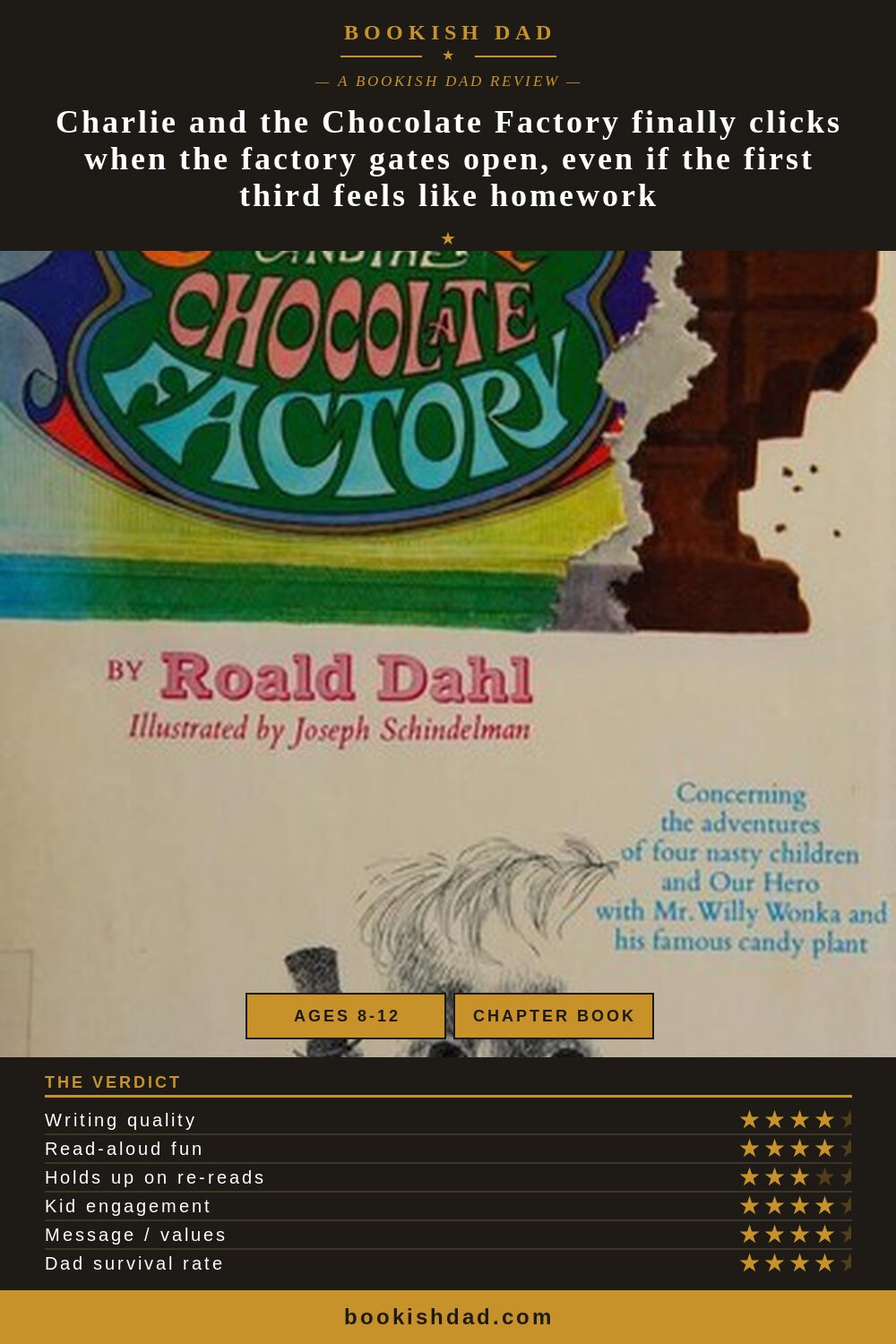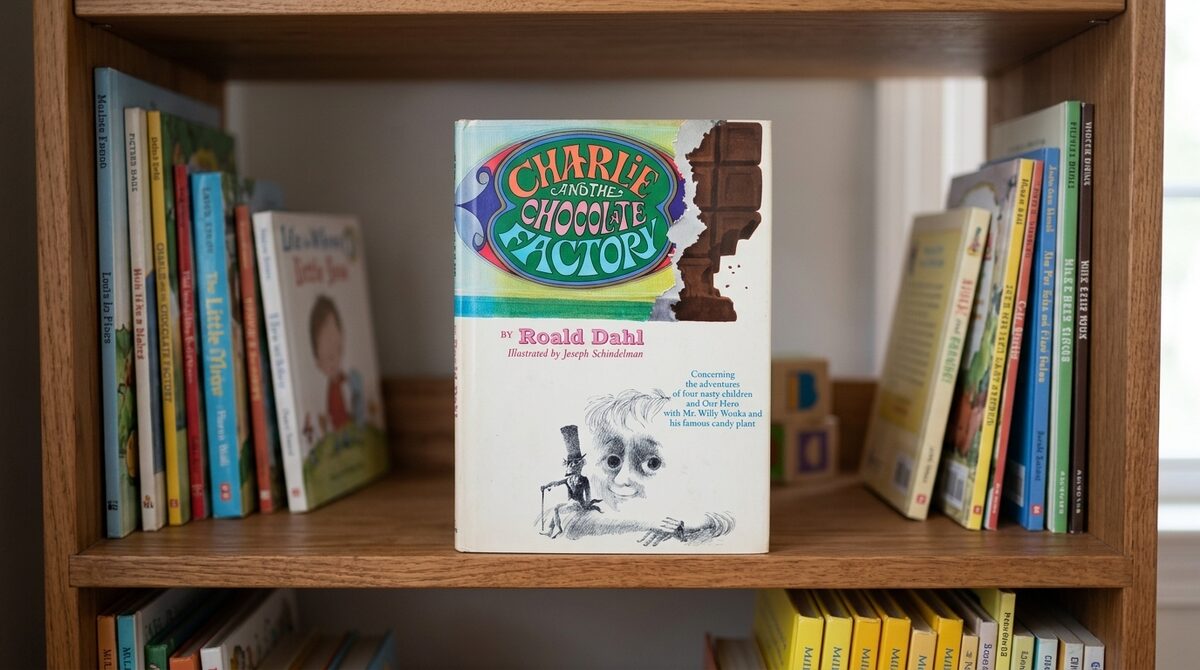

I put off Dahl with my daughter longer than I should have. Not because I doubted her (she'd already inhaled Magic Tree House and half the Boxcar Children by then), but because Dahl is weird in a specific way, and I wasn't sure she was ready for the weird. Turns out she was so ready for the weird that I was the one caught off guard. We pulled this off the shelf a couple weeks back and I discovered, roughly four pages in, that I had forgotten almost everything about how this book actually opens.
Because here's what nobody tells you when they hand you a copy: the beginning is bleak. Charlie Bucket lives in poverty with two sets of grandparents and not enough food, and Dahl does not soften it. I'd remembered the chocolate river and the tiny men in overalls. I had completely misplaced the part where a family is cold and hungry in a small house before any of the fun starts. My daughter clocked it immediately. First question, delivered flat, no drama: "Why doesn't Charlie's family have enough food?" I explained that his dad's job doesn't pay much. Second question, which is the one that got us: "Why doesn't the guy who puts caps on toothpaste make more money?" I did not have a clean answer, so we ended up somewhere near the industrial revolution at 8:40 on a Tuesday. That's the tell that a kid is ready for a meatier book. She wasn't asking to be cute. She wanted the mechanism.
What saves the front half from being a slog is that Dahl never makes you marinate in the misery. The book runs through Charlie's eyes, and Charlie is a hopeful kid, so even the grim stuff has this stubborn brightness laid over it. That's a real craft move and it's easy to miss. A lesser writer would either wallow or skip the poverty entirely. Dahl does the harder thing, which is show you a cold house and then let a kid's plain optimism sit on top of it without cancelling it out.
Then the gates open
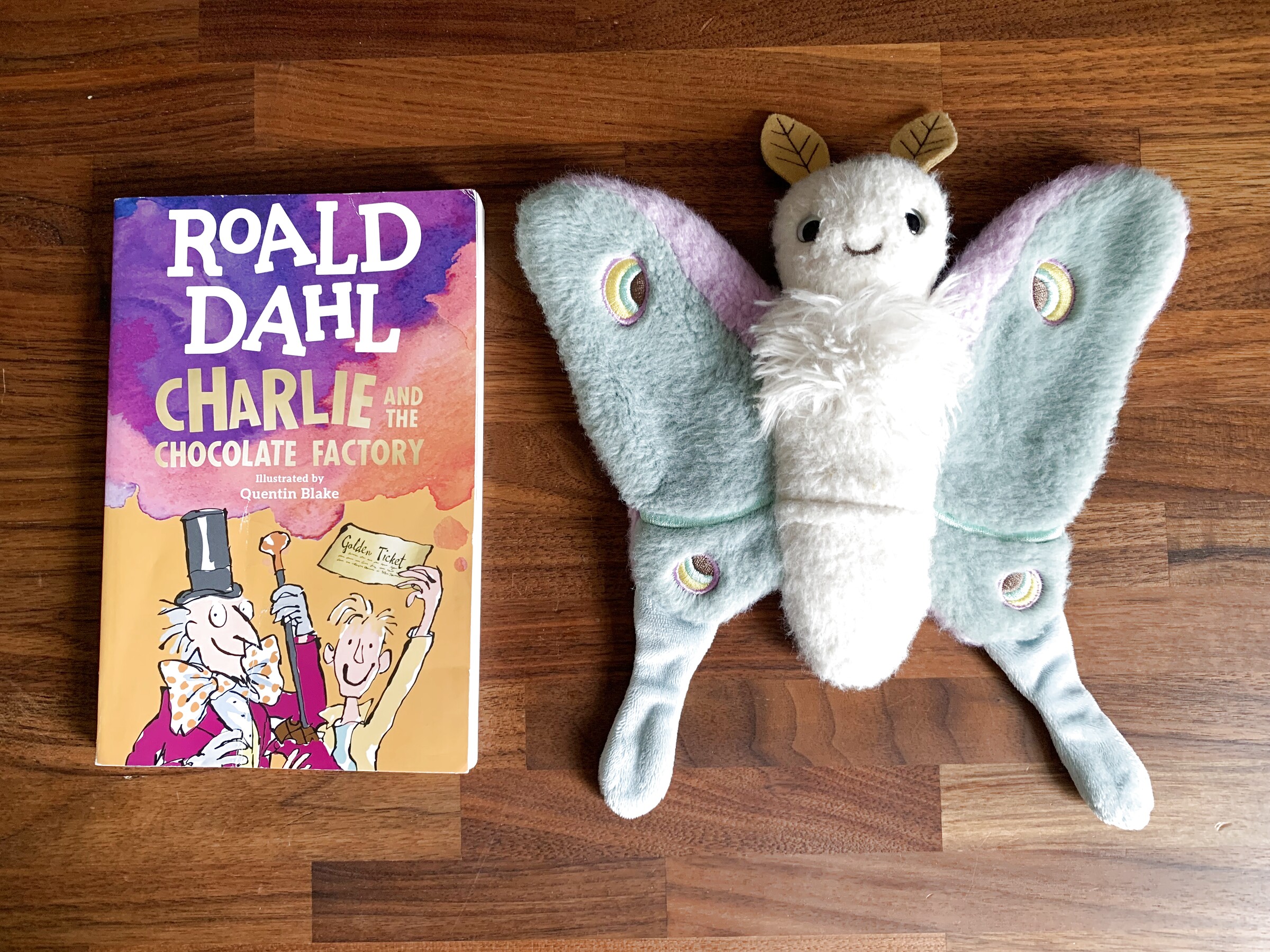
Moth is envious of the plush creature's wings and overall life choices, but respects the classic nonetheless.
Once the tour of the factory starts, the whole thing changes gears and takes off. Dahl clearly built the four other kids as targets, and their exits are so precisely calibrated to their specific flaws that it plays like a magic trick. Common Sense Media called it a morality tale in a fun costume and that's exactly right. The gluttonous one, the gum-chewer, the spoiled one, the TV kid. Each one gets a comeuppance that is basically their own worst quality handed back to them at scale.
My daughter and I got into a genuinely heated round of "which child is the naughtiest," and we landed, unanimously, on Veruca Salt. That spoiled little brat. My daughter said it with the calm certainty of a judge reading a sentence, then went back to picking at the corner of her pillow, which for her is basically a standing ovation for the whole book. She'd also, by that point, quietly read three chapters ahead of me without telling me. I only found out because she referenced something I hadn't read yet and then pretended she hadn't.
As a read-aloud it performs. The Oompa-Loompa songs give you built-in rhythm, and the four exits are basically four punchlines you can lean into. My son is four and mostly not part of the chapter-book crowd yet, but he drifted in one night, listened to about a page and a half, decided there was not enough happening to him personally, and went to go find something to climb. Fair. This isn't his book yet. It will be.
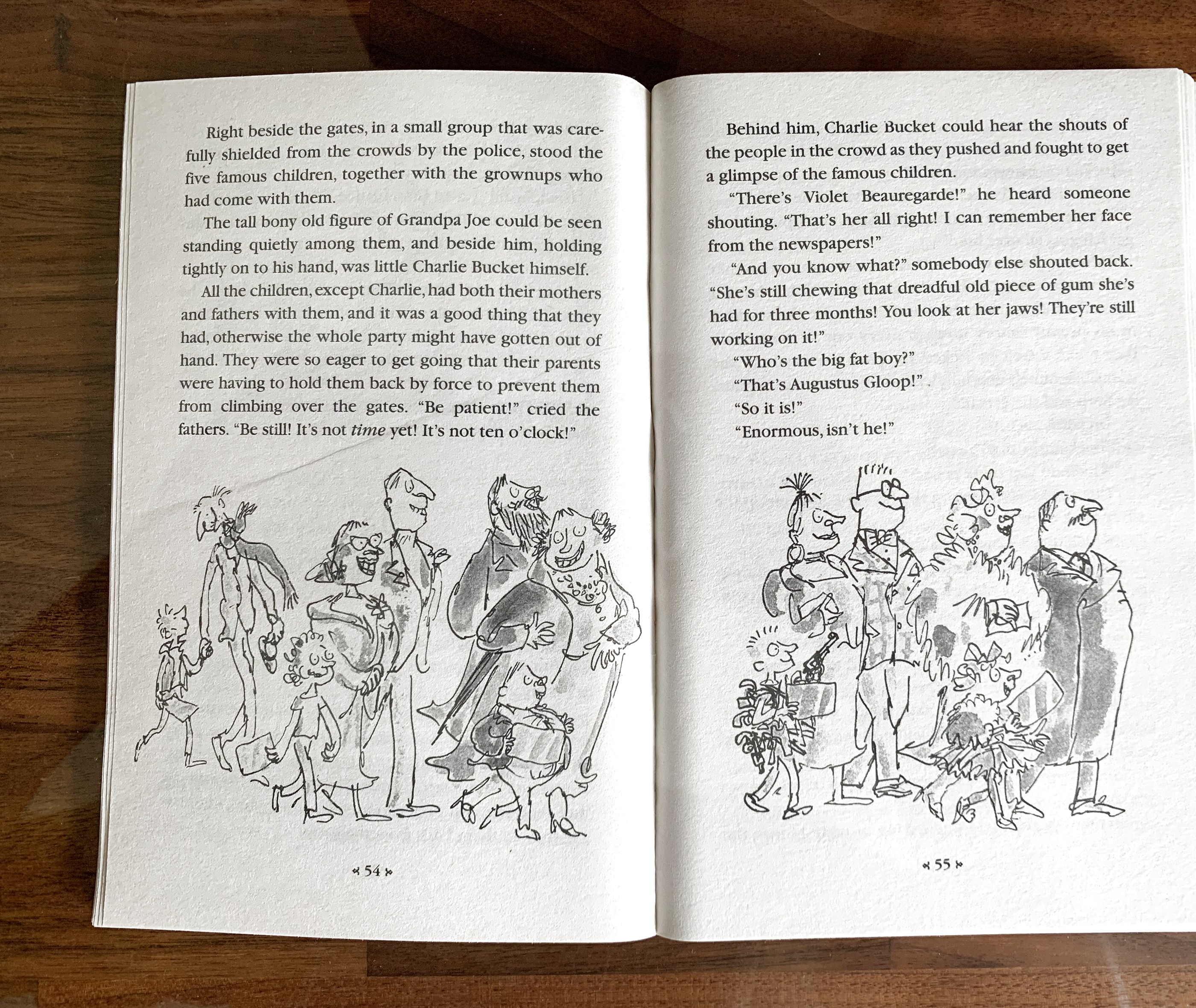
The loose, scratchy illustrations scattered through Dahl's books always nail the weird energy of the story itself. This style feels like it could spin off into its own cartoon and I'd watch every episode. It's the right amount of unhinged.
The re-read question, and the man himself
Does it hold up on a re-read? Mostly. The exits are the payoff and they land twice. The front third drags a little the second time through, because once you know the ticket is coming you feel the wait. And it ends the way Dahl always ends, which is abruptly, like he ran out of pages and just stopped. That's a Dahl feature more than a bug, but it does mean the last stretch has less to chew on than the middle. Dad survival is high, because the songs and the voices keep it fresh and I never once found myself performing it in the voice of a bone-tired old butler just to stay upright.
The message is the classic Dahl deal: the world is unfair, but sometimes the good kid wins anyway, and the terrible kids get exactly what they earned. Kids respond to that on a cellular level. It's not subtle and it doesn't need to be.
So why did I stop at four? Grandpa Joe. This is a whole internet phenomenon at this point, and once you read the book as an adult you cannot unsee it. A man who is bedridden for years suddenly leaps up and dances the second a golden ticket appears. There is a small but committed corner of the internet dedicated to how much people resent this guy, and I am a card-carrying member. He is the one thing keeping a near-perfect childhood memory from being a clean five. Everything else here still works. Even the parts I'd forgotten.