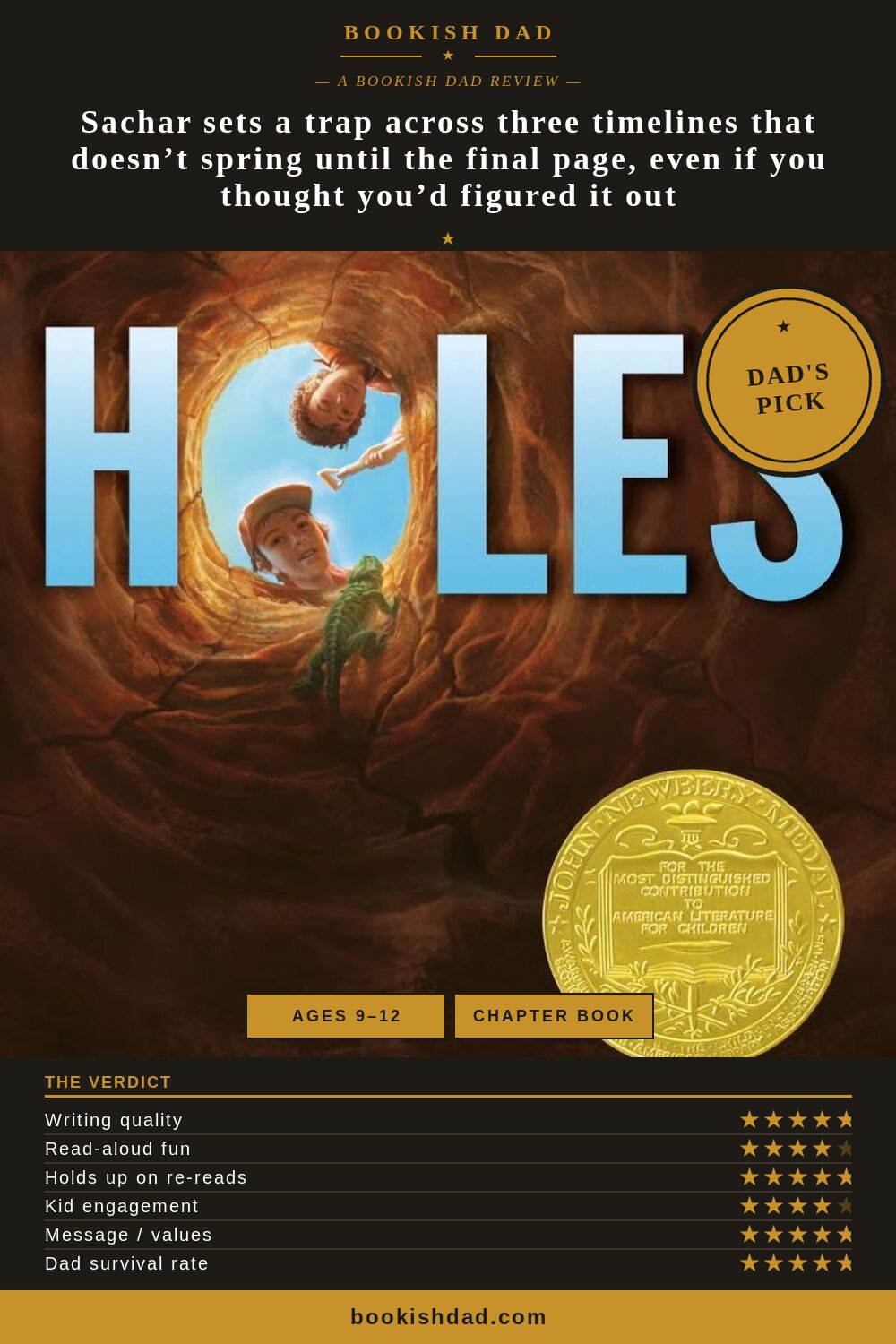

I read most of this book thinking I had it figured out, which is exactly what Louis Sachar wanted me to think, and I want to file a formal complaint about how cleanly he got me. I've read a lot of kids' books at this point (the number is embarrassing and my wife will confirm it). I know the shape of most of them by the end of chapter two. This one hands you three separate stories, lets you assume they're just decoration, and then quietly clicks them together at the end like the last piece of a lock. I actually said "oh, come ON" out loud at bedtime, which woke nobody up but did make me feel like an idiot in the good way.
The premise is almost aggressively simple. Stanley Yelnats gets sent to a place called Camp Green Lake for a crime he didn't commit, and the boys there dig a hole every day, five feet wide and five feet deep, in a Texas desert where there is no lake and there is no green. That's it. That's the engine. And it should get old, because it's literally a book about digging, and yet Sachar keeps the thing moving by feeding you a second story from a hundred years back and a third story from a Latvian village even further back, and you keep reading partly to find out why he's bothering to tell you any of it.
The sentences are shorter than you'd expect and that's the trick
Here's what I didn't clock until I was reading it aloud: Sachar writes flat. Declarative, plain, almost deadpan. He tells you a horrible fact in the same tone he uses to tell you what's for breakfast. There's a running family curse and a "no-good-dirty-rotten-pig-stealing-great-great-grandfather," and it's played for a laugh, but the same voice that jokes about the curse will drop a genuinely brutal thing on you a page later and not slow down. That restraint is the craft. He trusts you to feel the weight without him leaning on it. As a read-aloud it means the humor lands because the setup never oversells the punchline, and the dark parts land harder because he refuses to dress them up.
Which brings me to the thing I have to be honest about. This book goes places. There's real cruelty in it, adults who are supposed to protect kids and don't, and a stretch of the past-timeline that deals with racism and a killing in a way that is not softened for younger ears. It's not gratuitous. It's the opposite of gratuitous, which is somehow why it hits. But it means I'd hold this one for the older end of the range and read the room on your specific kid.
The kid in the doorway
My daughter is eight, which is a hair young for this, so I did it as a read-aloud rather than handing it over. Two nights in, during the desert chapters, she stopped and asked me whether the boys were being punished or whether the whole camp was the crime. That is not a question I had a clean answer for, and I told her so, and she nodded like she'd suspected as much and I'd just confirmed it. She caught the point of the book before Sachar had officially made it, which is roughly her entire personality in one sentence.
My four-year-old is not the audience for this and everyone involved knew it. He drifted through once during a quieter stretch, planted himself on the foot of the bed, listened for about a page and a half, then informed me the book had "no dragons" and left to go be loud somewhere else. Fair assessment, honestly. He's not wrong about the dragon deficit.
On the re-read question: this is where Sachar separates himself from most middle-grade. The first read is a mystery, so you'd think it dies once you know the ending. It doesn't. The second read is a different book, because now you can see the machinery, and watching the pieces get planted on purpose is its own pleasure. My daughter went back to the early chapters on her own a few days after we finished, looking for the setups now that she knew where they paid off. I did not tell her to do that. That's the book working.
The message, if you want to call it one, is doing more than a lesson. It's about names and who gives them to you, about kids getting written off as stupid or bad and being neither, about a friendship that's a straight-up business deal at first and becomes the realest thing in the story. Nobody stops to explain any of this to you. It just accumulates. That's the part I respect most.
Dad survival is genuinely high, which surprised me for a book this heavy. I never once slid into the exhausted, half-dead reading voice I reach for when a book has broken me, because the plot kept pulling me forward the same way it pulled the kids. I wanted to know what was in the hole. So did they. We finished it in fewer nights than planned, and the last night I kept going a chapter past where I meant to stop, which is the highest compliment I can pay a bedtime book.