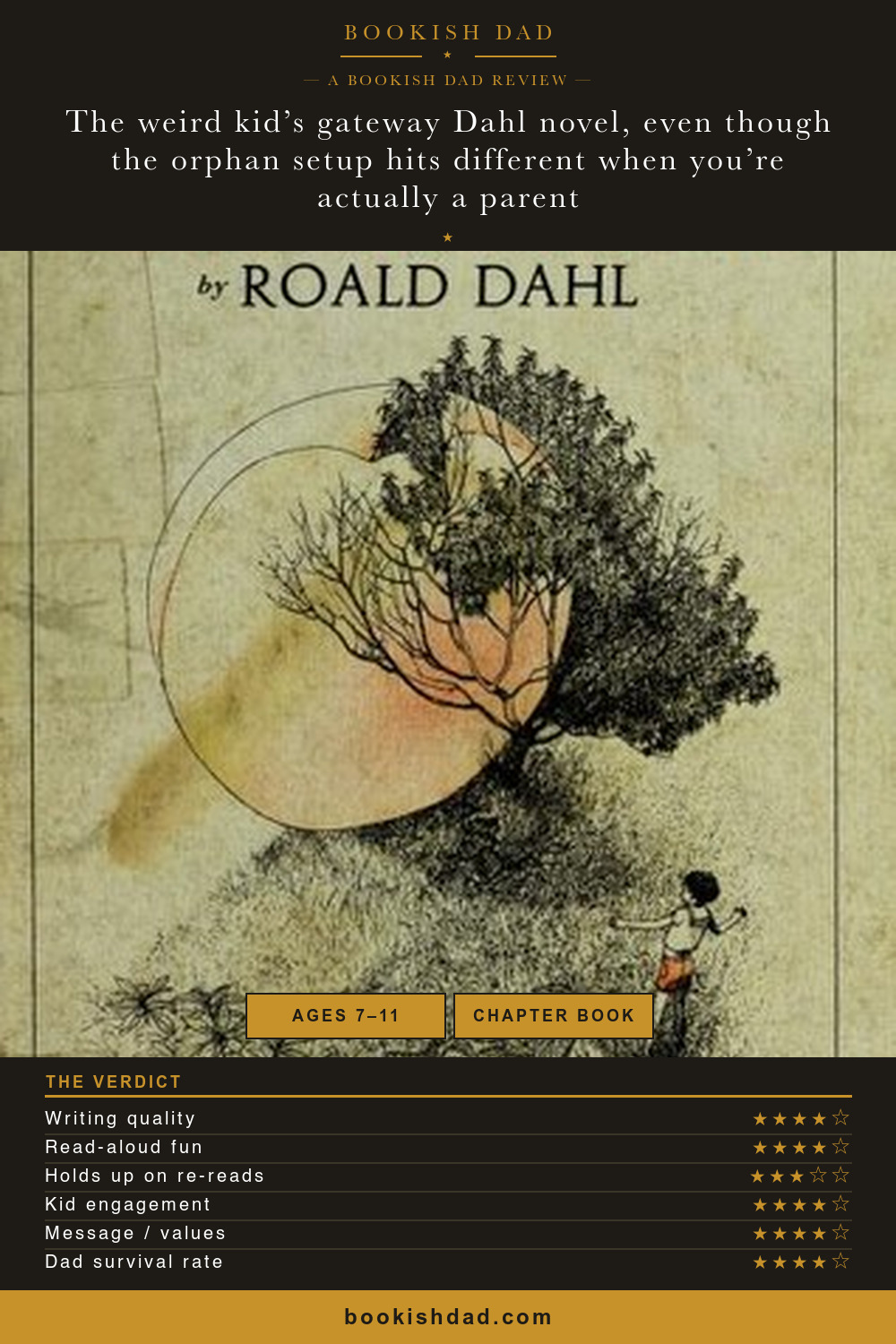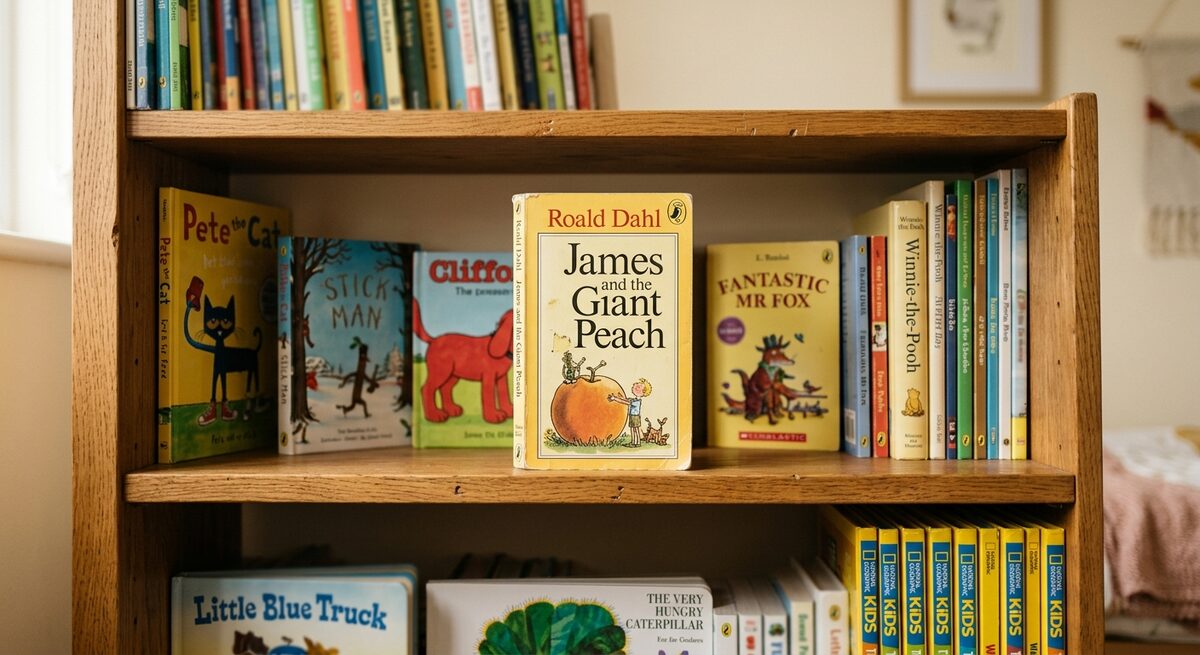

Here is a true thing about being a parent in 2026 and reading a Roald Dahl book out loud to a four-year-old: you will hit the second paragraph and realize, with a small internal lurch, that you forgot how this one opens. The opening of James and the Giant Peach is famously a rhinoceros eating both parents in a single sentence. There is no warmup. There is no easing in. Dahl looks you in the eye and says, "We're doing this." My son blinked. My daughter, who is eight and was reading over my shoulder because she does not trust me to deliver Dahl correctly, said, "Okay." That was the whole reaction. Two children, two completely different processing speeds, one dead set of parents.
I'd been putting this one off. We did The BFG last year, which I still think is the best Dahl, and I read Matilda when I was seven in 1991 and have been mentally comparing every other children's book to it ever since. James was a gap in our rotation. I remembered nothing about it except a peach and some bugs, which, to be fair, is basically the elevator pitch.
There's more craft here than you remember
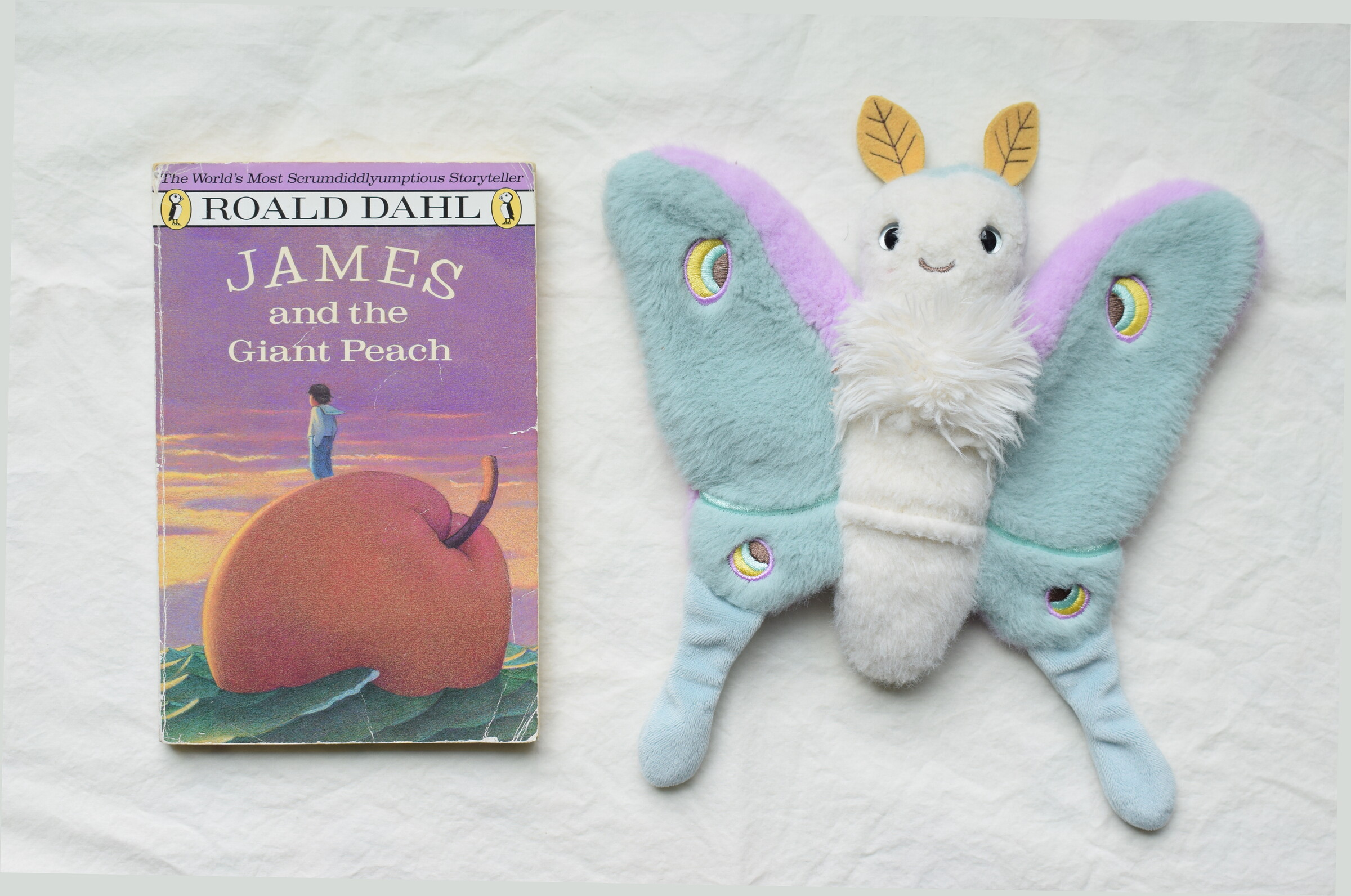
Moth, an insect herself, fully endorses a story where the giant bugs are the heroes. She'd just like it noted that she would never trust the Centipede.
Dahl is a precise writer in a way that gets undersold because his books are loud and weird. Sentences are short when they need to be short. The cruelty is delivered in a deadpan that lets a kid feel the wrongness without being lectured about it. He does not soften the aunts. He does not give them a redemption arc. He calls them what they are and then keeps moving, and I think this is part of why kids trust him: he is not lying to them about adults. The poems and songs sprinkled throughout are genuinely fun on the tongue, which matters because I am the one performing them at 8:15 PM with a four-year-old draped across my ribcage. Some of them I did three times because the rhythm is just satisfying. Quentin Blake's illustrations, which are the version we have, are the right kind of scratchy and unhinged. They look like a kid drew them while having an idea.
For read-aloud, this one rewards a little theatricality. The book is built around a found family of insects with extremely distinct personalities, and once you commit to giving the Centipede a voice (mine ended up somewhere between a Brooklyn cab driver and a very confident toddler), the back half of the book becomes a small nightly performance. My son was, predictably, in this for the bugs. He requested the bug parts. He did not care about New York City. He cared about the Centipede. There was, at one point, an attempt to be a centipede on the rug.
Where it wobbles
I'll be honest about the wobble: the middle stretch of the journey is episodic in a way that worked better when I was a kid than it does at 41 reading it aloud. Things happen, then other things happen, and the structure is more "and then" than "because of that." For my daughter this was fine. She loves a book that just keeps moving. For me, reading it out loud, there were a couple of nights where I could feel the engine coasting. It picks back up. It always picks back up. But this is the part of Dahl that I think people forget when they canonize him: he is not always tightly plotted. He is operating on vibes and momentum and the absolute certainty that a kid will follow him anywhere.
On re-reads, I think this one holds up well but not at BFG levels. The set pieces are strong enough that you can flip to a chapter and just live there. The opening is so brutal and so quick that it doesn't get easier or harder; it just is. My guess is we'll come back to it in a year and my son will request the bug chapters specifically, the way he requests "Ickle Me Pickle Me" from the Silverstein book and refuses every other poem.
Message, values, and the rhinoceros in the room
People sometimes get nervous about Dahl now and I understand why, but I think the values inside James are clearer and kinder than his reputation suggests. A kid who has been treated terribly finds people who treat him well. The people who treated him terribly face consequences that are, let's say, narratively decisive. Friendship is built across difference. A worm and a spider and a grasshopper figuring out how to function as a team is genuinely sweet, and not in a saccharine way. My daughter, who watches everything and says little, said the bugs were nicer than she expected. That is roughly the highest compliment she gives a book.
The Dad Survival Question
I could read this one maybe eight or nine nights in a row before I'd start improvising in a fake British accent for my own entertainment, and honestly that's a strong number. The poems carry a lot of weight here. Dahl's rhythm is forgiving to a tired parent. You can be half-asleep and the sentences still scan.
Four stars feels right. It's not the Dahl I'd hand to a parent first (that's still BFG, possibly Matilda depending on the kid), but it is unmistakably a great book by a great writer doing the thing only he does. My son asks for the bugs. My daughter read ahead. My wife heard the rhinoceros sentence from the hallway and stopped walking. That's a book working.