
My son drew on the wall last Tuesday. Not a small drawing. A committed, full-arm, ankle-to-shoulder mural in the hallway, done in marker that the package had sworn to me, in writing, was washable. I stood there in my socks holding a mug of coffee and the only thing I could think was: this is a Harold problem. Crockett Johnson did this to my house. Crockett Johnson, dead since 1975, reached through time and handed my four-year-old a permission slip I never signed.
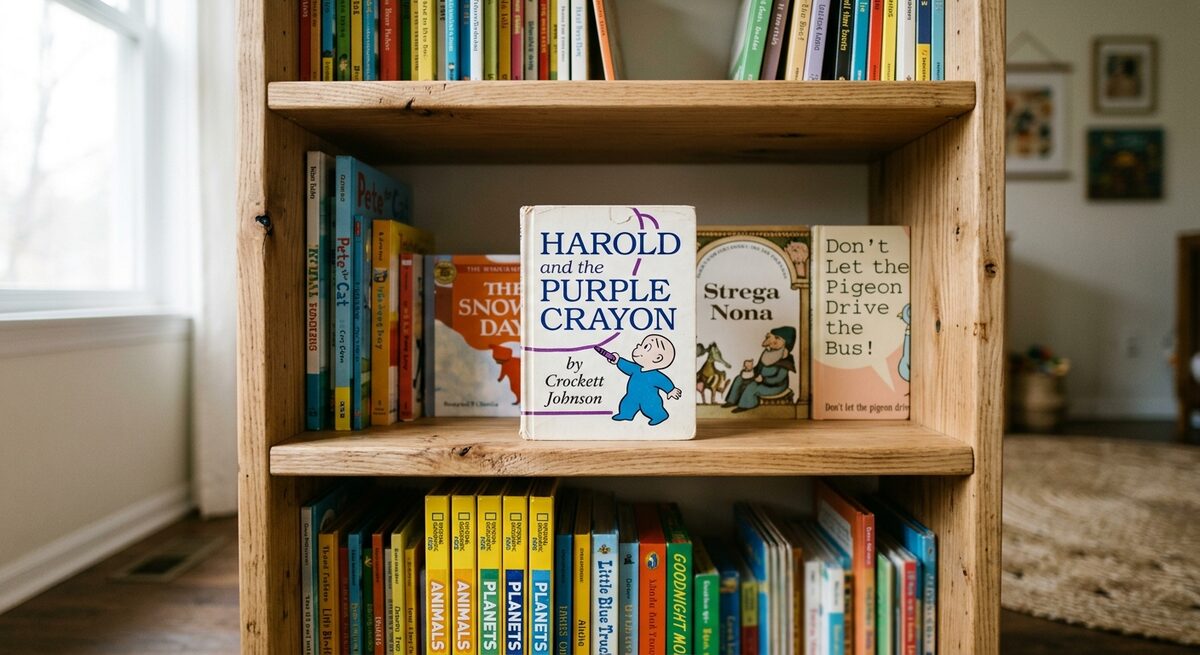
I'm not actually mad. I am, in fact, the guy who keeps putting this book in the rotation. We've had it for years. It survived the great purge of 2024, when I culled about thirty board books that nobody had asked for in over a year, and it survived because every time I think we're done with it, my son pulls it back down and hands it to me like the decision has already been made and I am simply staff.
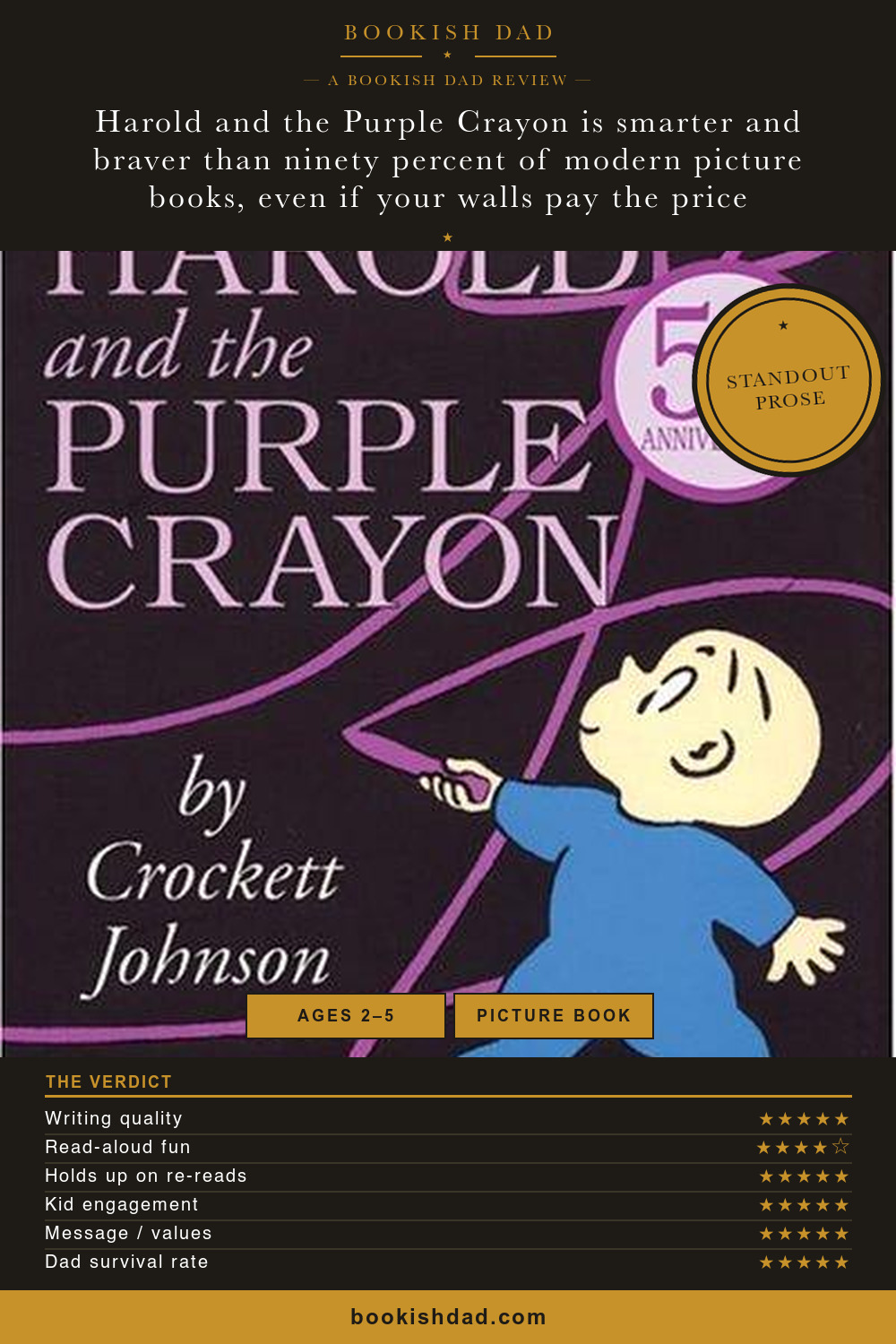
If you somehow missed this book in your own childhood, here's the whole pitch: a small boy in footie pajamas, a purple crayon, and the entire concept of a world he can simply draw into being. There's a walk, a moon, an apple tree with a dragon guarding it, some deep water, a picnic with an unreasonable number of pie flavors, and eventually the universal toddler problem of trying to find your own bed. That's the book. That's everything. It was first published in 1955 and I do not believe a picture book has been more efficient since.
The flat, unbothered voice is the trick
Johnson narrates the whole thing in a flat, matter-of-fact voice, no straining for cute, no winking at the parent over the kid's head. The sentences trust the kid to keep up. He decides he wants a moon. There is no moon. So he draws one. The book treats this as a normal solution to a normal problem, and that's the whole trick. Most picture books would dress that moment up with twelve adjectives. This one just tells you what happened and shows you the picture.
As a read-aloud, it's deceptively performable. I do a calm, low-key narrator voice for the main text, because I learned the hard way that if you go big with Harold, you blow out the contrast on the rare moments that earn it. The book builds its tension in small, almost boring increments and then suddenly you're in trouble with him, and your kid leans forward because the narrator did not warn them. My daughter is eight now and reads on her own, but she used to be the one leaning forward. My son does it now. Same lean. Same little held breath. The book is reaching out and grabbing them in the exact same spot.
The fifteenth read is where it gets weird
Most picture books die somewhere between read three and read seven. The seams show, the jokes flatten, and you start mentally editing the text as you go. Harold doesn't do that. Around read fifteen it stops feeling like a story and starts feeling like a tiny instruction manual for being a person. Harold hits a problem, draws his way out of it, the drawing causes the next problem, and he just keeps going. I genuinely think this is more useful than ninety percent of the books on the market that are openly trying to teach my children Life Lessons.
And it doesn't moralize. There's no page where someone tells Harold he did a good job or learned something. He just figures it out, gets tired, and goes to bed, which is the most accurate depiction of childhood I have ever read. The "message," if you want to call it that, is that you are allowed to make the world bigger by drawing on it. Which, yes, brings us back to my hallway. Fine. I accept the cost.
The audience report
My son does not interrupt this book. That is the single biggest endorsement I can give, because he interrupts everything, including books he loves and books he requested by name. He sits very still for Harold in a way that I find slightly suspicious, like he's planning something. My daughter, when she was younger, used to ask if she could have a purple crayon "like that," and I'd have to explain that all the crayons are like that, theoretically, and then watch her absorb that information with the quiet seriousness she absorbs everything.
The 8:45pm performance review
I can read this book back to back to back and stay engaged, which I cannot say about most things in the 2-to-5 category. It's short enough to not become an endurance event, weird enough to keep my attention, and well-written enough that I notice new things in the rhythm even now. The art is the same simple line work the whole way through, but Johnson is sneaking real composition under that simple line work, and I keep catching new bits of it. Not bad for one crayon.
The only people who shouldn't own this book, honestly, are people who don't yet own a hallway they're willing to lose.