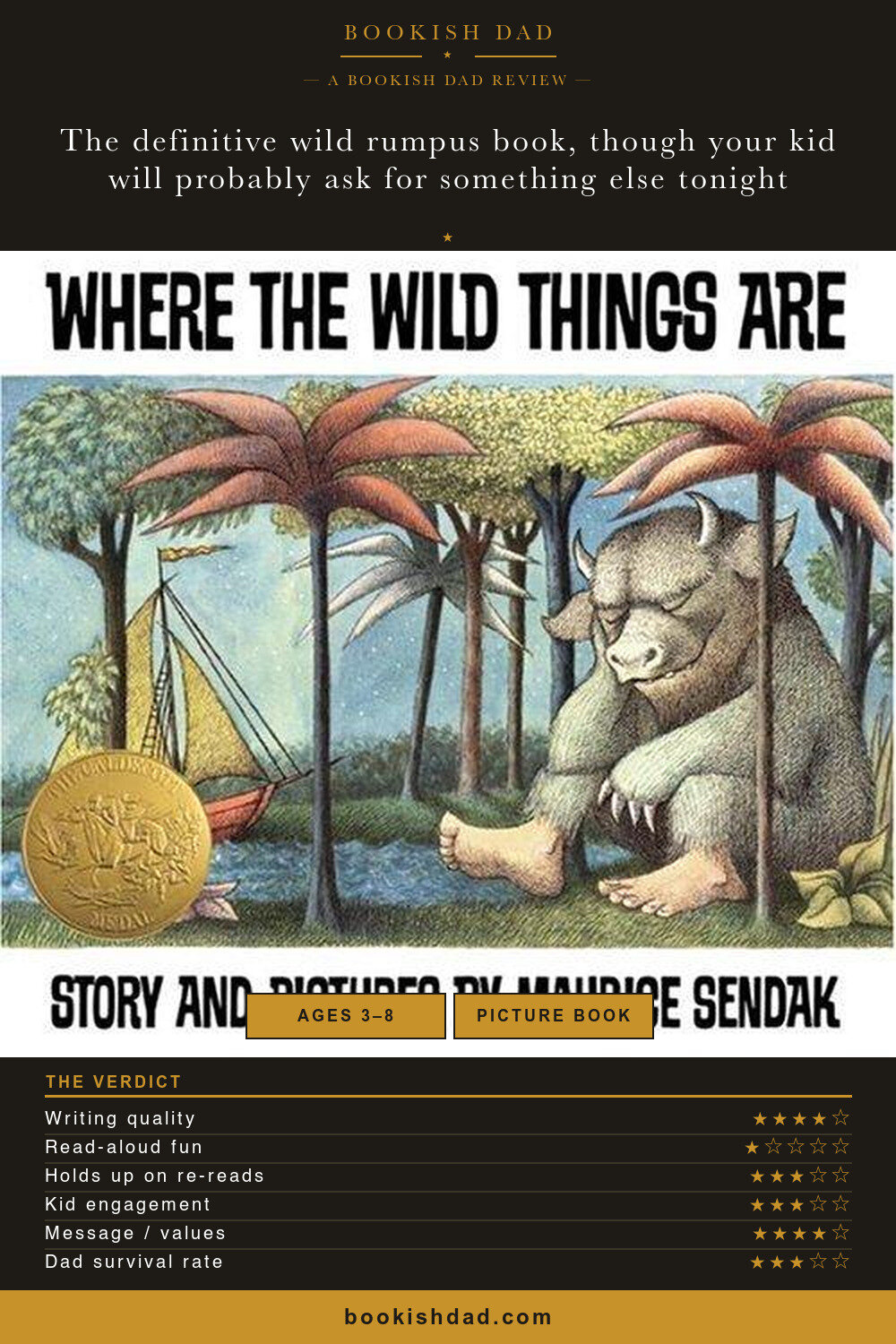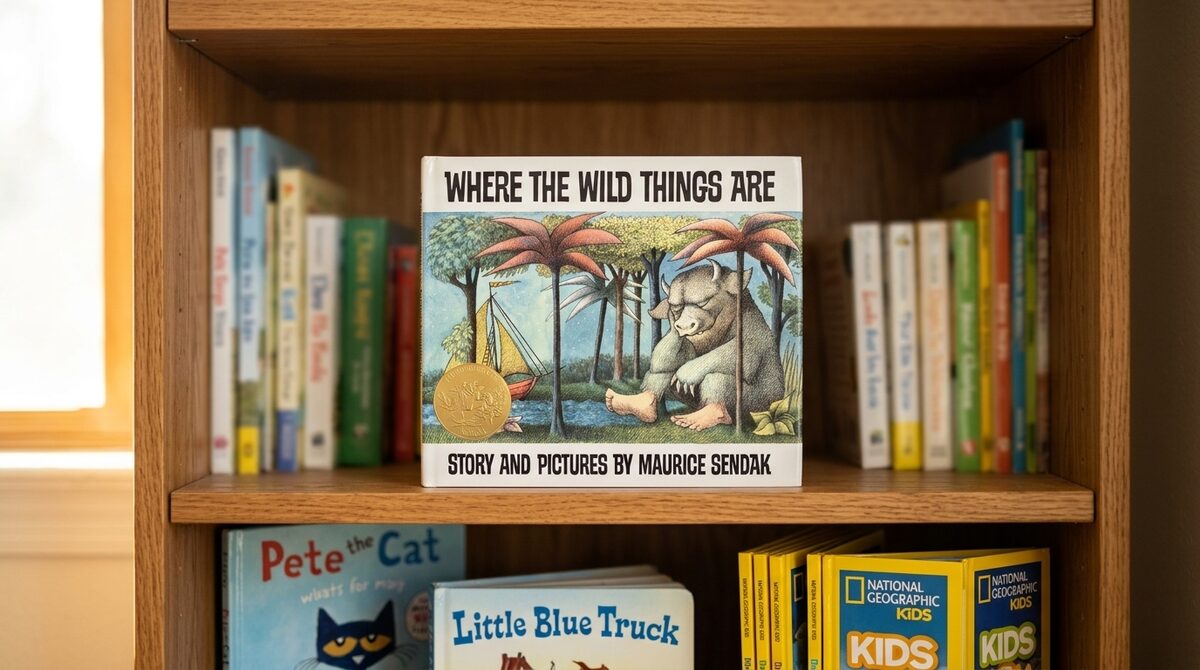

I am supposed to feel awe about Where the Wild Things Are. What I actually feel is a kind of polite, low-grade admiration, like I'm walking past a famous painting in a museum and nodding at it on my way to the gift shop. I know this is the wrong opinion. I have known it was the wrong opinion since approximately 1991. And yet, after reading this book to both of my kids more times than I can count, I am going to put it down here in writing: this book is great, and I personally find it just okay.
So that's the review, basically: great book, and I'm personally just okay on it. Let me at least try to be fair about why.
What Sendak Is Actually Doing
There are only 338 words in this entire book. I counted once during a slow bedtime, and yes, that's a true story. Sendak clearly fought over every one of them, and the pictures handle most of the feeling anyway. You can tell a real artist built every spread. The pacing of the illustrations, the way the imagined world swallows the page entirely during the wild rumpus, that's craft you don't see in most modern picture books, which tend to look like someone's iPad coughed.
And the emotional content is real. Sendak is famously interested in the fury and frustration of small children, and he refuses to pretend that kids are tiny saints. A kid throws a tantrum, gets in trouble, imagines an entire kingdom where he is in charge and the giant beasts have to listen to him, and then gets quietly, lovingly fed at the end. As story shapes go, that's about as clean as it gets. If you described that arc to me as an idea for a picture book I'd say "yes, please, immediately."
Reading It Out Loud
This is where my appreciation hits a wall. The book is built to be looked at, not necessarily performed. The wild rumpus is wordless, which is gorgeous on the page and slightly awkward at bedtime, because you are now humming or making monster noises into the void while your four-year-old waits for you to do something. I do a respectable monster voice. I commit. My son is into it for about a page and then starts trying to roar louder than me, which is technically the correct response.
The lines themselves don't have the buttery rhythm of, say, Sendak's own Chicken Soup with Rice, or anything by Julia Donaldson. There's nothing to lean on. You can't sing it. You can't really chant it. You read it, and the pictures are the whole show, which is fine, but it means the read-aloud experience is more like narrating a slideshow than performing a story.
The Kid Reactions, Honestly Reported
My son does the monster roar every time. Every time. This is, I am told, the universal four-year-old response to this book, and I cannot fault his taste. The big toothy creatures on the page are exactly his energy on a Tuesday afternoon. The gap between his inner life and Max's inner life is roughly zero, which is the whole reason this book has lasted sixty-plus years.
My daughter, when she was four, was more measured. She liked it. She did not request it. Now at eight she finds it slightly babyish, which is its own kind of compliment, because it means she has graduated to thinking of it as a "little kid book," and little kid books are the ones that stick. She did note, the last time I read it to her brother, that the ending is "nice." That's about as effusive as she gets. Coming from her, "nice" is a four-star rating.
Read Number Fifteen
Here is where I think the book quietly suffers compared to its reputation. On re-read, the brevity that makes the book sharp also makes it thin. There aren't a lot of little jokes tucked into corners, no throwaway lines that suddenly reveal themselves on read seven. What you see on read one is mostly what you get on read twenty. The art rewards lingering, which is great if your kid is the lingering type. Mine, the four-year-old, is not. He wants the rumpus, the roar, and out.
I find myself, around read ten, narrating in a slightly clipped voice, trying to get to the wordless rumpus pages so I can mug at my son and skip ahead. That is not the book's fault. That is the curse of any short, illustration-driven book in a household with a kid who has decided this is the one for the next two weeks.
The Message Question
What is the book teaching? That you can be furious, you can stomp off into your imagination, you can be king of the monsters, and your dinner will still be waiting when you come back. That is a deeply reassuring thing to tell a small angry person, and one of the genuine reasons this book has earned its place. Sendak takes kid rage seriously and doesn't try to fix it. The tantrum just runs its course, and dinner is waiting on the other side. A lot of picture books, with their tidy little behavioral lessons, can't manage that.
So: a real message, gently delivered, no preaching. I tip my hat. I just wish the eight minutes of reading on the way to that message hit me a little harder.
Where I Land
Three stars is, I realize, going to upset some people. Where the Wild Things Are is on every list of the greatest picture books ever made, and I'm not arguing against that. I'm saying that in our specific house, on a specific shelf, it sits in the respected-but-not-requested tier. We read it. We don't reach for it. At this point my son's roar is the main attraction and the book is the opening act.
If you don't own it, you should. It belongs on the shelf the way a dictionary belongs on the shelf. You just might not pull it down as often as everyone told you you would.