
My daughter, who you may recall does not cry at Charlotte's Web and informed me it was "raining" while I sobbed through The Giving Tree, sat up halfway through chapter two of The Witches and said, in the flat tone of a small woman delivering a verdict at a town council meeting, "I think I need to know what a witch's fingernails look like before I sleep." That was the moment I knew we were locked in. She wasn't scared exactly, more like on alert. This was the first book she'd ever walked into knowing it might bite, and she went in anyway.
I should say up front: I am extremely biased here. I read The Witches at roughly her age, on a brown couch in the 90s, and the cover alone gave me the kind of low-grade dread that you mistake for a personality trait until you're 35. Coming back to it as a parent, with a Quentin Blake hardcover in my lap and an eight-year-old leaned against my arm, I was braced for the nostalgia tax. Some books I loved as a kid are revealed, on re-read, to be held together by a child's willingness to forgive bad sentences. Not this one. The Witches still hits. The Witches hits maybe harder.
Dahl describes a child murder in the same voice as breakfast
Dahl writes like someone who fundamentally respects that children are bored by hedging. Sentences are short, then long, then short. He tells you something horrifying in the same tone he uses to describe breakfast. He puts the grandmother on the page and immediately makes you feel like you've known her for forty years, and I cannot fully explain how he does it. Nothing in it drags. Nobody stops to over-explain the magic system or pad out a chapter, and you can tell an actual craftsman built the thing, which is rarer than it should be in books for this age.
The other thing, which I forgot from childhood: it's funny. It's so funny. The grandmother is funny. The narrator is funny in that dry, slightly resigned way that British kid-narrators have. Even the witches, who are unambiguously monstrous, are funny in a way that makes them more frightening rather than less. A villain who's also a little ridiculous turns out to be scarier, because you have no idea what she'll do next.
Read-aloud was a gift
This is one of the great read-aloud chapter books, full stop. There is a voice you are required to do for the Grand High Witch. The book essentially mandates it. I will not transcribe my attempt because it does not survive translation to text, but I will say my son, who is four and was supposed to be coloring quietly in the corner because he is technically too young for this book, started leaving the corner. By the third night he was on the bed. By the fifth he was demanding the voice on command, like a tiny king with a court jester. My wife passed the doorway once, made eye contact, and kept walking. That's a win.
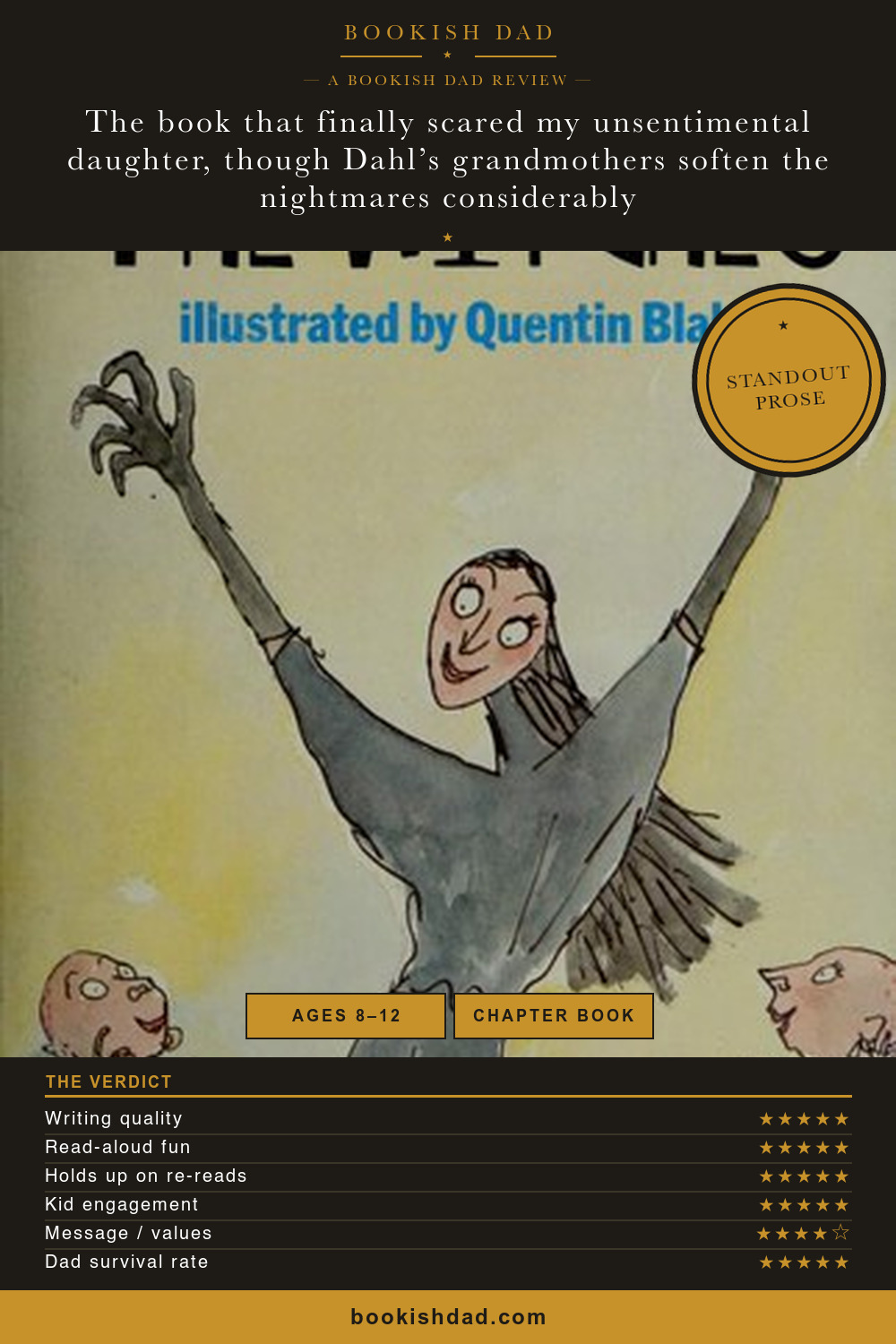
Quentin Blake's illustrations help enormously. They're scratchy and weird and a little ugly in the best way, and they break up the prose at exactly the right intervals so a younger sibling can stay engaged even when the language gets ahead of him. Blake never softens what Dahl is doing. He doesn't draw cute witches. He draws witches who look like they've been awake too long.
Holds up on re-reads and we will find out, because she's already asking
My daughter has requested a re-read. This is the rarest possible signal from her. She is not a re-reader by temperament; she finishes a book, files it mentally, and moves on. The Witches got under her skin in a way I haven't seen since Magic Tree House cracked her open as a chapter book reader last winter. She wants to go back because she wants the feeling again, not because she missed anything. I don't know a better sign that a book landed with her.
I think it'll hold. Dahl front-loads atmosphere and information, but he doesn't lean on shock, and nothing important hangs on a twist. It's grandmother and dread the whole way through, and neither of those wears out.
A note on the scary, because parents will ask
It's scary. I'm not going to soft-pedal that. Common Sense Media flags it, and they're right to. If your kid is the kind of kid who gets actively haunted by what they read, who lies awake reassembling images in the dark, this might not be the book for them at eight. My daughter is built differently. She processes scary things by interrogating them. The Witches gave her a lot to interrogate, and she emerged on the other side fascinated rather than rattled. Your kid is your kid. You know.
Message and values, such as they are
People have argued for decades about what The Witches is "really saying," and I'll spare you the full discourse. The book has been challenged. It has been called misogynistic. It has been called, by other people, a sneakily feminist text. I don't think Dahl was sitting at his writing shed worrying about either reading. The book's actual heart, the thing that makes it land, is the relationship between the boy and his grandmother. They genuinely love each other. They are partners. She talks to him like an actual person, and he listens to her like one right back. In a genre that often treats grandparents as plot scenery, that's huge. The book ends on something tender and a little sad about how long they each have left together, and I will tell you honestly that my voice did a thing on that page.
Would I read it a tenth time? Yes. Out loud.
High. Genuinely high. I did not dread a single chapter, and there were nights I read longer than I'd planned because I wanted to know what happened next, even though I already knew what happened next. That is the gold standard. The book is short enough that you never feel trapped, and weird enough that even the dialogue tags are having fun. I would happily read this one ten times before I'd read certain bedtime offenders a second time, and you know the ones I mean.
This is the book I'd hand to a parent whose kid has just finished their first round of Magic Tree House and is ready for something with more meat on the bone. It's also the book I'd hand to a kid who has been told, repeatedly, that books are for nice things and gentle lessons, and who has begun to suspect, correctly, that they are being condescended to. Dahl is the antidote. The Witches is Dahl uncut.