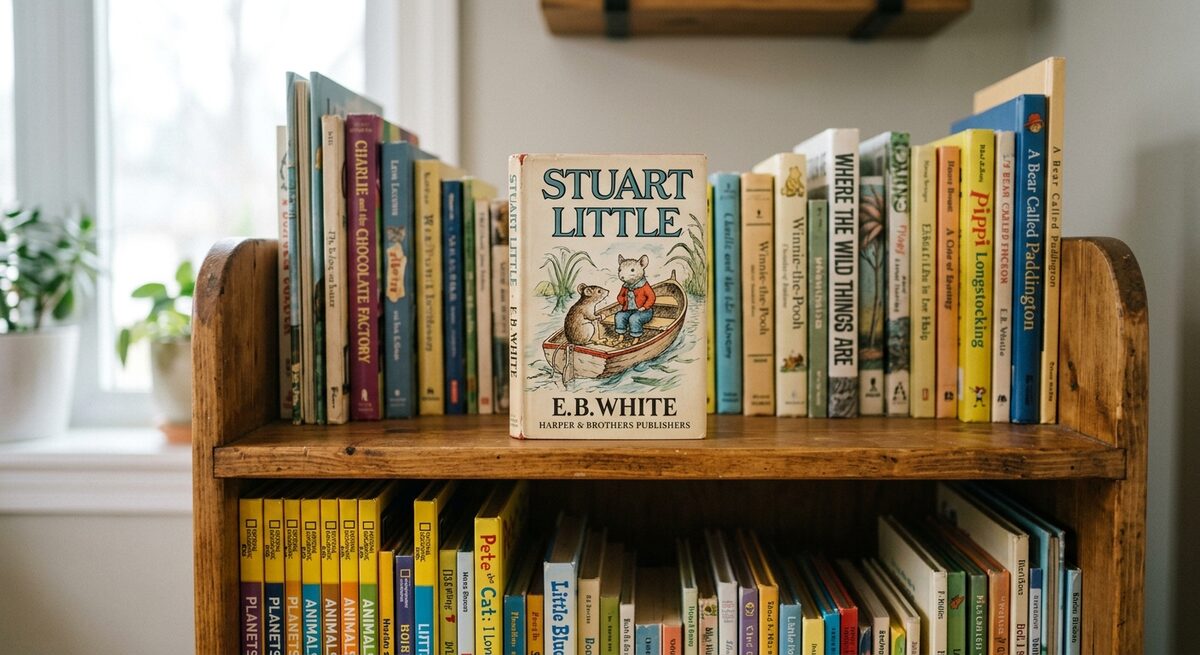

So, about E.B. White. I have spent my entire adult life telling people that Charlotte's Web is the best children's book ever written, full stop, do not argue with me, and I will cry on command to prove it. I have spent approximately none of my adult life thinking about Stuart Little. I'd read it as a kid. I remembered roughly three things: there's a mouse, he drives a car, my mom owned the paperback with the green spine. That was it. Reading it to my 8-year-old this spring was less of a re-read and more of a first read with vague déjà vu.
And reader, I have feelings.
The prose is the prose, obviously
E.B. White writes a sentence like a guy who knows exactly how many words a sentence needs and refuses to add one more. There's a dryness to it, a grown-up matter-of-factness that treats a two-inch mouse-son as a perfectly reasonable household development. The book opens with the premise and just keeps walking, which I find genuinely funny. No hand-wringing. No fantasy logic. A family has a small son who looks like a mouse, and we move on with our lives. That confidence is the whole magic trick. My daughter clocked it immediately and gave me one of her little half-smiles that means "this writer is not condescending to me," which is the highest compliment she gives.
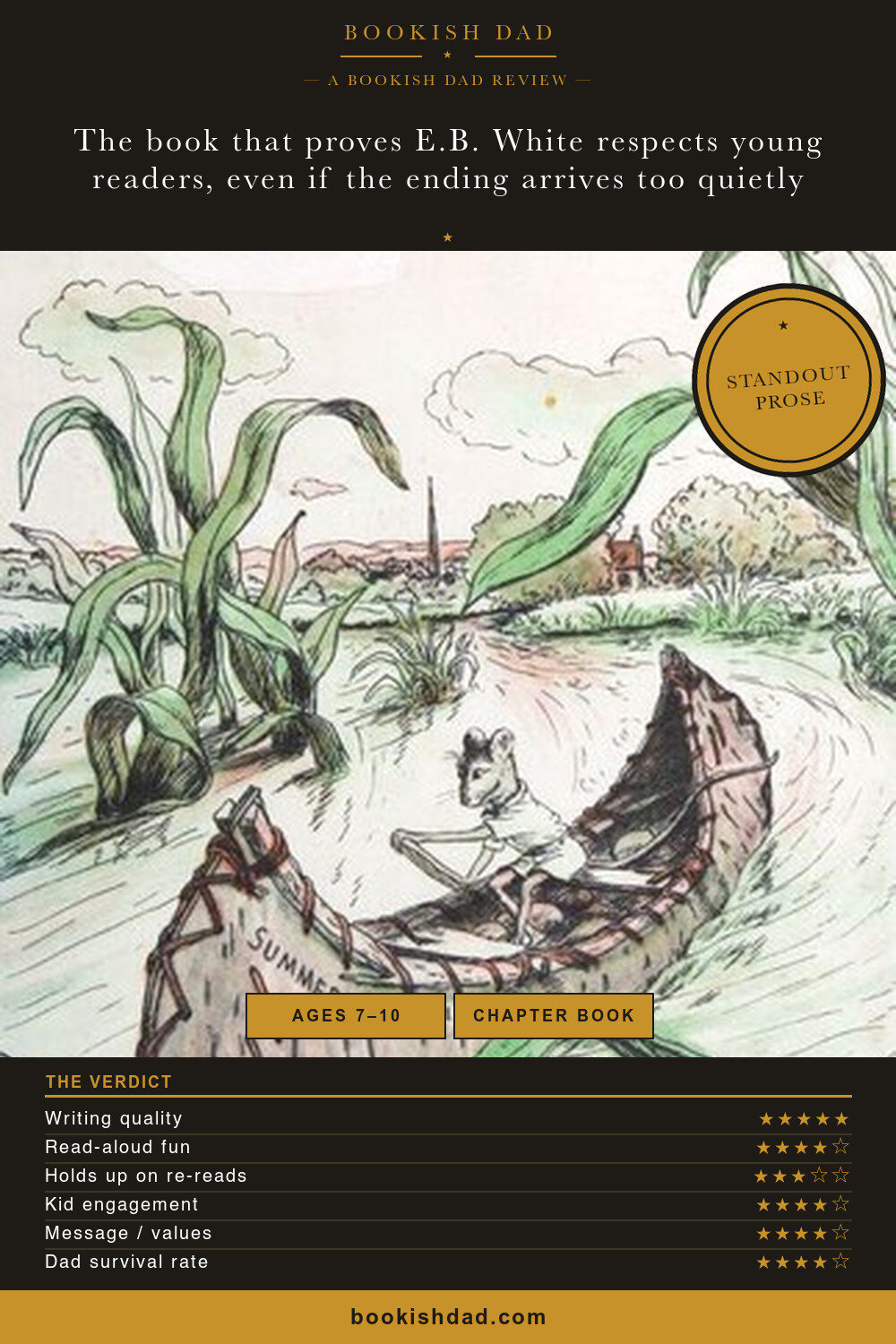
The vocabulary, as advertised, is a little vintage. We hit words I had to stop and define, but that's a feature, not a bug. She's 8, she's a sponge, and a chapter book that makes her ask "what does that mean" twice a night is doing the Lord's work. Garth Williams' illustrations are the same warm, precise pencil work he brought to Charlotte's Web, which makes my heart do a small dependable thing every time we hit a new one.
Read-aloud-wise, it's a strange animal
This book reads aloud well in pieces and weirdly in aggregate. The sentences are clean and the chapters are short, which means I can knock out two in a sitting without my voice giving up. Stuart himself is fun to do. I went with a small, slightly formal voice, like a tiny man who reads the newspaper, and my daughter approved. Snowbell the cat I gave a smarmy mid-century radio-villain thing that made my four-year-old briefly hate the cat, which I count as a win for our actual cat, who has been getting books thrown at him.
What's strange is the shape of the whole. The chapters don't really build to anything the way I'd been promising they would. I won't go into the specifics of how it ends, because what I'll say in the verdict box covers it, but I will say: I had to do some real-time editorializing to my daughter about what kind of book this is. Some chapter books are a journey with a destination. This one is more of a walk with your interesting uncle. If you go in expecting the second thing, you're golden.
Re-reads and the kid
My daughter loved Stuart as a character. The competence is what got her. She likes characters who are quietly capable, who solve problems with their brains in a calm way, which tracks because she is herself a quietly capable person who solves problems in a calm way and finds her four-year-old brother's approach to life baffling. She'd ask me to read "one more chapter" most nights, and twice she read ahead on her own and then pretended she hadn't, which is the sincerest form of book love a kid can show.
Will we re-read it? Probably in chunks. It's a book that rewards dipping rather than marathoning. Some chapters are little gems that I'd absolutely revisit as standalones, and a couple I'd happily skip on a second pass. The episodic structure means re-read value lives in the best episodes, not the throughline. That's an honest tradeoff.
What is this book even teaching
The values question is interesting. There's a lot of low-key competence porn in here. Stuart handles things. He's small, he's resourceful, he stays polite. The book treats courage as a small daily habit instead of a fireworks display. I like that. I want my kids to learn that the small careful person who keeps trying is often the one who actually solves things. My son, the human cannonball, could particularly benefit from a few decades of this message, although at four he's mostly here for the cat being a jerk.
There's also a quietly weird strain of melancholy running through the whole book that I don't think I appreciated as a kid. White does not write fairy-tale endings. He writes endings the way an essayist writes endings, which is to say with restraint and a little ache. My daughter, being who she is, did not blink at this. She said "huh" and went to brush her teeth. I, being who I am, sat on the edge of her bed for a minute thinking about my own life choices.
Reading it aloud without regrets
Pretty high, honestly. The sentences are short enough and odd enough that I never went into autopilot. White doesn't write filler, so there's no fat to slog through. My only complaint is that Stuart Little is not Charlotte's Web, and I kept catching myself comparing them, which is unfair to a first novel from a guy who would later write the single greatest closing chapter in children's literature. Judged on its own, this is a strange, charming, slightly wistful little book that I'm glad we read and that I will absolutely not push on other parents the way I push the other one.
Four stars. One star withheld for the ending, which I am still chewing on three weeks later, and which I refuse to call a flaw because I think White did it on purpose, but which also means I will never love this book the way I love its bigger, sadder, more famous sibling.