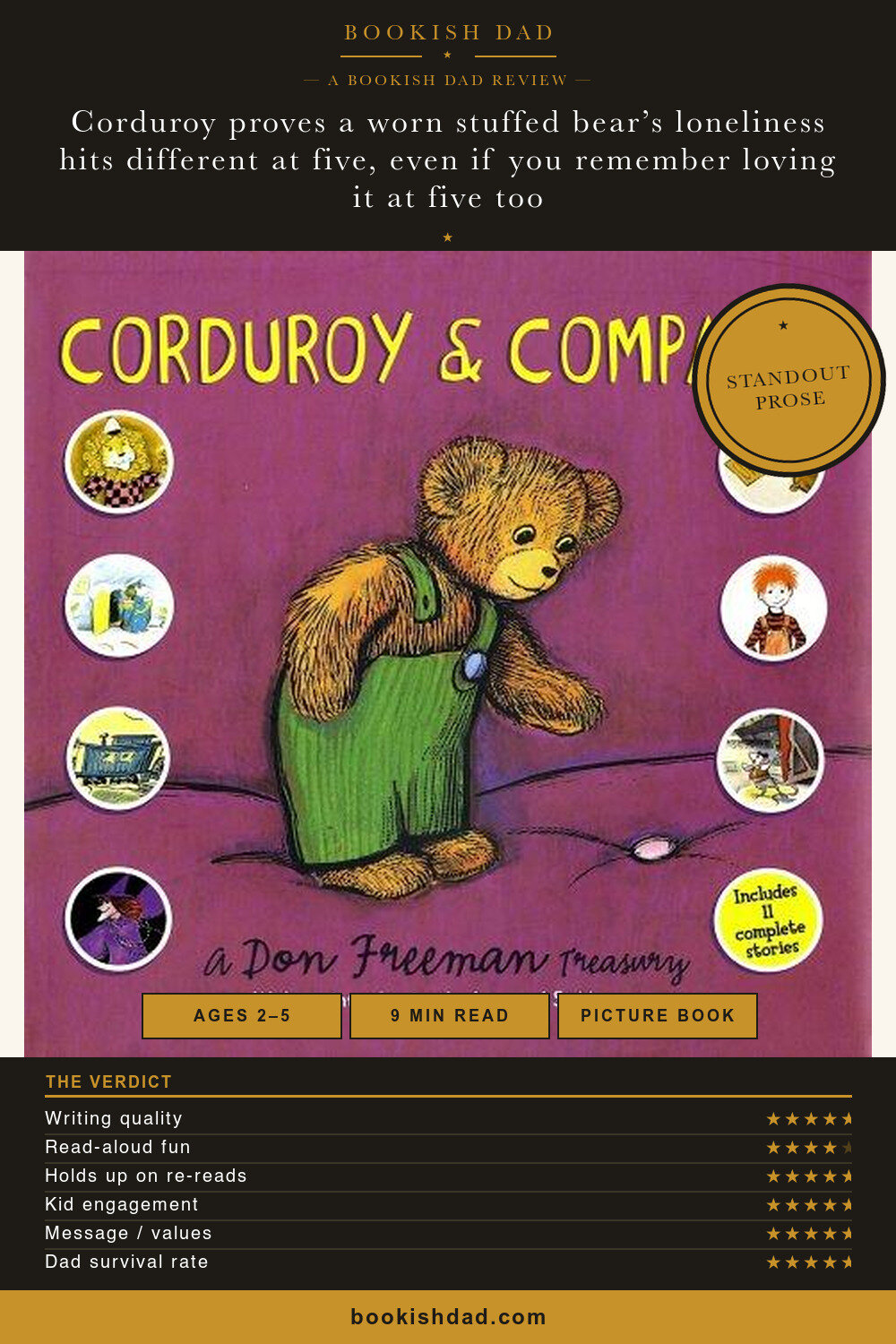

I had not thought about Corduroy in roughly thirty years until my son pulled it off a library shelf last fall, held it up like he had discovered a relic, and said "this one." He didn't know what it was. He just liked the bear's face. We checked it out, read it that night, and within four days I had bought our own copy because the library was going to start charging me rent.
This is one of those books I had filed away as "fine, sort of dated, charming I guess," and reading it as an adult to my actual children has been a small, quiet correction. Corduroy is a flat-out great picture book. The kind of great that doesn't announce itself. It just sits there working perfectly on every level while flashier books are doing cartwheels for attention.
Plain sentences, perfect timing
Don Freeman writes like someone who has read a lot of picture books out loud and noticed where they fall apart. The sentences are short but not choppy. There's a real cadence to it. Nothing is over-explained. When a feeling needs to land, he trusts the picture to carry half the weight and the words to carry the other half, and the math works out every time. There's a restraint here that I think modern picture books could learn from. Nobody is winking at the parents. Nobody is cracking jokes over the kid's head. The book is just telling its story, honestly, to a small person.
The art is the other half of it, obviously, since Freeman did both. Those loose, slightly smudgy illustrations have a warmth that AI-perfect modern picture book art can't touch. Corduroy's face in particular does enormous work. My son will stop me on a page just to look at the bear's expression, then nod and let me turn the page. That is a four-year-old conducting a private emotional check-in with a drawing.
Read-aloud and the voice problem
I do voices. You know I do voices. Corduroy is interesting because it doesn't really demand a voice (there's not a ton of dialogue and the narration carries most of it), but the rhythm of the prose rewards reading slowly and letting the pauses happen. I have settled on a kind of gentle, slightly stunned narrator who sounds like he's also seeing a department store for the first time, and my son finds this deeply correct. My daughter (8) walked through the room during a read the other night, paused, said "you're doing a weird voice," and kept walking. From her that is a four-star review.
It holds up on re-reads in a way that genuinely surprised me. We are probably twenty-five reads deep at this point and I still notice things. The pacing of the book is so cleanly constructed that I keep finding little craft choices I had glossed over. Compare this to the books that die at read three because there's nothing under the surface; Corduroy keeps giving. Part of it is that the emotional core of the book is so simple and so true that you can't really wear it out. The feeling at the end is the feeling at the end. It works every time.
What my actual kids do
My son leans in. He has a specific lean for books he loves, where he sort of folds forward into the page and goes very quiet, and Corduroy gets the lean. He gets quiet at the sad parts and visibly relieved at the happy parts. My daughter is technically too old for this book and will still sit on the arm of the chair and listen if she happens to walk by during it. She told me once, in her dry way, that she thinks the mom in the story is "kind of right, actually," which I have been thinking about for two months.
About the message, since you'll ask
The values stuff here is not subtle but it's also not preachy, which is a hard line to walk. There's a quiet thing about looking at something that has been overlooked and deciding it's worth your attention anyway. There's a quiet thing about earning what you want. There's a quiet thing about friendship being a two-way street (the bear has been waiting too). None of this is hammered. None of it is in a moral-of-the-story box at the end. It just lives inside the book, the way values live inside the actually good books and float on top of the bad ones.
Dad Survival Rate is high. I can do this book five times in a row without my eye twitching, which puts it in rare company. I think it's because the prose has actual rhythm; my mouth enjoys saying the sentences. Bad picture books punish the reader's mouth. Corduroy is kind to it.
Yes, some of this is nostalgia talking. I'll flag that. But I tested it: I read it to my son before I had reread it as an adult, so my first impression was filtered through his face, not my memory. His face said five stars. Mine just agreed.