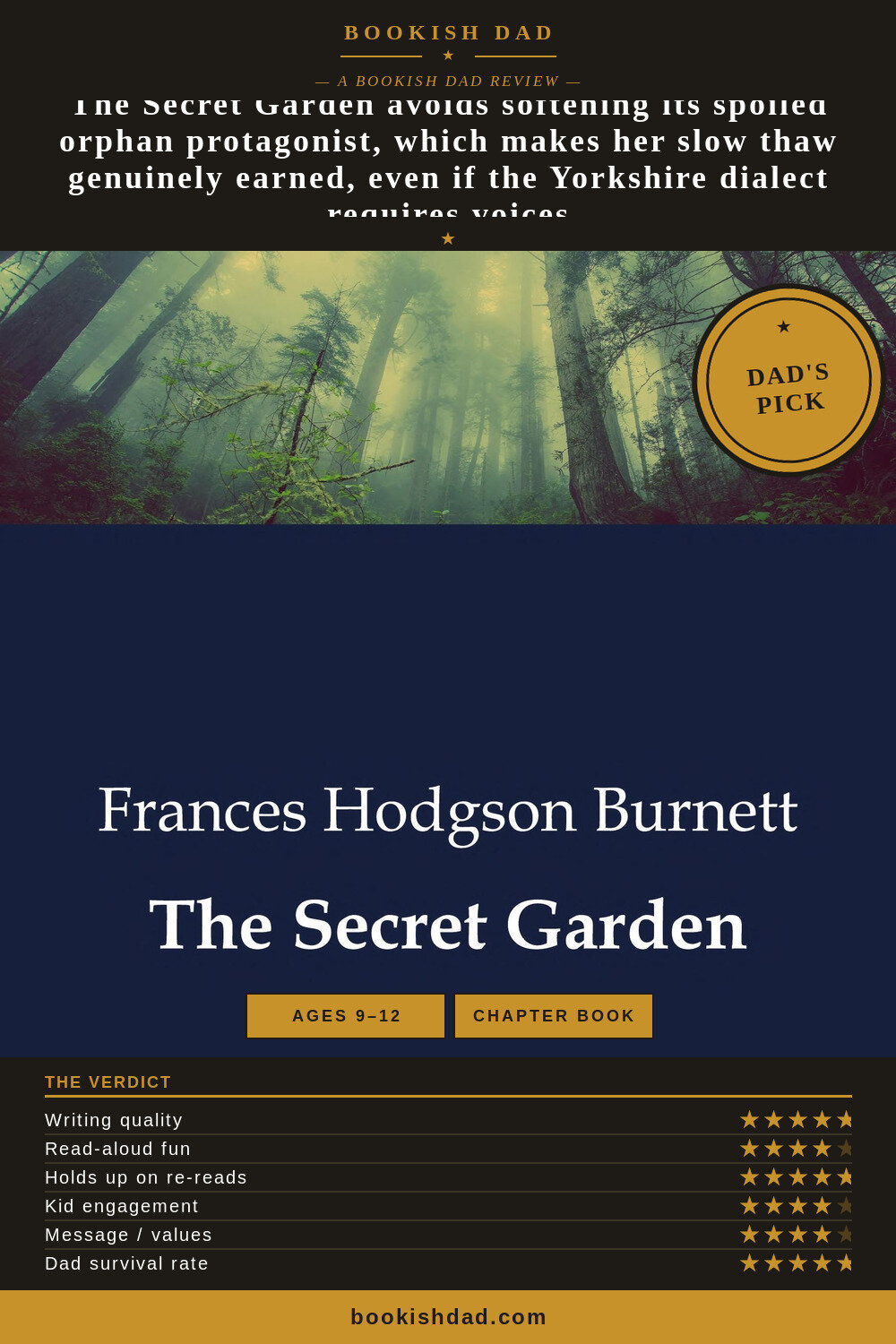

I went in braced for disappointment. You know the kind: everyone swears it's a classic, and then it reads like homework with a nice cover. Instead I got two weeks of my daughter going to bed without complaint because she wanted the next chapter, and a four-year-old who has no business being in this book's age range still hanging around the doorway because something in the rhythm of it caught him. I did not plan for any of that.
Here is the setup, and it is not a gentle one. Mary Lennox is a ten-year-old orphan, sour and spoiled and unloved, shipped from India after a cholera epidemic kills the parents who never paid her any attention to begin with. She lands at her uncle's enormous, gloomy house on the Yorkshire moors, a place full of locked doors and rules and a hundred rooms nobody uses. There is a walled garden that's been sealed shut for ten years. There are cries in the night that the grown-ups won't explain. And Mary, who has never wanted anything in her life because everything was always handed to her, starts wanting to know what's behind those walls.
What surprised me most is how unsentimental Burnett is at the start. She does not soften Mary to make her likeable. Mary is genuinely unpleasant, and the book sits with that, lets her be contrary and rude and hard to love, and trusts the reader to keep going anyway. That's a bold move for a children's book, and it's the engine of the whole thing. You watch a difficult child become a person, slowly, through dirt and fresh air and a robin and a couple of other kids who don't put up with her nonsense. The transformation never feels cheap because the starting point was so honestly drawn.
The writing snuck up on me
The writing is the part I underestimated. Burnett describes the moor and the waking-up of the garden in spring with the kind of detail that doesn't show off, it just piles up on you. By the time green things are pushing up out of the cold ground you feel it in your chest, partly because she's been so patient about the cold and the gray that came before. She's really good at pacing, is what I'm saying. She knows when to be plain and when to let a sentence open up. The Yorkshire dialect spoken by some of the characters reads strange on the page at first, then becomes one of the best things in the book once you commit to it.
Which brings me to reading it aloud, because that dialect is a gift to a dad who does voices. I gave the warm, broad Yorkshire characters a whole burr that I cannot reproduce in print, and my daughter, who guards her reactions like state secrets, actually snorted on a couple of the funnier lines and then quit picking at the corner of her pillowcase during the quieter ones. That is as close to applause as she gets mid-chapter, and it means I've got her. The book performs well because Burnett keeps changing gears on you. One chapter is cranky comedy, the next one's spooky, and a read-aloud voice always has somewhere new to go.
The slow burn and the long haul
On re-reads I think this holds up better than most because nothing in it depends on surprise. It's atmosphere and character all the way down, and both of those are still there the second time. My daughter has already gone back to her favorite stretches on her own in the early morning. The middle does sag if you're four; my son drifted in and out and was mostly here for the sound and the occasional creepy nighttime bit. Honestly fair. This is a nine-to-twelve book and he is four. I'm not going to pretend he tracked the symbolism.
And there is symbolism, the kind my daughter usually clocks before I do. The garden coming back to life as the children come back to life is not subtle, but it doesn't need to be; it works on a near-physical level. As for what it's teaching, the whole book is basically making the case that going outside and getting interested in something will fix you. As prescriptions go, I've heard worse. That's a good thing to put in a kid.
One honest flag: this is a 1911 book set against the British Empire, and a few characters carry the casual prejudice of that era. We paused on it. The book itself frames cruelty as wrong, which gives you a door into the conversation rather than slamming you against a wall, but you should read it with your kid, not hand it off and leave the room.
As for the Dad Survival Rate, this one barely tested me, and that's the highest compliment I give a long read-aloud. I never once caught myself reading on autopilot to get to the end of the chapter, which after a few hundred bedtimes of lesser books feels like a small miracle.
A hundred and some years on, it still lands. That's not nostalgia talking. I didn't read this as a kid, so I came to it fresh, no childhood haze protecting it, and it got me anyway.