
In the bookish dad household, we definitely encourage our kids to get involved with sports, and for a lot of the natural reasons you'd expect. Number one is just going out and doing something physical and getting energy out, which honestly isn't a point you have to hammer home with kids, whose natural state seems to be constant movement (or as my wife and I sometimes say, bodies in motion stay in motion). Then there's the team aspect: working with other kids, being a good teammate, showing good sportsmanship, and knowing what it means to be part of something bigger than just yourself.
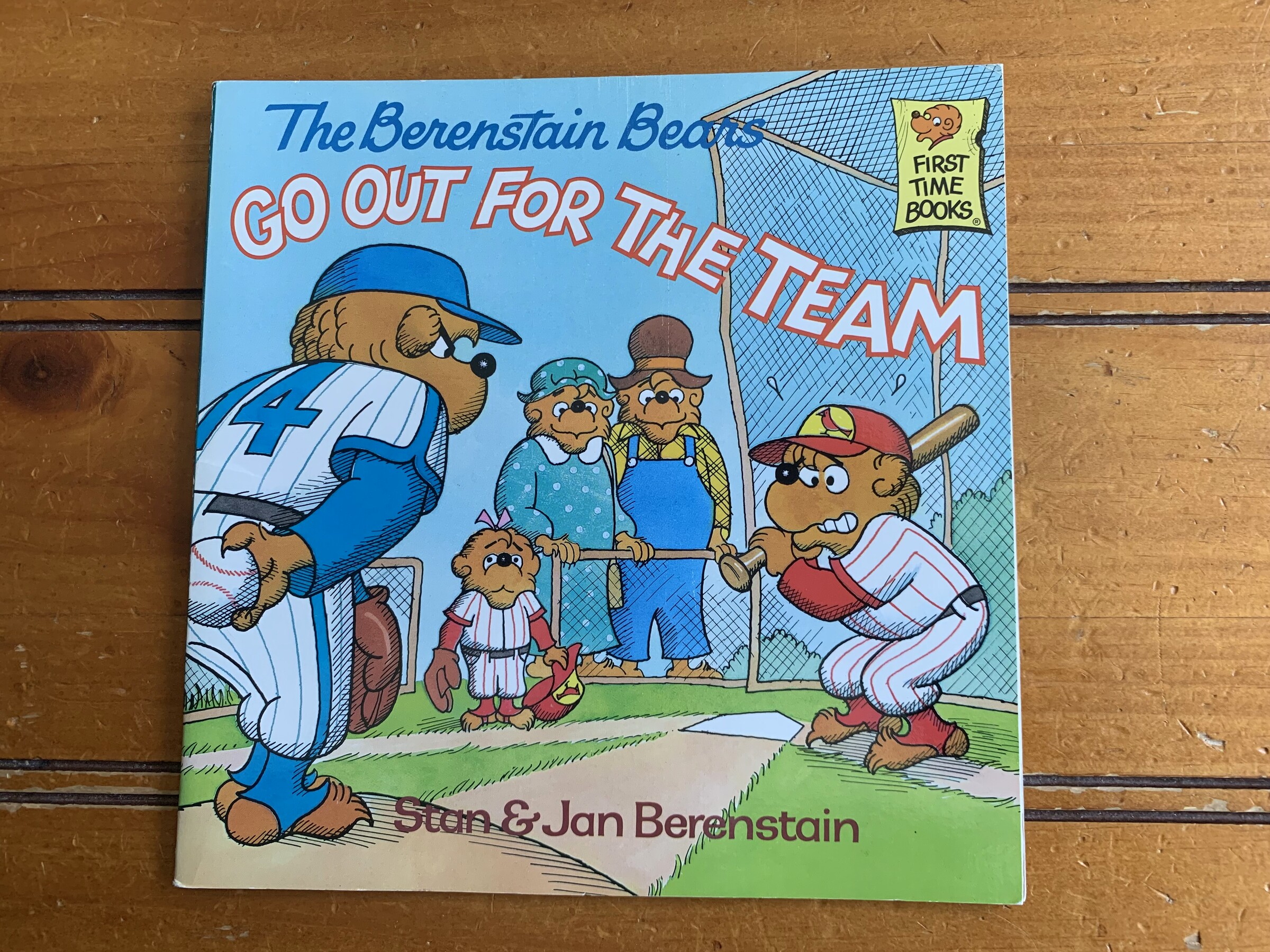
The third reason is the competitive aspect, and I think this one is potentially the trickiest to deal with when it comes to kids. Any kid you've ever played a card or board game with hates losing, and you have this internal pull (well, at least some of us do) to just let them win and avoid the complete and total meltdown, which would sometimes be the case for our youngest. But that's not preparing them for what life is going to be like. They're going to go out into a world full of people who want to beat them, and they need experience with what healthy competition looks like. Sports is a really great place to do that. It still provides the pressure to want to do well and to win, but in an environment where failure is okay. Losing a game isn't the end of the world; the worst that really happens is you miss out on a plastic trophy. And that pressure piece is exactly what the next entry in my Berenstain Bears marathon, Go Out for the Team, is trying to touch on.
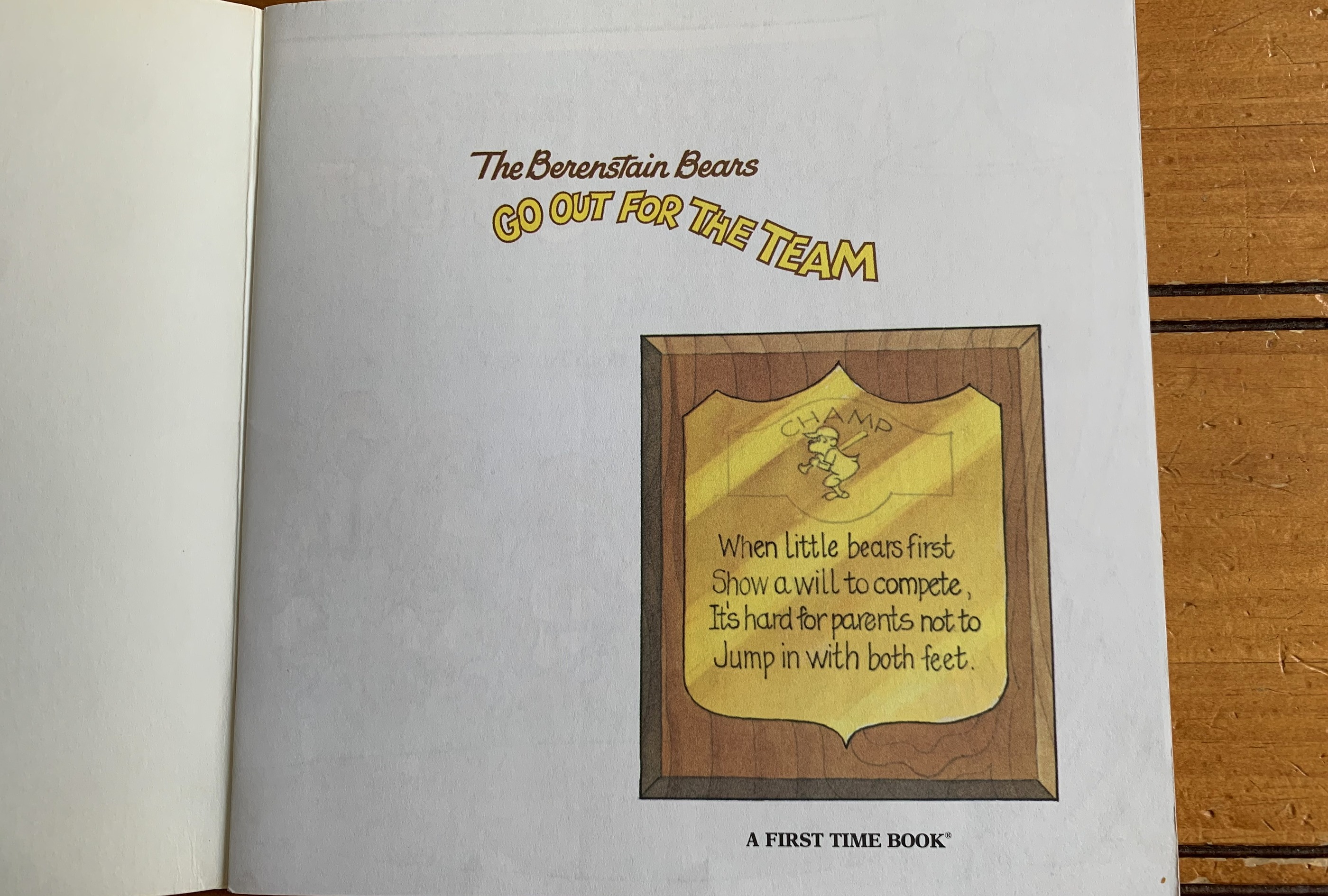
The Opening Rhyme
Yet another misleading poem. The central issue in the book definitely isn't Mama and Papa getting too invested in the cubs going out for the team. Although as a youth baseball coach, I would suggest that a book that covers this topic could be highly useful to some parents.
The setup: Brother and Sister are playing baseball with their friends in Farmer Ben's back meadow until Farmer Ben's goat chews the cover off the ball and ends the game. Papa sees in the paper that the Bear Country Cub League is holding tryouts, Mama warns the cubs that a high-powered league involves quite a lot of pressure, they sign up anyway, practice, survive the tryouts, and both make the Cardinals. Then we get a first game with a surprise twist from Mama, which we'll get to.
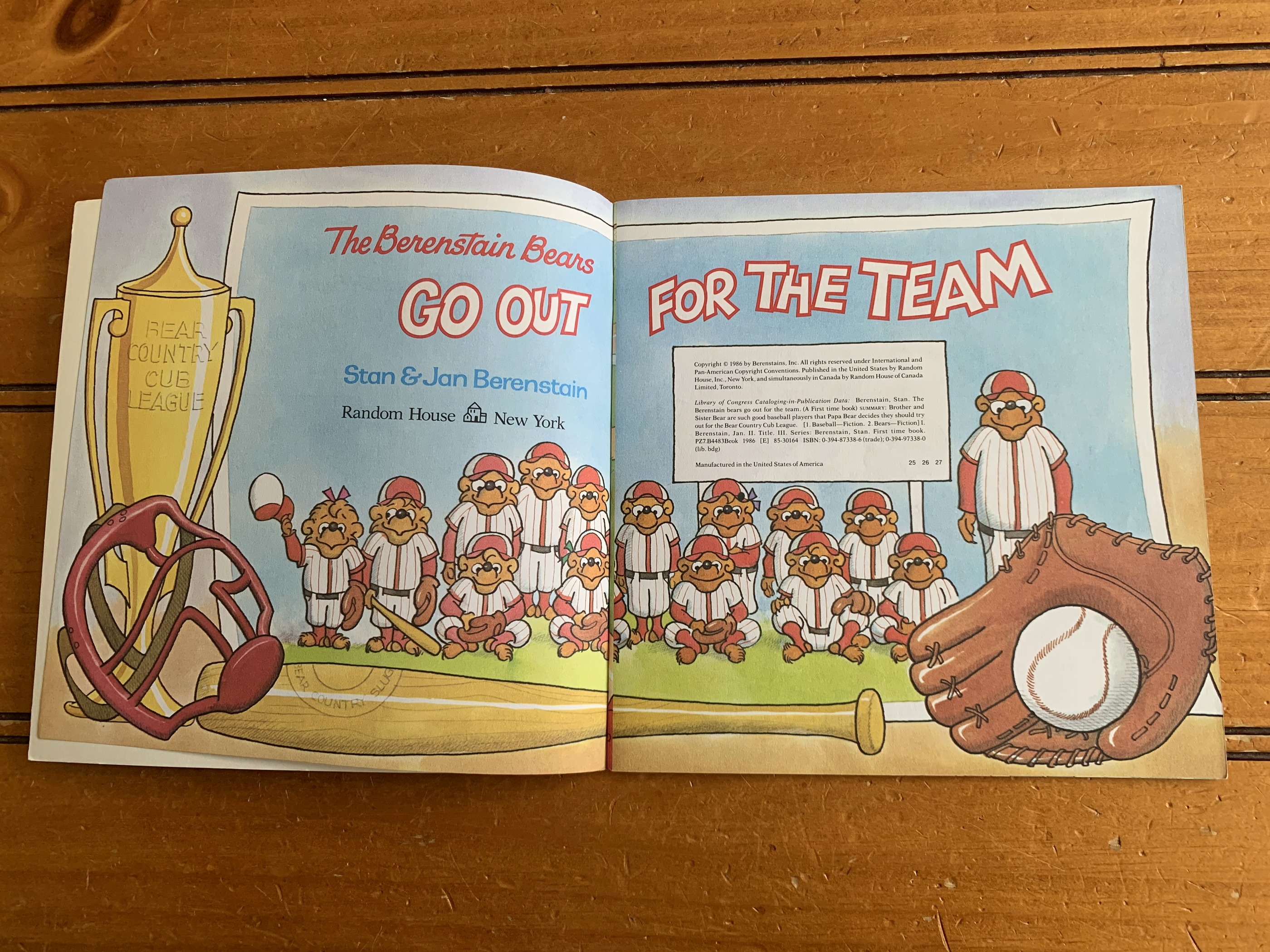
The Title Page
Foreshadowing? Wishful thinking? Are we to believe that not only did the cubs make the team, but they won the championship too? I particularly enjoy Brother Bear's side look at Sister Bear as she tips her hat to the camera.
A simple plot that builds to its point
The general flow of the book works really well. We get the intro where Brother and Sister are just out there playing sports through the seasons, having fun, with baseball their favorite, and they're getting better at it over time, which makes it a nice natural step forward when Papa suggests a more official league to join. It's definitely one of the simpler plots of any of the Berenstain Bears books. There aren't really any other plot lines going on here, and that's fine, because everything builds up to the pressure point they're trying to make.
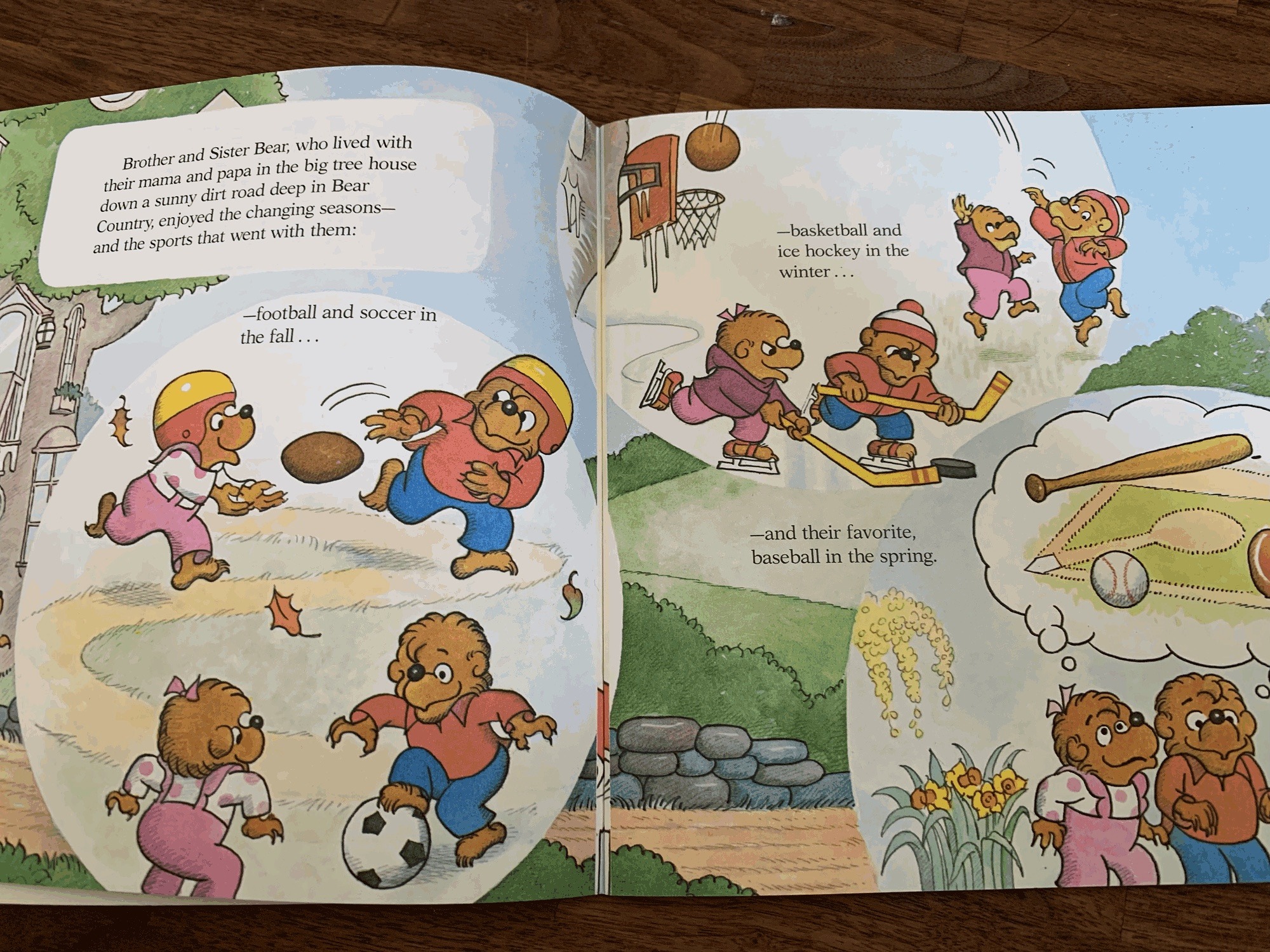
Cubs are wearing helmets for football, but not for hockey. Hmm.
The meadow game itself is a fun stretch. Sister whacks her first ground rule double into the duck pond, and her knowledge of the rules comes in handy when Cousin Freddy forgets to touch second base on his way to third and she tags him out, with Farmer Ben confirming the call from the sideline.
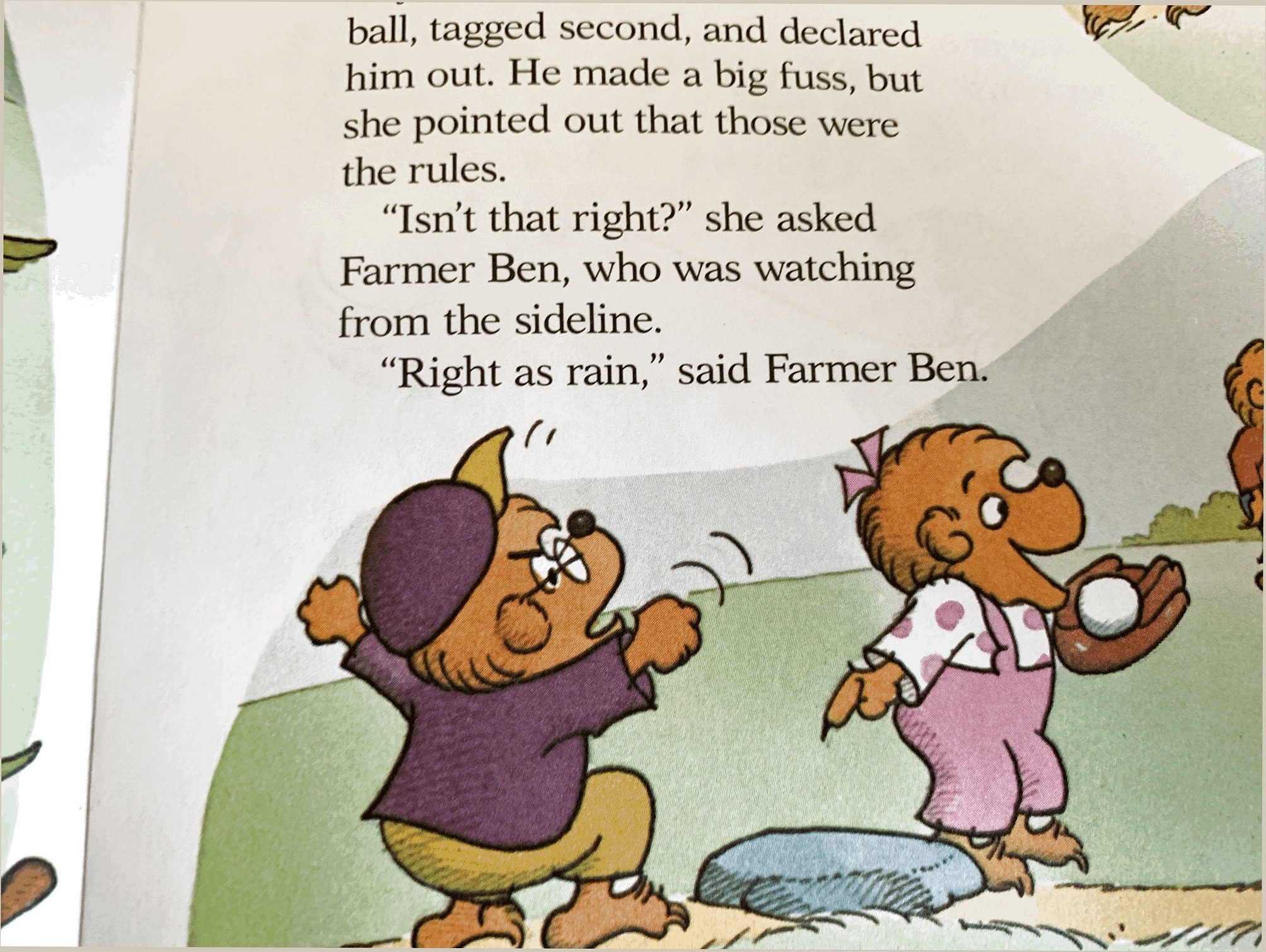
Another classic Cousin Freddy appearance here. This time with meltdown included.
Mama and Papa mostly take a back seat here, other than being the conduits for suggesting the league in the first place and bringing up the pressure component. Now that I write that out, would Mama have been better off not mentioning pressure at all and letting the cubs just not think about it? I think she's probably right to bring it up, because you don't need somebody to tell you about pressure in order to feel it, and it's better to get them mentally prepared now than to have them show up the day of wondering, hey, why is my heart racing, what's going on here? After that the parents are just observers, and this is something I definitely get as a parent. When your kids go out there, you want them to have fun first and foremost, but you're also their biggest fan, and Mama and Papa are right there wishing both cubs make the team. They're probably thinking the same thing Brother was thinking, which is: what do we do if one of them makes the team and the other doesn't?
Then at the end we get maybe one of the stranger endings of any of these books, where Mama, completely out of character, starts yelling at the umpire during Brother's first at-bat and Sister has to set her in line.
"That was no strike! It was wide by a mile. Call yourself an umpire?"
I don't know why they did that. Well, okay, I lied, I do know why they did that, and maybe I need to make a whole blog post about this someday. The Berenstain Bears generally struggle with ending their books, and the fallback they really like is returning to some previous point in the story and having the kids prove they've learned the lesson by flipping it around on someone else. Think of The Berenstain Bears Get the Gimmies, where Brother and Sister leave the store and point out the cub having a meltdown, basically closing the door on the lesson. That's somewhat what they're going for here, with Sister handing the "it's only a game" lesson back to Mama, who was the one teaching it in the first place. For me it misses the mark for two reasons. Number one, that's not really the lesson; the moral of this story is a lot more about handling pressure than "just go out there and have fun." And number two, it's just very out of character for Mama Bear. I'm not saying she's never allowed to do things out of character, but yelling at a ref is one step too far. Overall though, the plot is nice and straightforward and builds up to the point really well.
A good lesson with maybe not the best example
The point of the book is clearly the pressure aspect, which is a very good lesson for kids to learn. Kids need to be comfortable taking risks, putting themselves out there, and being in situations where they feel anxious to do their best. Even if your kids never play sports, they're going to take some standardized test in school someday and that's going to feel very similar. They've been practicing all year, the test is really just a reflection of what they already know, but it's hard to get out of your mind the fact that you need to do well on this one specific day.
Where I think the example maybe isn't the best: the target age for these books is usually somewhere between four and eight, and no kid between those ages will ever have to try out for a team. I'm not going to put an asterisk there. Okay, that's probably not literally true, but 99 out of 100, unless it's some child prodigy super intensive situation, a four to eight year old is not trying out for a team. Every league they sign up for is going to be fun first, and everybody gets a participation medal. So the punishment of this book, that if you're not good enough you won't make the team, isn't going to land as well with the target audience, because they've never been in that position. The experience most kids that age would actually recognize is being up at bat, wanting to get a good hit, and either striking out and crying or getting the hit and being overjoyed. Maybe that really is what the book is about, just performing your best under pressure, in which case I'm a little off on my critique here. But I think the one piece this book doesn't have that it could have had (or maybe another book will cover it) is the competitive aspect more directly: the difference between winning and losing, and the idea that you don't have to win but you still want to try your best. At the very end, with Mama, they almost seem to suggest the book was a little about that, but the whole book leading up to it wasn't.
Peak 1980s Berenstain
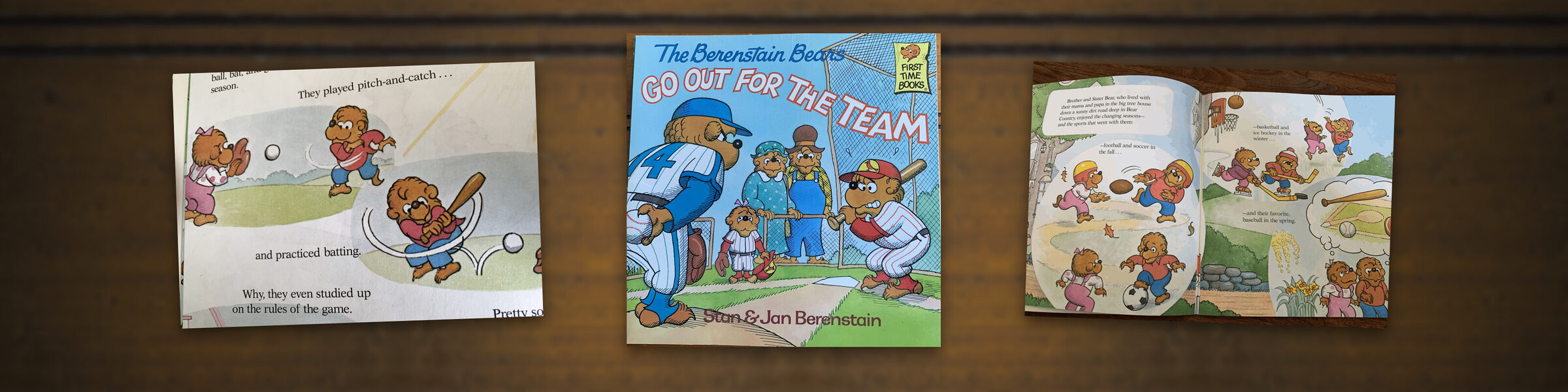
This is right in that wheelhouse of 1980s Berenstain Bears where I think they were at the peak of what they were doing. Every page is just loaded with illustrations. It's not even just single spreads; we get thought bubbles and circles showing the cubs in all the different sports, football and soccer and basketball and hockey and baseball, not just the one the book is about. It's the opposite of lazy illustrating. They're giving us everything we could potentially want on any given page.
What stands out about this book in particular is that there's a lot more motion in it, because they're playing sports, and I really enjoy watching the bears in action: swinging a bat, throwing a baseball, trying to catch one as it goes over their head, running to first base. You can usually tell whether an illustrator is actually familiar with sports by how they draw it, and I'd say Stan and Jan do a pretty good job depicting what sport motion looks like. The only one that maybe falls short is the baseball swing, which is all arms and no body. The bookish dad has coached a little youth baseball in his day, so I'm moderately qualified to critique that, but maybe it's just that the cubs are so young that's genuinely what their swing looks like.
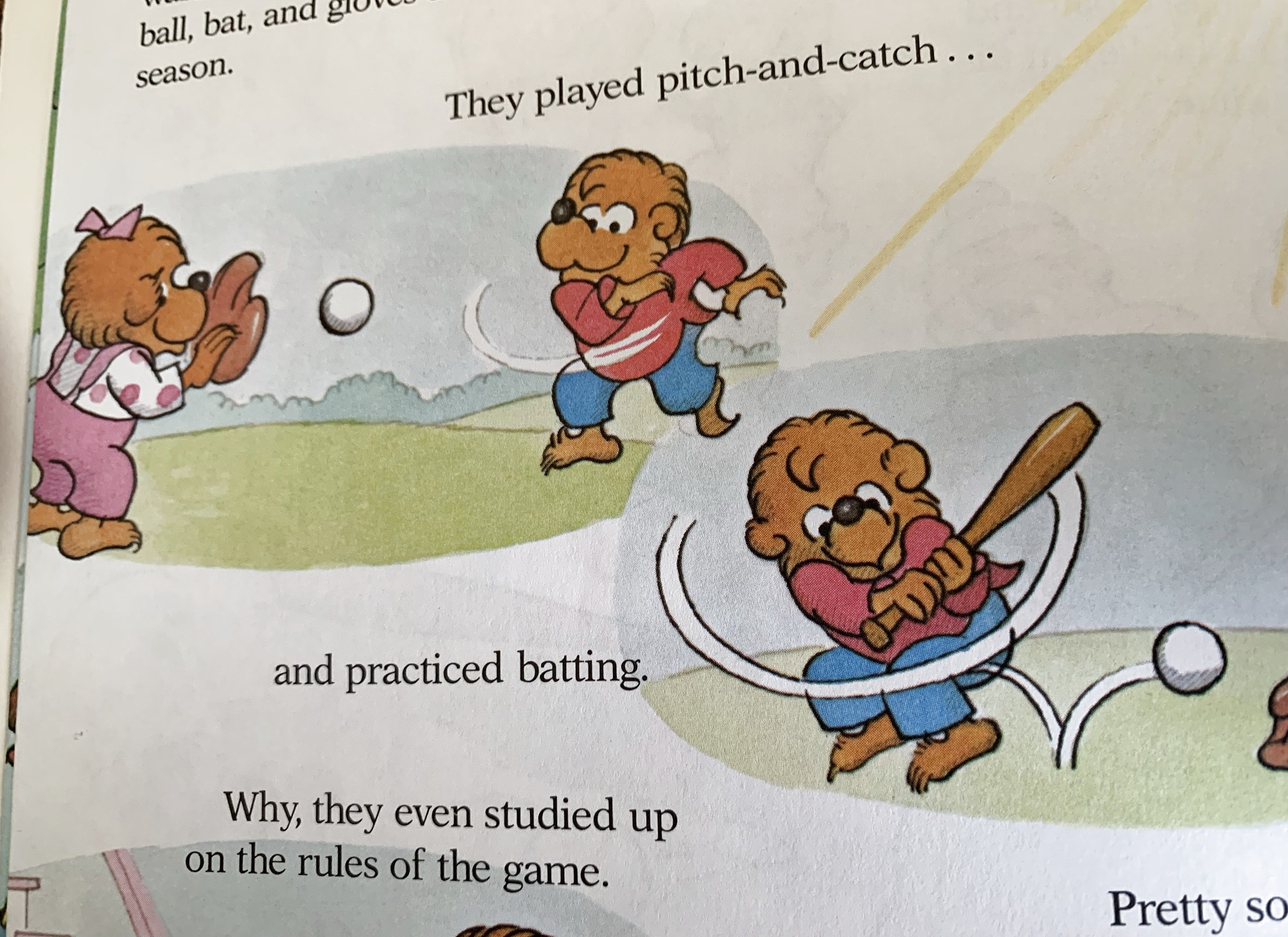
So Brother is a side arm thrower and an all arms hitter. Maybe he was right to be concerned about making the team.
We also get the full range of faces that's the calling card of these books. Pure joy as Sister hits her ground rule double. Nervousness as they think about the tryouts, then concentration as they're out there trying to do their very best, and nervousness again from Mama and Papa as they wait to find out whether their cubs made the team.
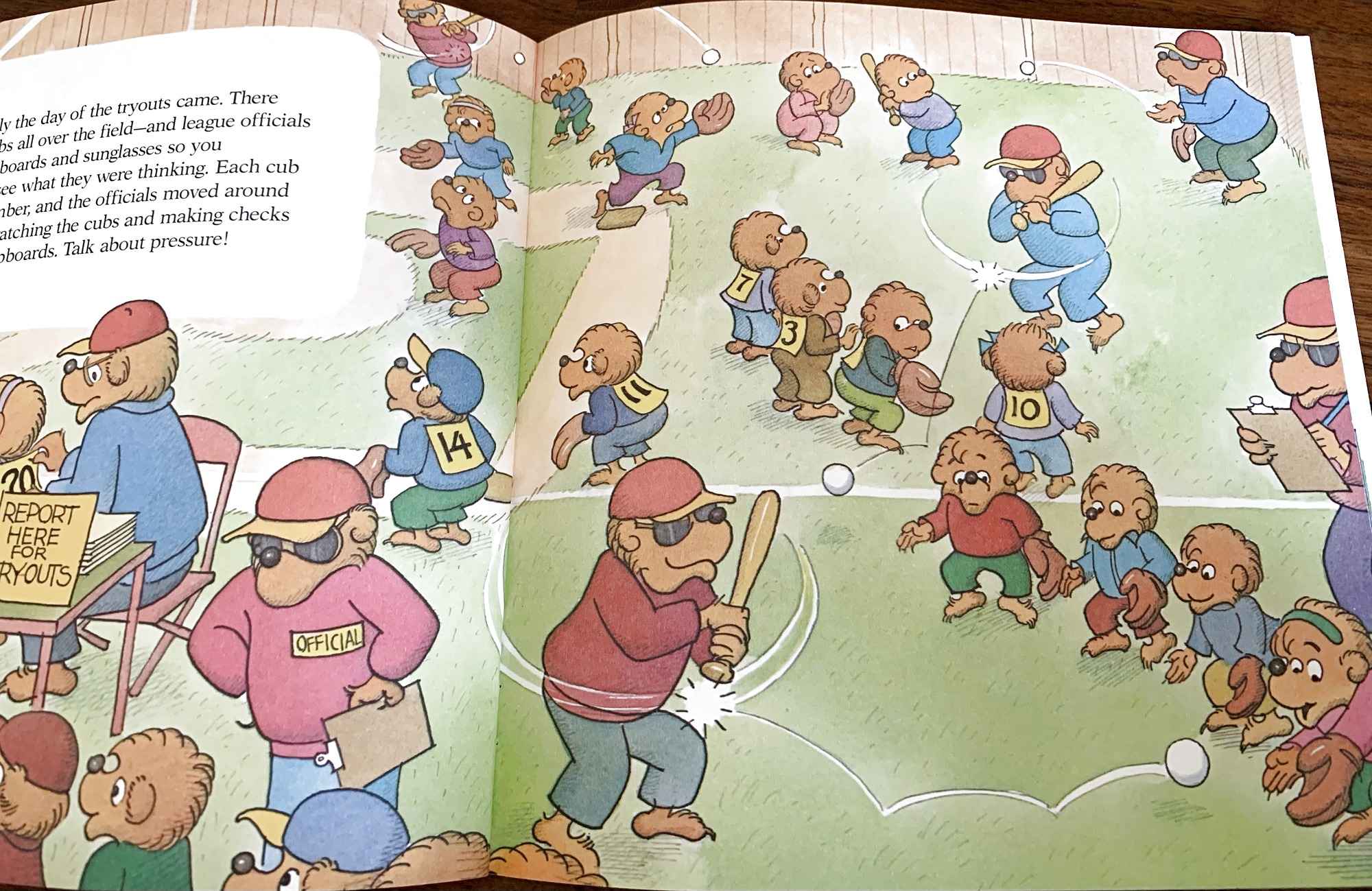
Is it just me, or does this look unsafe? They are packing way too many bears into a small area here.
This is one of the standout Berenstain books for me on illustrations, and not because it has some really appealing candy to look at or silly monsters or ghosts. It's because I'm seeing the cubs in motion and really feeling it, and the illustrations support everything we're reading on the page while adding more on top.
Other thoughts
Despite its quality, this one doesn't come out as much as some other Berenstain Bears books in our house. I think some of that is just that this specific scenario of pressure is one kids don't need as much repetition on as some others. Get the Gimmies comes out pretty frequently because that's a lesson that needs constant reminding throughout the year; with this one, there are just fewer scenarios to pull it out for, especially for kids between four and eight. That said, it doesn't have to come out for a scenario. It's a standalone good book all on its own, and the dad readability score, or how it holds up on rereads, is maybe a four out of five.
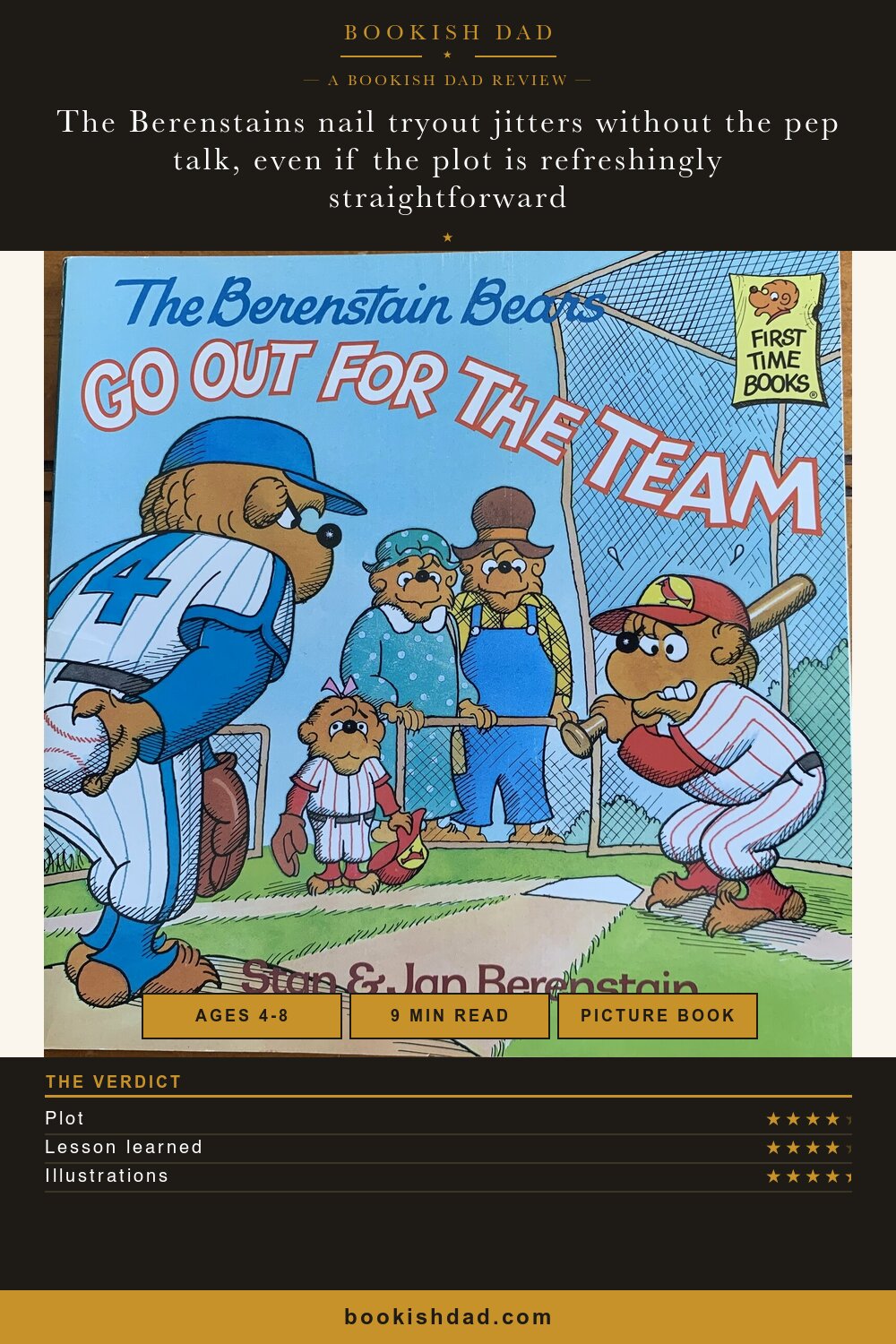
The Berenstain Bears Go Out for the Team (Stan and Jan Berenstain, 1986) starts with a goat eating the baseball and ends with Mama yelling at the umpire. In between, Brother and Sister sign up for Cub League tryouts, survive the clipboards, and both make the Cardinals, pressure intact. It's a nine-minute picture book read-aloud for ages 4 to 8, best for a kid staring down a first tryout, test, or recital. One of the simpler Berenstain plots, and sturdier for it: 4/5, worth the shelf space.