
Earlier this year my wife and I got a tip that there were some kitties that needed fostering. Really young ones, not quite bottle baby age but just past that, no mother cat in the picture, just needing to be taken care of and gain some weight. It had been about a year without a pet after our dog had passed, and the kids had on and off wanted a new one, but my wife and I had always been a little hesitant. Life changes a lot when you have a pet. All the responsibilities that come with it, sure, but it's more than that too. It impacts how you go on a trip, whether the animal can come, arranging care if it can't, all the expenses stacked on top. We knew eventually we were going to get a pet. It's just one of those decisions you settle on over time, with some encouragement from the kids slowly breaking you down. Anyways, we said yes to the foster. The goal going in was that it was strictly a foster. We had no plans to become, quote unquote, foster failures. The kids were ecstatic. We isolated the kittens off in a little room in our house, the kids would go in there, close the door, and let the kitties jump all over them, and you can see where this story is very likely going. You become attached. We weren't ready to keep all five, but there was one kitty that stood out as particularly affectionate, who just seemed like he could easily slide in as a member of the family. And that's how the Bookish Dad household added a new family member: Buttons, the kitten.
It's been six months now, it's been extremely enjoyable, and all I can think about is that maybe we should have read The Berenstain Bears' Trouble with Pets more often. If anything, it would have done the exact opposite of what the title says it's intended to do and made us want to adopt a pet even sooner. Which brings me to the next stop in the marathon, and potentially the most poorly named Berenstain Bears book there is.
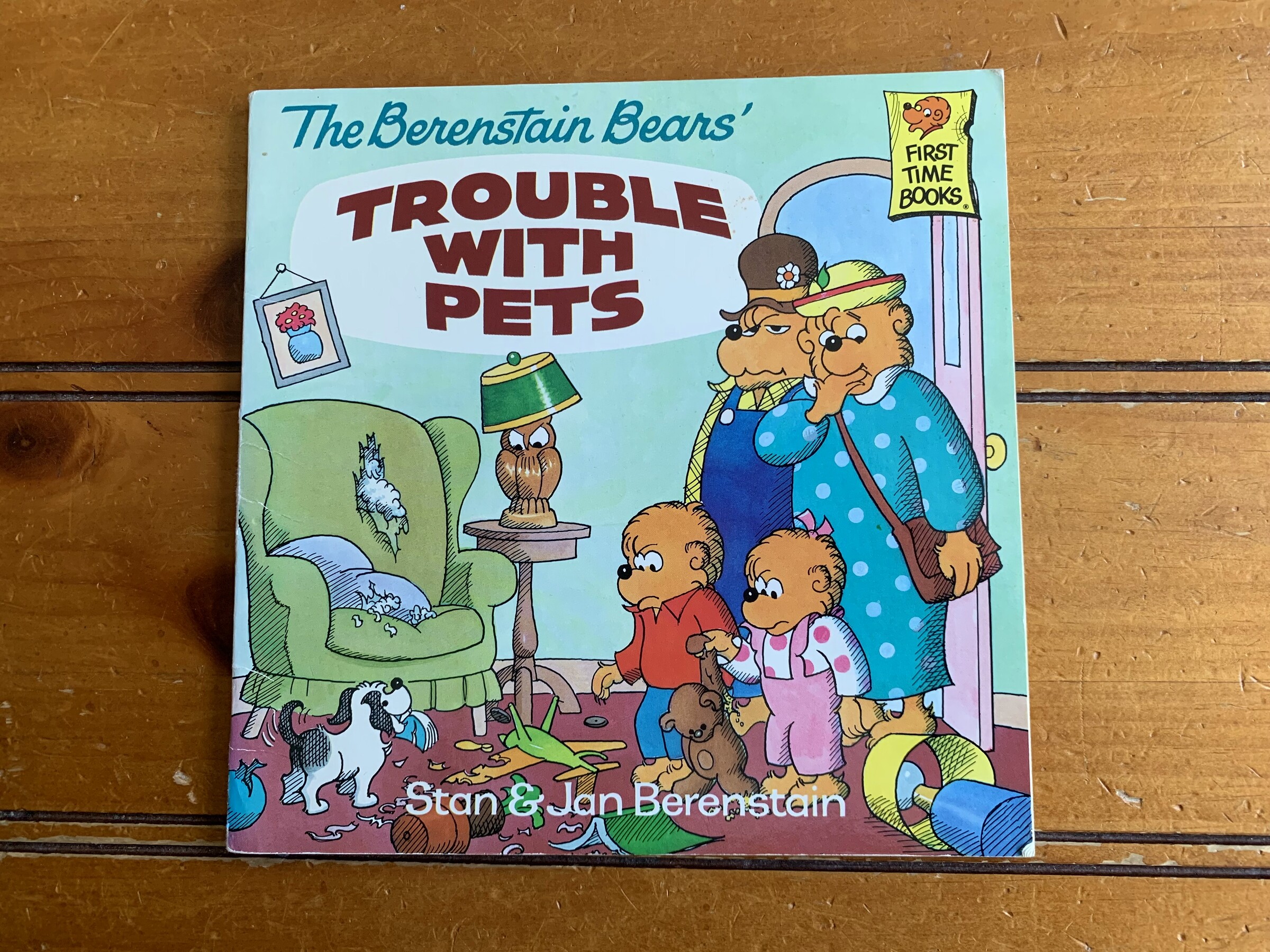
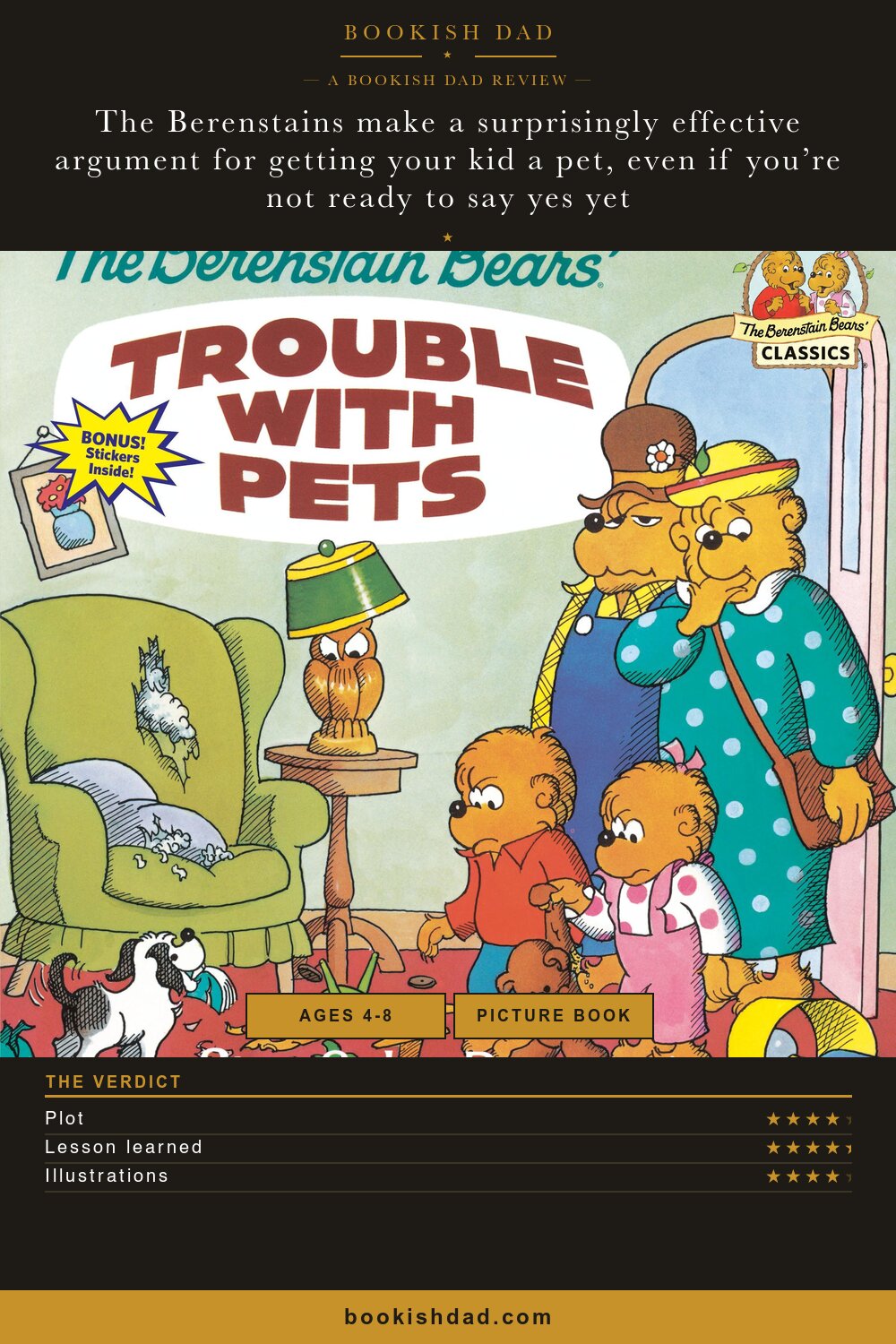
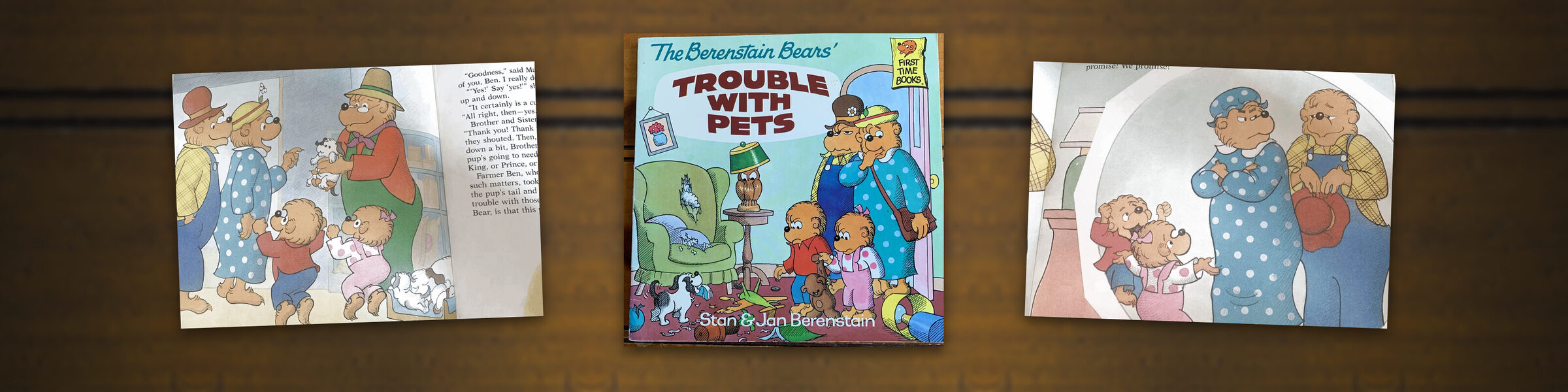
Let me get my main complaint out of the way, because it's also the reason this one isn't getting a five. This is not a book about how pets are troublesome. Outside of one spread, which I'll get to, there is no trouble with pets here at all. It's a very pro-pet pet book, and its purpose is really just to give kids exposure into what pet ownership looks like, from wanting a pet to having a pet. If I were to rename it, it would be something a lot more boring, probably The Berenstain Bears Get a Dog, or Decide to Get a Pet, because that really is what it is: the process up to ownership, and then what ownership looks like after that.
The Opening Rhyme
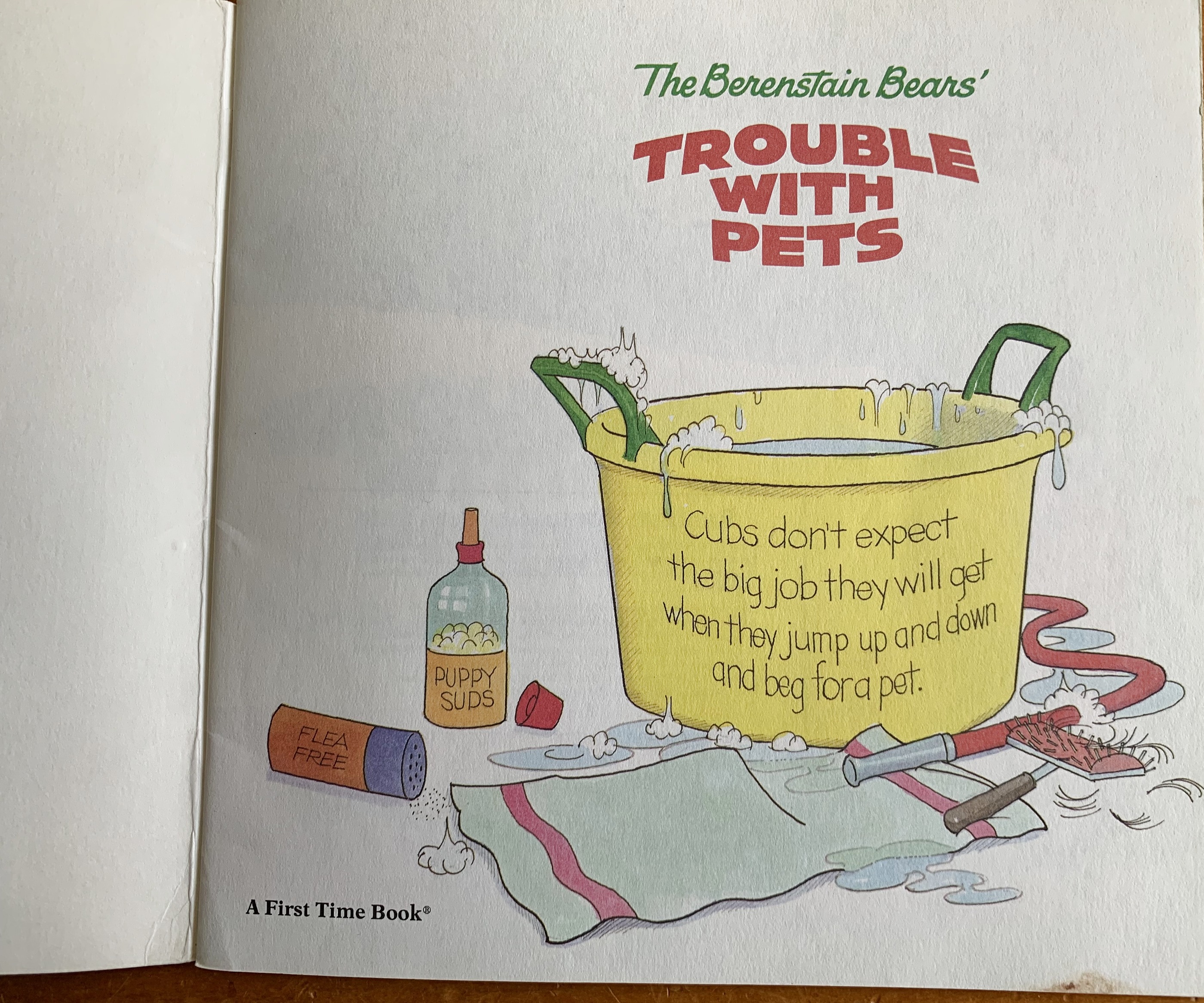
Just like the title page, we are being misled that having pets will be troublesome.
I understand why Stan and Jan did this. All Berenstain Bears books have some centralized problem they're trying to solve, some circumstance the cubs find themselves in where the book's whole goal is a process of resolution. They wanted to structure this book the same way, but they also didn't want pet ownership to come across as negative. They wanted you to walk away feeling that pet ownership can be really great, just not a walk in the park. I just think they're maybe a little bit misleading in terms of what the cover says there.
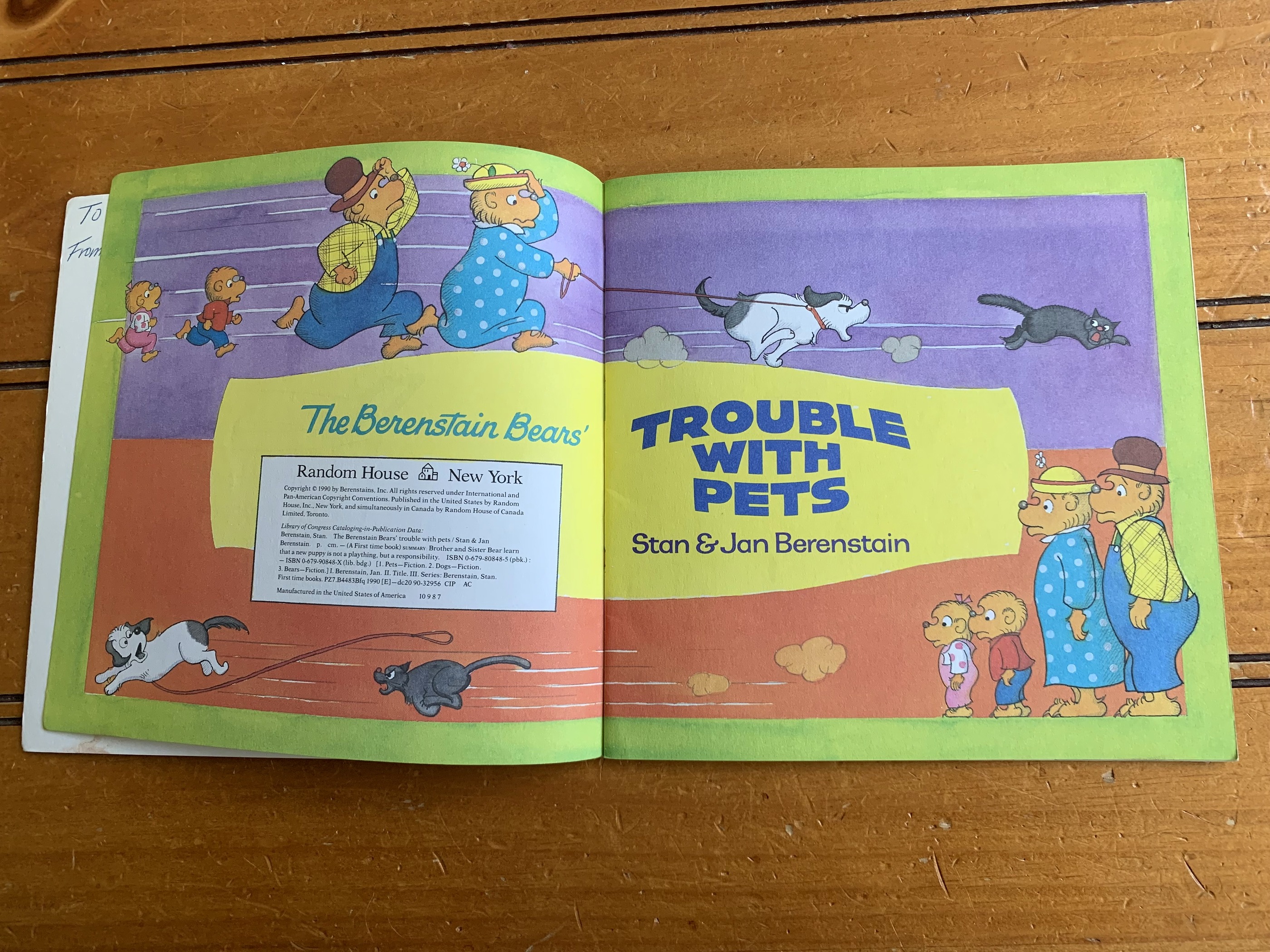
The Title Page
If the book was entirely about what this spread seems to portray, nobody would ever be wanting pets after reading this book.
Breaking Mama Bear down
The story opens with the bears releasing a sparrow they fostered, Tweety, back into the forest. The cubs miss having a pet around the house, Mama reminds them that Tweety wasn't a pet, it was a wild animal, and that gets the cubs on the subject of wanting a real one. And for about half the book, it's just the process of breaking down Mama Bear. I'm going to put Papa firmly on the side of the cubs here. He's not supportive of Mama's whole "a pet is a big responsibility" angle; he's in the same mindset as the cubs, dreaming about a big dog, "about so high," that can go fetch and play Frisbee. And I think this is a really realistic representation of what it's like to have kids who want pets. They know they want all the fun things. They're not really aware of all the responsibilities that come alongside it, and the parents want them to have that realization before jumping over the deep end. But it's really not possible. As much as you can talk about it, you can never just tell somebody about the responsibilities of a pet. You have to live it.
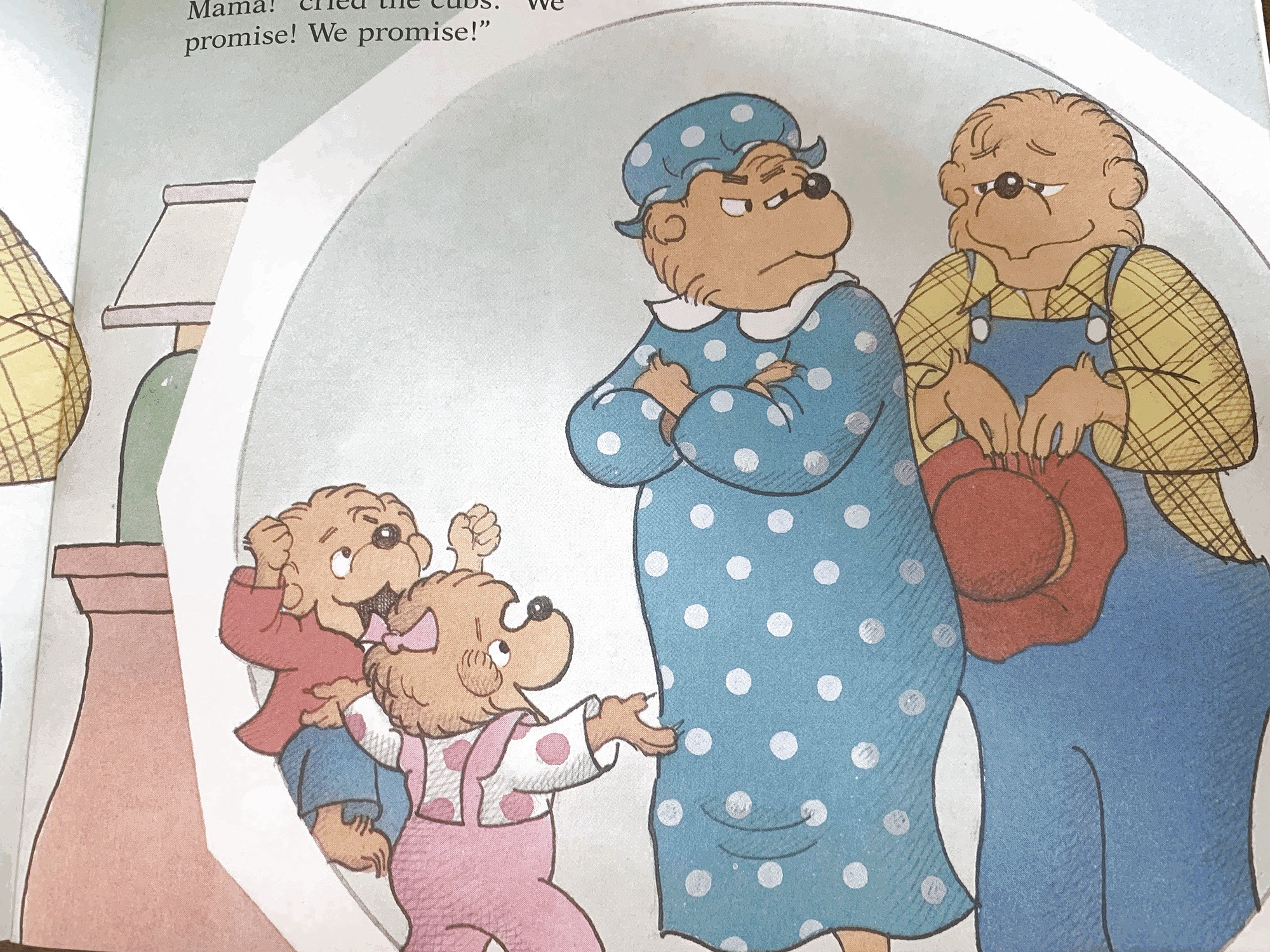
I've never once gotten this look from my wife when siding with the kids instead of her...
I also appreciate how Mama and Papa are on slightly different wavelengths through this stretch. Mama exercising caution, pumping the brakes without being an outright no, while Papa is gung ho and thinking about all the benefits right alongside the cubs. That's a realistic depiction of a marriage, where you're not always in lockstep with each other, and you have to negotiate together even while presenting a unified front to the kids. In our household the roles are reversed. I'm the pump-the-brakes person; my wife is more the let's-collect-some-more-pets person. I don't know that the book ever solves the disagreement, exactly. The one exercising caution is eventually the one who breaks down when she's holding the puppy, so maybe Mama felt she'd done the part she was trying to do, which was get the family (and herself) to actually think about it first.
From there they work their way past Farmer Ben's, who just happens to have a litter of puppies available, they pick out the cutest one, and before you know it the intention of "just looking" means all of a sudden they've committed to a new pet. The best part of the whole book comes right after, when the cubs lie in bed daydreaming about dog ownership. Sister pictures tea parties and doll clothes; Brother pictures blue ribbons and yelling mush like he's running the Iditarod. And then the book drops the line I now use all the time: "a puppy isn't a toy to be dressed in doll's clothes. It's a living creature with a mind and nature of its own." That's maybe the most difficult part for kids with pets. They can think of an animal as this really interactive toy, and the play part is absolutely true, but it's a living creature that you have to respect and train, and if you pull its ears it's going to respond negatively, possibly in scratch form. That's a part I really wanted my kids to understand when we got a pet.
Then they did this, then they did that
Once the decision is made, the central conflict goes away, and the latter half of the book is really just a step-by-step guide to pet ownership. The license, the vet, the shots, the puppy box in the kitchen, the cubs arguing about whose turn it is to feed and walk her, and then after a while arguing about whose turn it isn't. I don't think this part is quite as strong. There's not really a plot anymore; it reads more like a guidebook of what to expect, then we went to the vet, then we did this. It's not that it isn't useful, because it fits the book's intended design, which is to walk through what ownership looks like both pre and post. It's just less compelling as a page turner, because there's nothing the kids are really waiting for.
Except, I suppose, the one moment of actual trouble with pets, when somebody forgets to close the kitchen door and the family comes home to find Lady has chewed up half the living room. Honestly, if I came home to that scene it would be more than shock; it would be genuine confusion about how a little dog could possibly have done that much damage. I don't know if they threw this spread in just to match the title, but it does fit in its own way, because problems happening while you stand there wondering why you ever became a pet owner is an accurate reality of the whole arrangement.
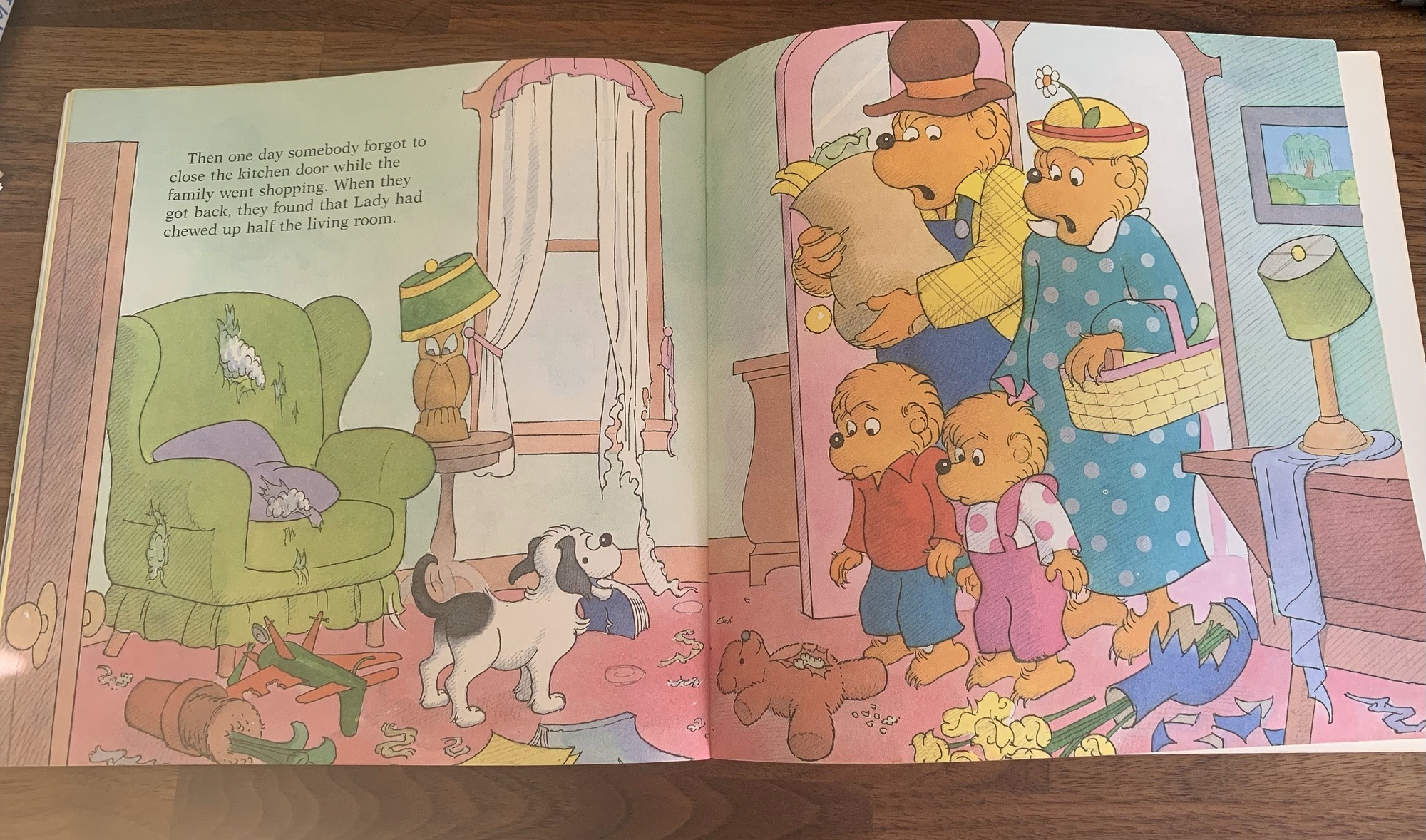
Really the only "Trouble With Pets" we are given all book long.
Less a moral, more a demonstration
There's kind of a moral here, and it maybe leans on pets being a good addition to a family, but mostly the book steps away from saying anything in particular and just gives a realistic demonstration of what pet ownership looks like. That's why the lesson gets full marks from me: the lesson is what pet ownership looks like, before and after, and it nails that. This is definitely one to pull off the shelf whenever you're in that pre-pet phase where there's a lot of hype about wanting an animal. Fair warning, though: it is absolutely not the book to bring out if you want the answer to be "you shouldn't have a pet yet." Any kid reading this is going to want a pet more, not less. It's also a good one when you already have a pet and you want your kids thinking about the responsibility side, when you want them to start taking the dog for a walk and to see that there's more than just play that comes along with an animal in the house.
Lots of Lady to look at
Each page definitely has a lot in it. The first half gives us the typical Berenstain facial expressions, the kids overjoyed at the mere thought of a dog, a few concerned looks from Mama, and then, once they actually see the puppies, it's smiles all around. And I will say, the drawings of the puppies are very cute. They did a great job making Little Lady adorable enough that you understand exactly why Mama's heart melted on the spot.
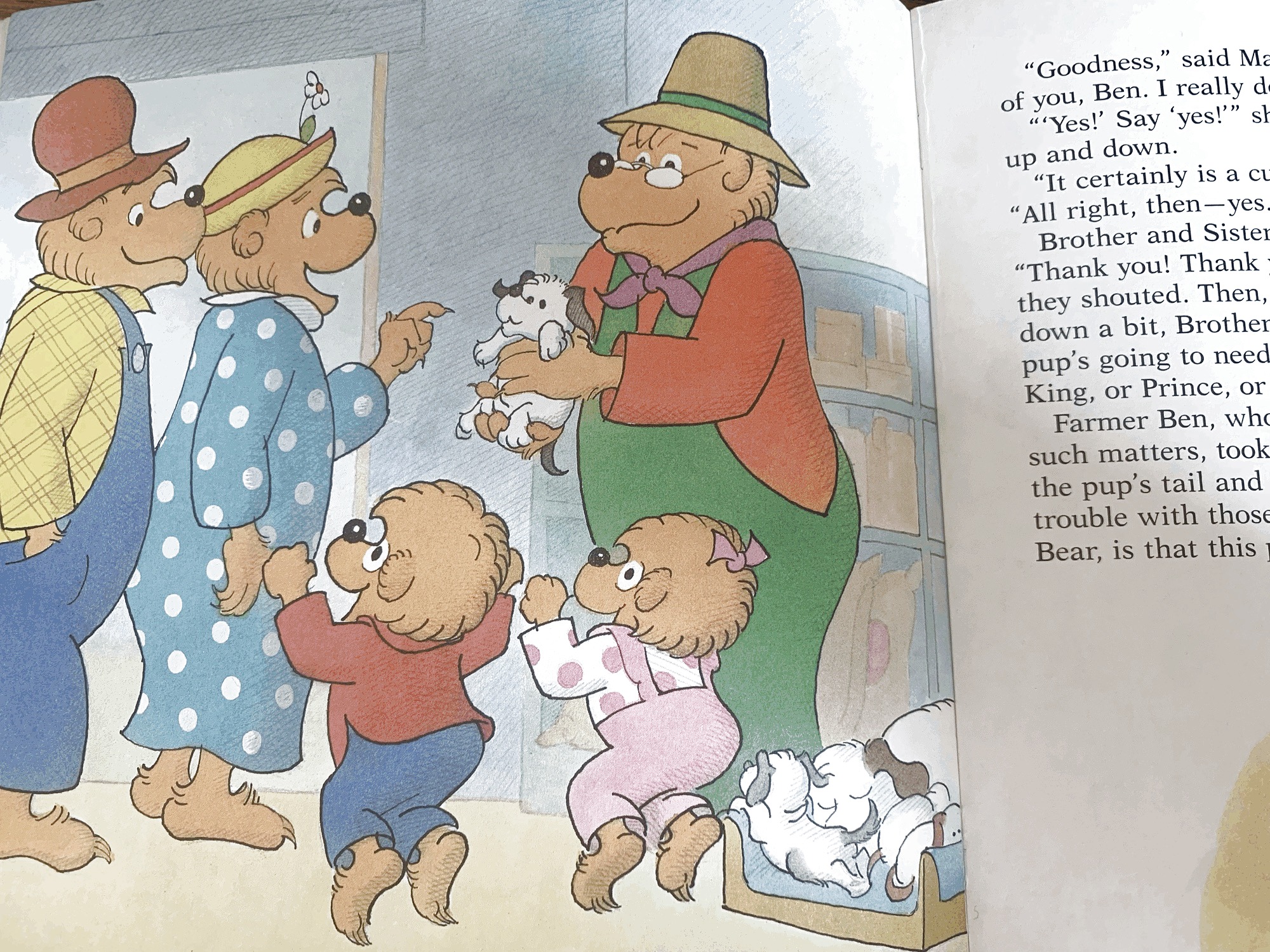
The entire Bear family caught up in the excitement of owning a pet, even Mama.
The second half gets more pictures per page as the guidebook portion rolls along, and the daydream spread is my favorite in the book, with Sister holding a happy little puppy at a table with stuffies and teacups, picturing something totally unrealistic.
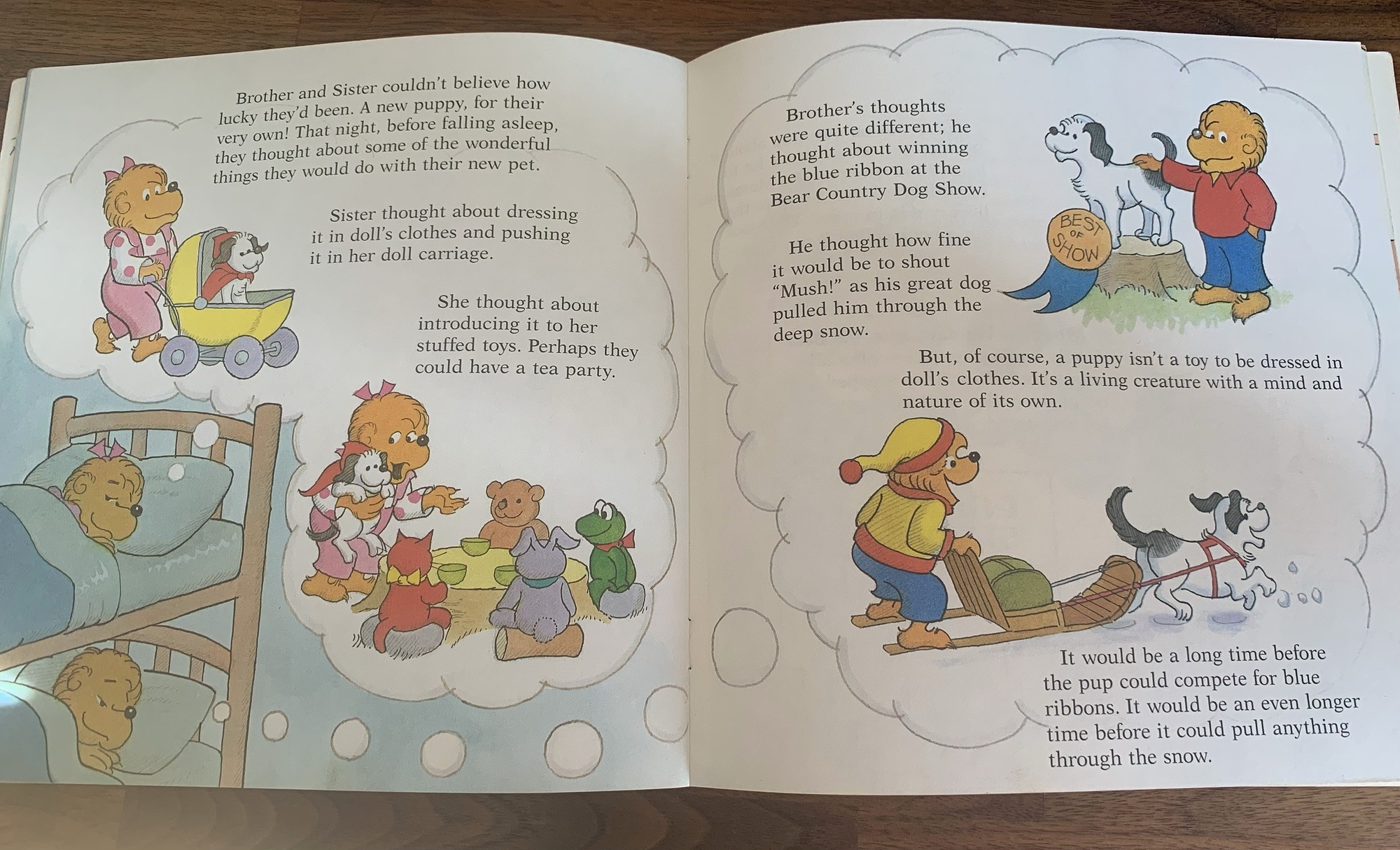
This is exactly the way my kids brains work when it comes to pet. I think my youngest son still thinks our cat is a toy..
After that it's just a parade of Little Lady: nervous at the vet, curious as she explores her new kitchen, and looking up at the cubs while they argue about who's cleaning up after the accident as she sits directly next to said accident, wondering what the heck the kids are doing. My kids really like this latter half of the book, I think precisely because it's a bunch of images of a cute dog getting into funny positions. While the text is reading like a guidebook, the images do the job of holding their attention.
The writing itself, though, is one of the clunkier reads in our collection. There are big paragraphy descriptions at the beginning, and later on it turns into flat lists: she chased her tail, she did somersaults, she fought her rubber dog bone. It's a little less fun to read out loud than most of these, and I think part of it is that there's almost no actual speaking in the second half for a dad who likes doing voices, outside of the cubs arguing over whose turn it is, which is probably the funnest part of the whole back stretch.
Mislabeled from the cover down, The Berenstain Bears' Trouble with Pets by Stan & Jan Berenstain (1990) contains almost no actual trouble with pets. It's a thoroughly pro-pet picture book for ages 4-8, walking cubs (and kids) through the whole arc from pet-begging to ownership, dog included. Call it 10½ minutes of read-aloud that will leave a pet-wanting kid wanting one harder. 4/5, worth it, as long as you're prepared for the eventual answer to be yes.