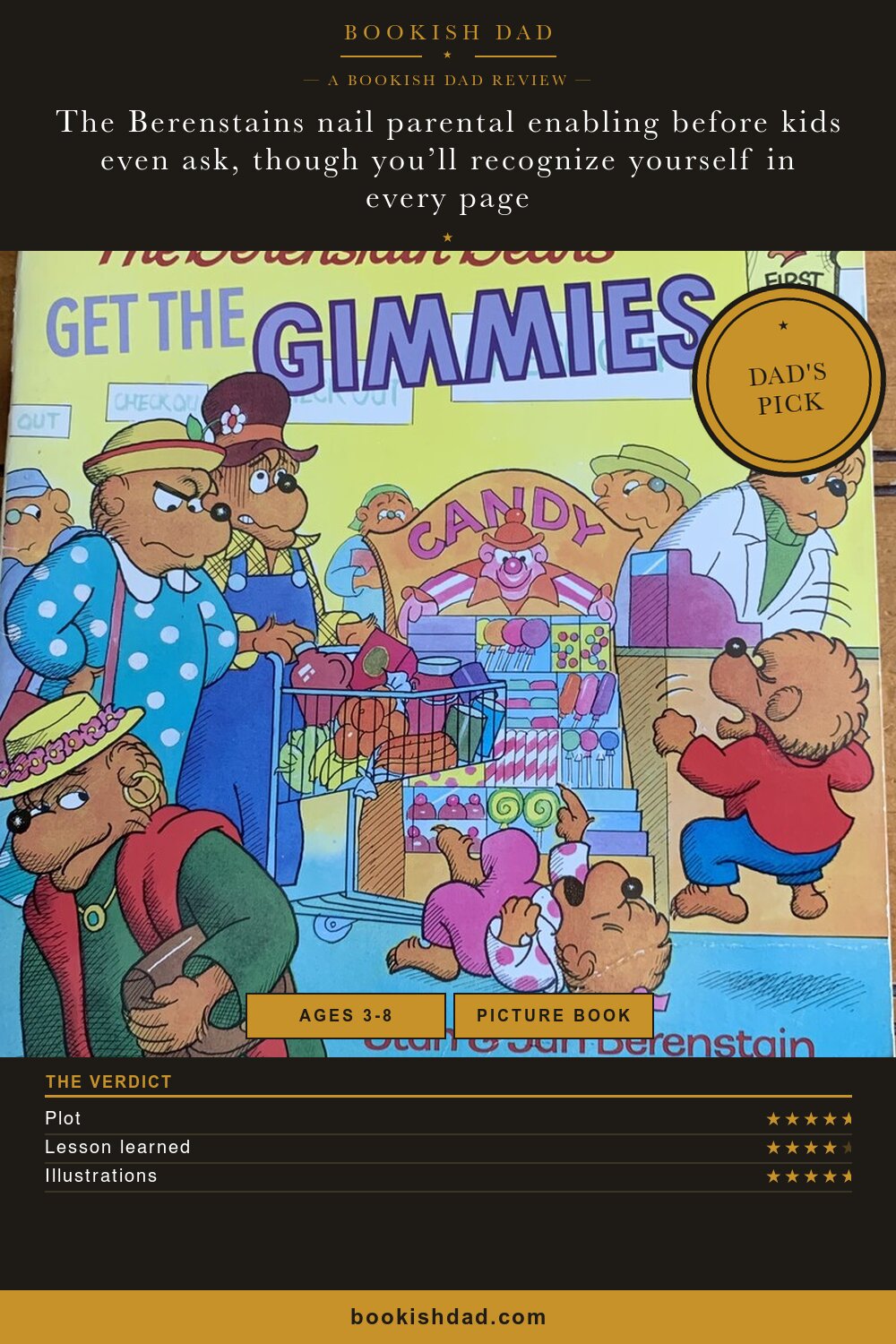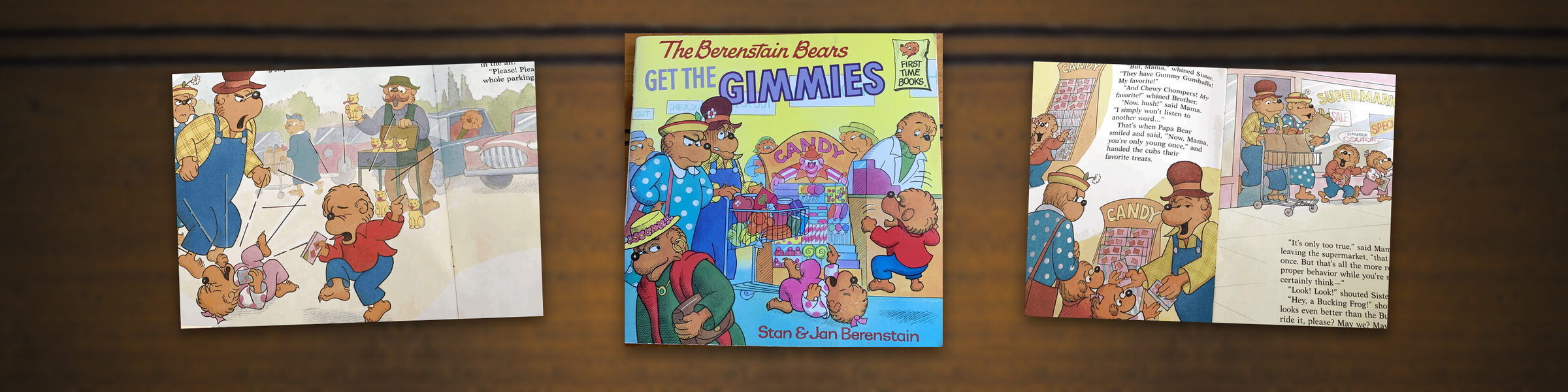

Every single dinner in our house needs to end with a dessert, and my kids will use every line in the book to get it. "Oh, but I ate my vegetables." "Oh, but I always get it." "Oh, but my little brother got one yesterday that was really big and now I need one." Any trip to the grocery store will often include a little side trip to the toy section too, where they'll ask us for something, and sometimes I think of that as parenting practice. It's a good opportunity for me to practice saying no and for the kids to get practice hearing no. That's really the story we get in The Berenstain Bears Get the Gimmies, which is definitely one of my favorites of all the books in this marathon.
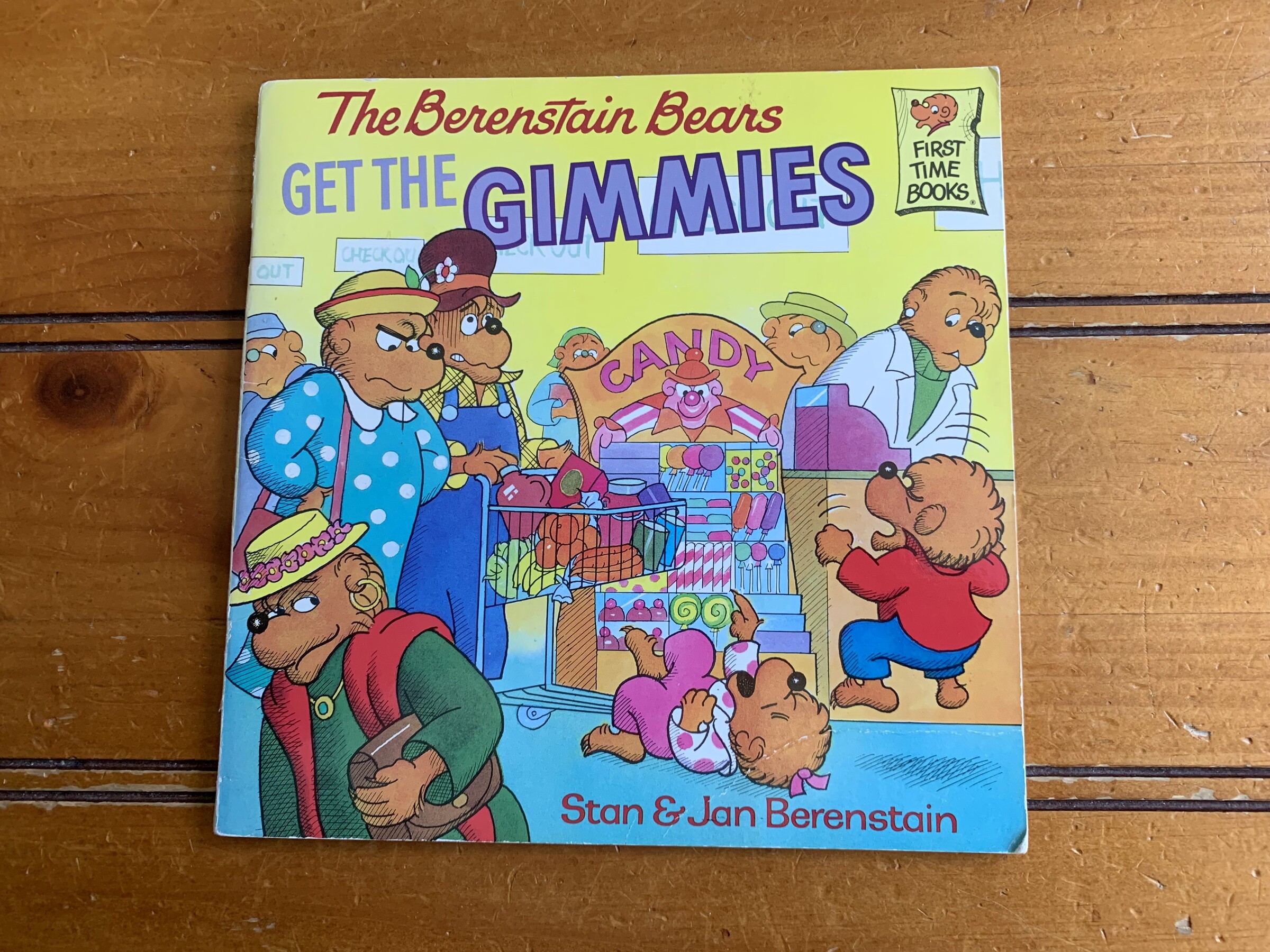
The intro here is really well done. It doesn't just go straight into the cubs having the gimmies and then go from there; there's a buildup that explains how the gimmies happen in the first place, and that it's not necessarily a bad thing. The book almost starts with the fact that it comes from a place of love. Mama and Papa love the cubs and are nice to them, as nice as they can be, and it's not until that niceness gets too enabling that the gimmies start to come out of it.
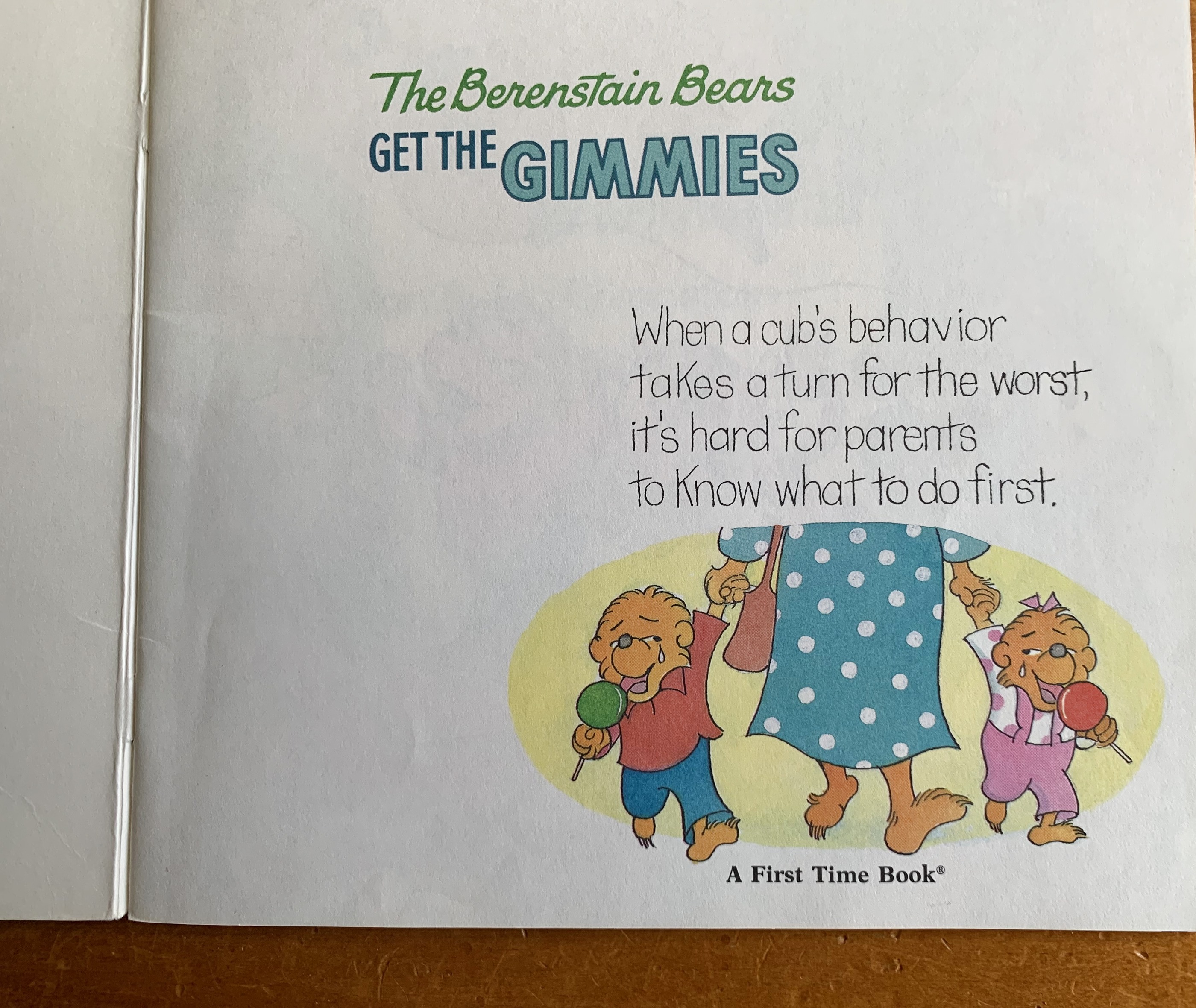
The Opening Rhyme
Pretty general statement, but hinting that it'll be up to the parents to decide how THEY need to change, not as much the cubs.
Sometimes, the book tells us, the cubs got too many treats, too many toys, and too many rides on the bucking duck at the mall. There's also a really interesting point where they talk about how the cubs are constantly exposed to temptations on the TV, walking through the store, in just about every which where. I think this is probably the Berenstain Bears version of commenting on a materialistic culture. More stuff always in somebody's face, and the kids wanting whatever they see. Successful marketing, basically.
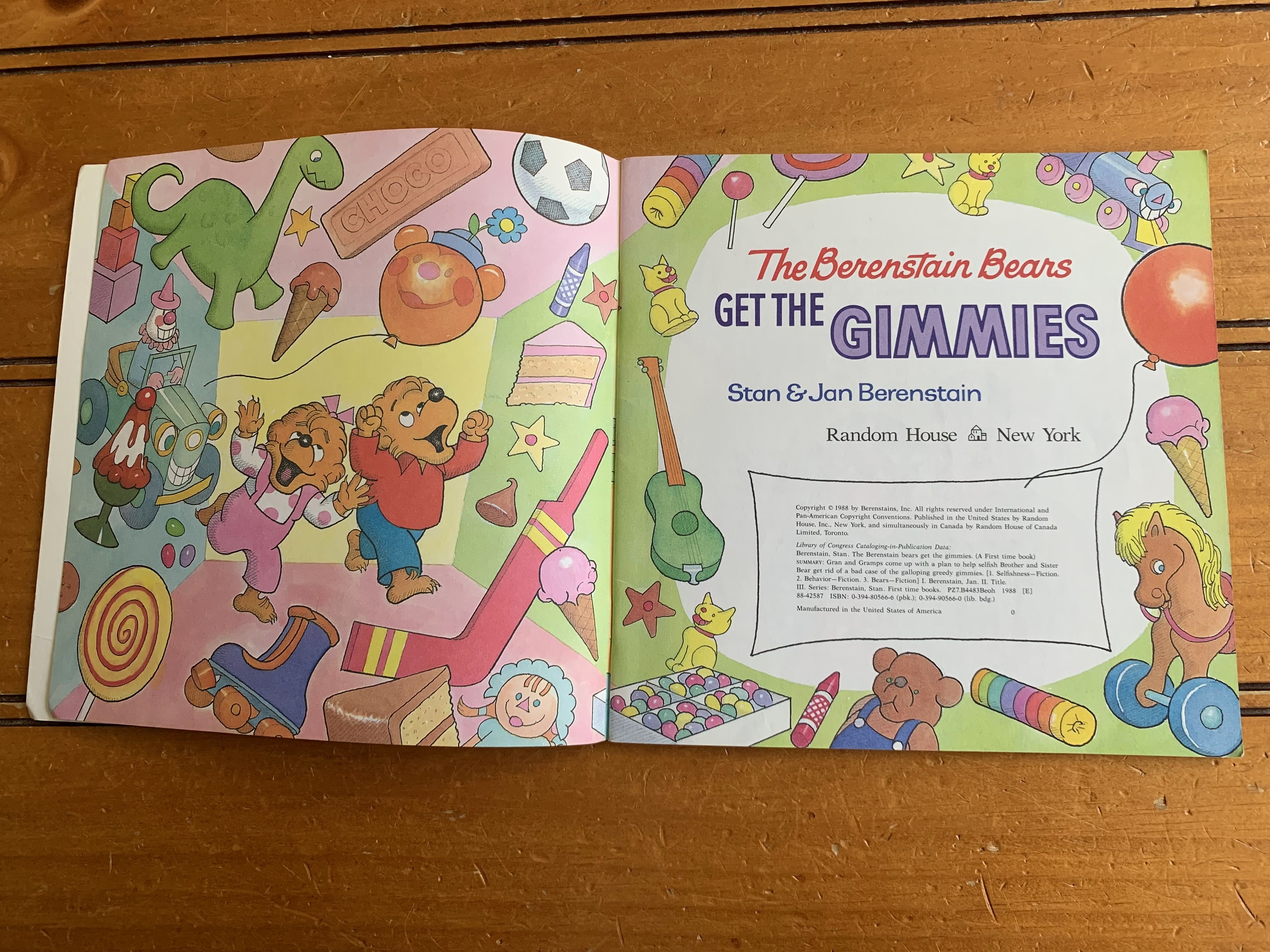
The Title Page
So many delicious looking goodies. The toys maybe not so much, although I appreciate THREE squeaky cats that stick out their tongue.
Where the gimmies come from
Mama warns the cubs at the supermarket checkout that she won't stand for a big fuss every time they pass candy, Sister whines about gummy gumballs, Brother whines about chewy chompers, and that's when Papa smiles, says "Now, Mama, you're only young once," and hands them their favorite treats. We've all been Papa here.
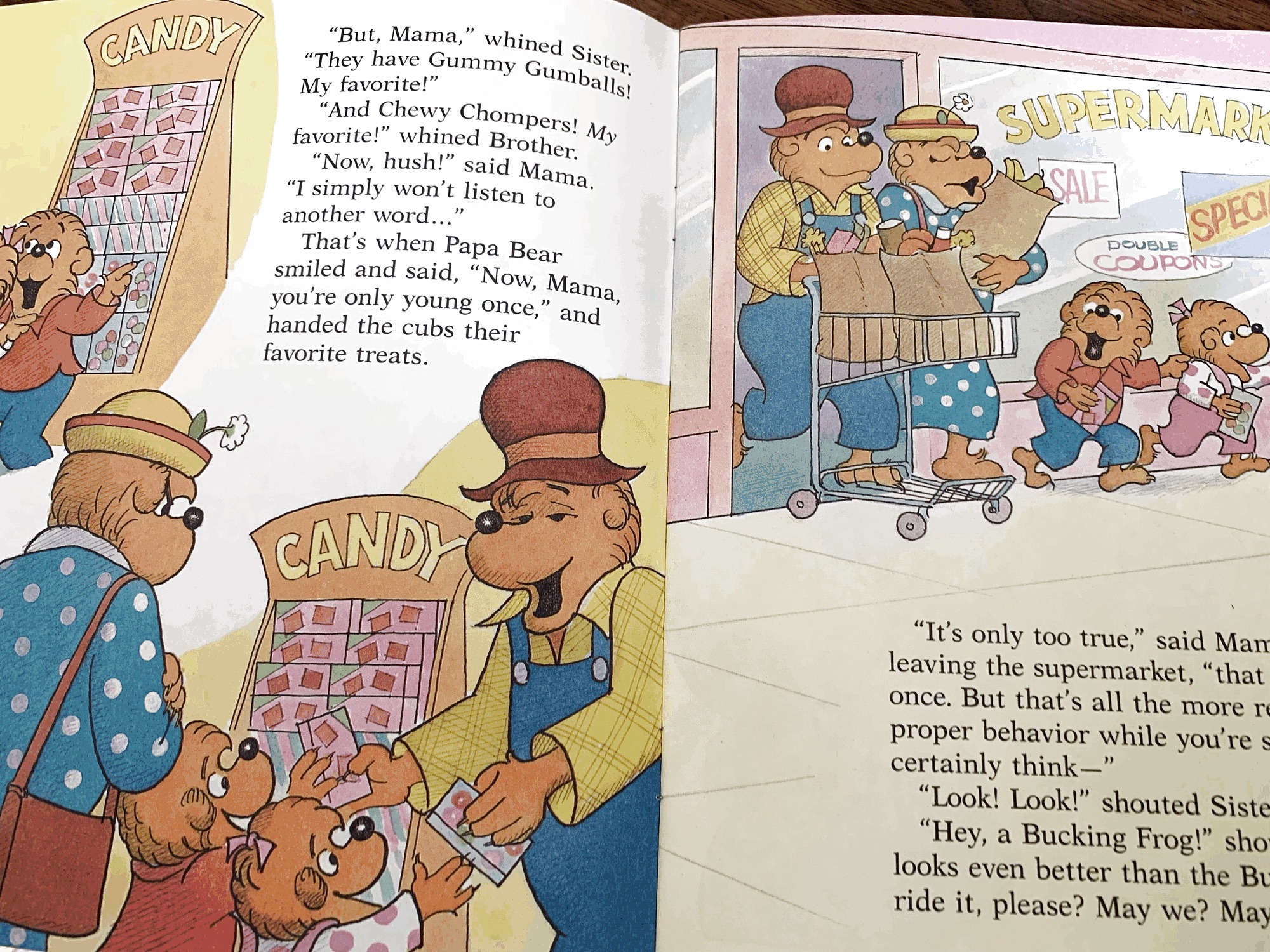
These eyes from Papa Bear in one illustration and from Mama say 10,000 words and I have been both of them before.
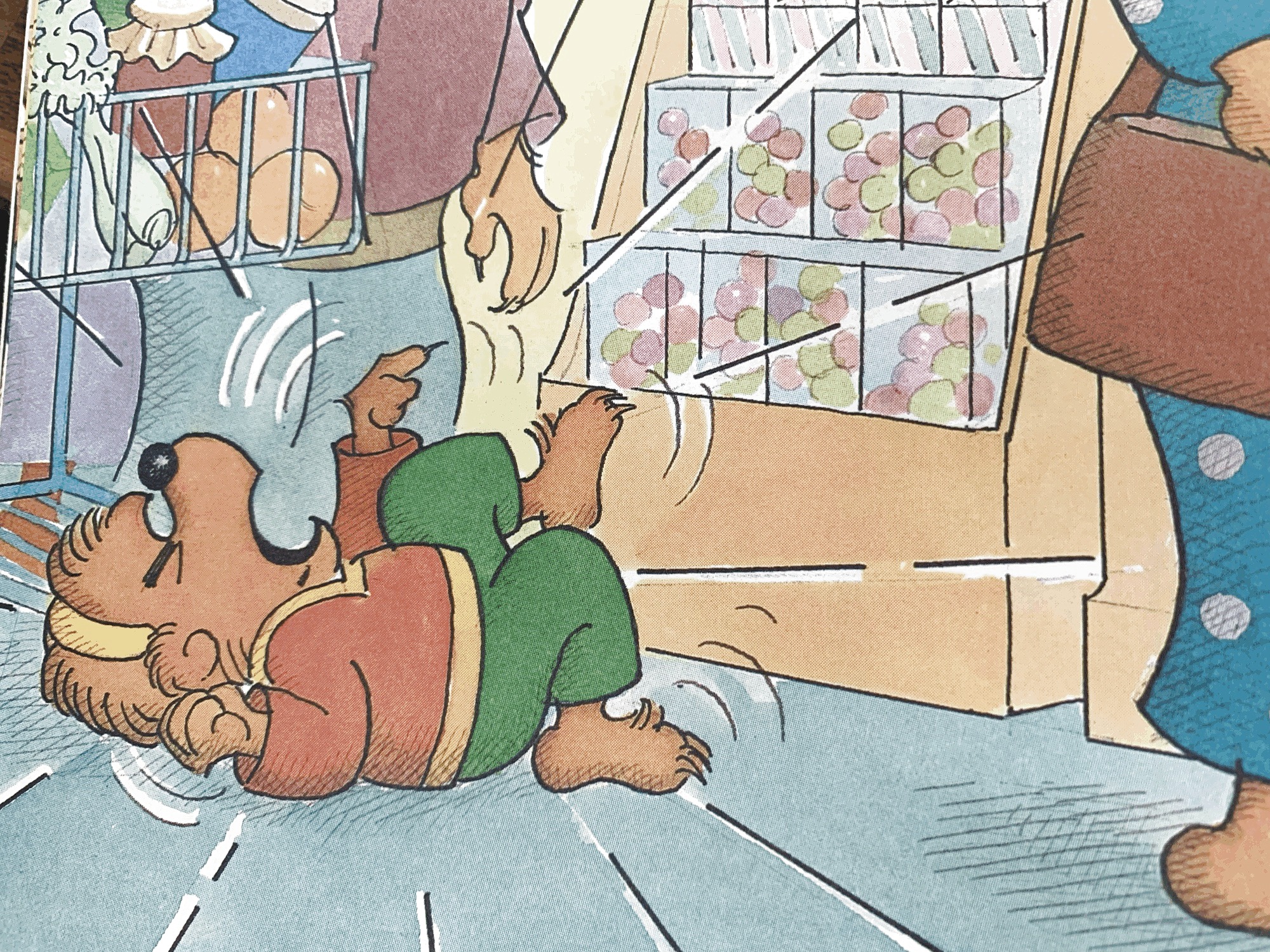
From there it's the bucking frog ride, then the rubber pussycats in the parking lot, where Sister jumps up and down so hard she falls over backward and starts kicking her feet in the air. Papa buys the toys just to stop the scene, and the squeaky cats squeak-squeak all the way home. This is the example page I'd point my kids to when telling them what embarrassing looks like. Look at these cubs. This is ridiculous.
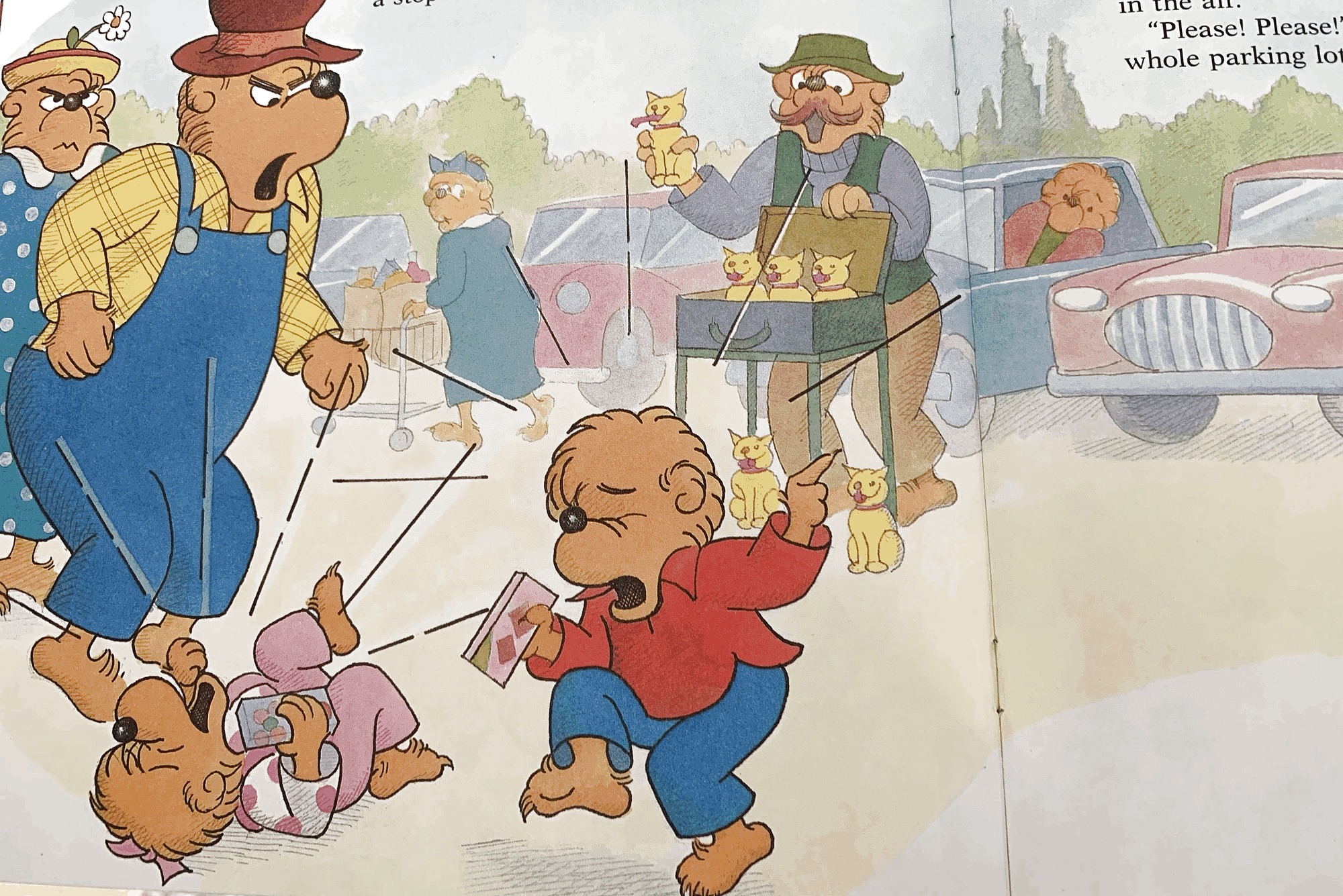
The ultimate meltdown, observed by seemingly all of Bear Country.
Then comes the reckoning, which is the part that makes the plot really great. Papa, voice finally recovered, roars about the most outrageous, disgraceful, embarrassing behavior he's ever seen, and Mama, calmly sipping her tea, asks whether their greedy behavior isn't partly the parents' fault for giving in every time they make a fuss. Right on cue, Grizzly Gramps and Gran arrive and the cubs make the biggest fuss yet, screaming "What'd you bring me?" over and over. The cubs get banished upstairs, and that's when Gramps looks Papa in the eye and points out that Papa was quite a gimme-cub himself when he was little. As a parent of young kids, it's easy to get caught up in the moment, or to have some existential concern about the state of your kids, like am I just doing everything wrong and that's why they're behaving this way. Getting that elder wise knowledge from grandparents is a great addition here. This isn't just the cubs being bad and greedy. It happened to Papa too, and here's how his parents thought about it.
The plan: decide on one treat ahead of time, a sweet, a toy, or a book, and that's it for the day. Come down with the gimmies, you go home with nothing. The next trip, Brother picks a dinosaur book, Sister picks crayons, and they pass the candy rack without so much as a peep. Then a cub just behind them in the checkout line melts down with a bad case of the gimmies of his own.
I love that ending. The cubs can now see greedy behavior externally being played out through other cubs. Also, as a parent, it's super funny, because that was literally them the last time they went to the store.
It starts with the parents
The moral of the story here is a lot less about the cubs having greedy behavior and more about the cause of the greedy behavior, and I think that's the right approach to a topic like this. Any parent who knows about the gimmies knows it really starts with them. There's some moment where you're doing something to be nice, or just to avoid friction, which is probably the most common one. I always go back to the example of our kids and night snack. We initially said yes probably because we wanted to be nice, or they'd had a really bad dinner that night and we wanted a banana in their stomach before they fell asleep. That turns into a habit where the next time they want it because they had it the first time, and we already set the precedent, and it's just easier to say yes again. Before you know it, it's a month straight of night snacks, and when you finally say no, that's when you get the big fuss. The book isn't putting the blame solely on the cubs, and it's not solely on the parents either, but ultimately it is the parents' responsibility to set the line, and this is the realization that combats it. It's very much a book for the parents to read as much as it is for the kids to see how ugly greedy behavior looks from the other side.
The secondary lesson is something Papa brings up in his talking-to that doesn't really seem to land with the cubs, but it's the one I'll take from this book and teach my kids all the time. Selfish, greedy cubs can never be happy, because the thing you just got doesn't provide you any happiness when you're already thinking about the next thing you want. This is just outright true, and anybody who's been in that situation knows it. Actual joy doesn't come from the wanting, it comes from the satisfaction of what you have, or as bears might call it, counting your blessings.
So why is the lesson a 4 and not a 5? It's the Gramps and Gran plan itself. If your goal is to get rid of those public gimmie events, it's very effective, because the cubs know in the back of their minds that fussing means losing the thing. What it's not effective for is getting them used to hearing the word no. They're still allowed to get something every single time they go to the store. I understand why they didn't go for that; it's almost a step-by-step program, and step one is removing the episodes of the galloping greedy gimmies. But I think the book would be better served if there was a moment where the cubs heard the word no and were ultimately okay with it, because that's the end lesson kids actually need. You don't get everything you want, and that's fine. It's the one spot this book is missing.
When they take the whites out of their eyes
Illustrations front to back, absolutely amazing. My absolute favorite facial expression in these books is the special type of eyes where they completely remove the whites and the bears just have black eyes. I'd honestly like to do a whole blog post deep dive on the scenarios where it happens. We get it here when Papa goes against Mama's wishes on the candy, and those eyes are saying a lot of things at once: some guilt that he's overriding Mama, but also a bit of loving dadhood, some satisfaction that he's making the cubs happy. Then on the very next page we get the same eye treatment from Mama, except in her case it's showing total dissatisfaction with Papa, who went against what she said and made the gimmies worse. Not a great example of unified joint parenting.
Sometimes you can read the text of these books and get a really great plot, but when you combine it with illustrations that show this much emotion on the bears' faces, you get double the context you'd get from the words alone. They break out these eyes in future books too, and every single time I see it, I smile.
Everybody's watching
One thing I really enjoy about this book is the experience of third parties observing bad behavior from children, and the parents' reaction to it. I've definitely been there: you're in a grocery store, your kids are acting poorly, and other people are around, maybe not directly watching, but at least passive observers. Your parenting is on display, and you're running the math on what the socially acceptable response is. None of this is ever mentioned outright in the text. It's all done through the illustrations, and when you're the parent you see those faces and go, yes, I have been in that exact situation.
The parking lot is the best example. First off, it's kind of weird that some random bear is just selling toys in a grocery store parking lot (maybe this was different in the eighties), but the toy seller gives Papa this look that's both "oh, I'm sorry" and "I will still take your money," while bears in the background loading groceries look on, shocked. You can only imagine Mama's reaction if she knew other adults were watching in horror. Then Gramps and Gran look stunned as Papa yells the cubs upstairs, like, well, what did we walk in on.
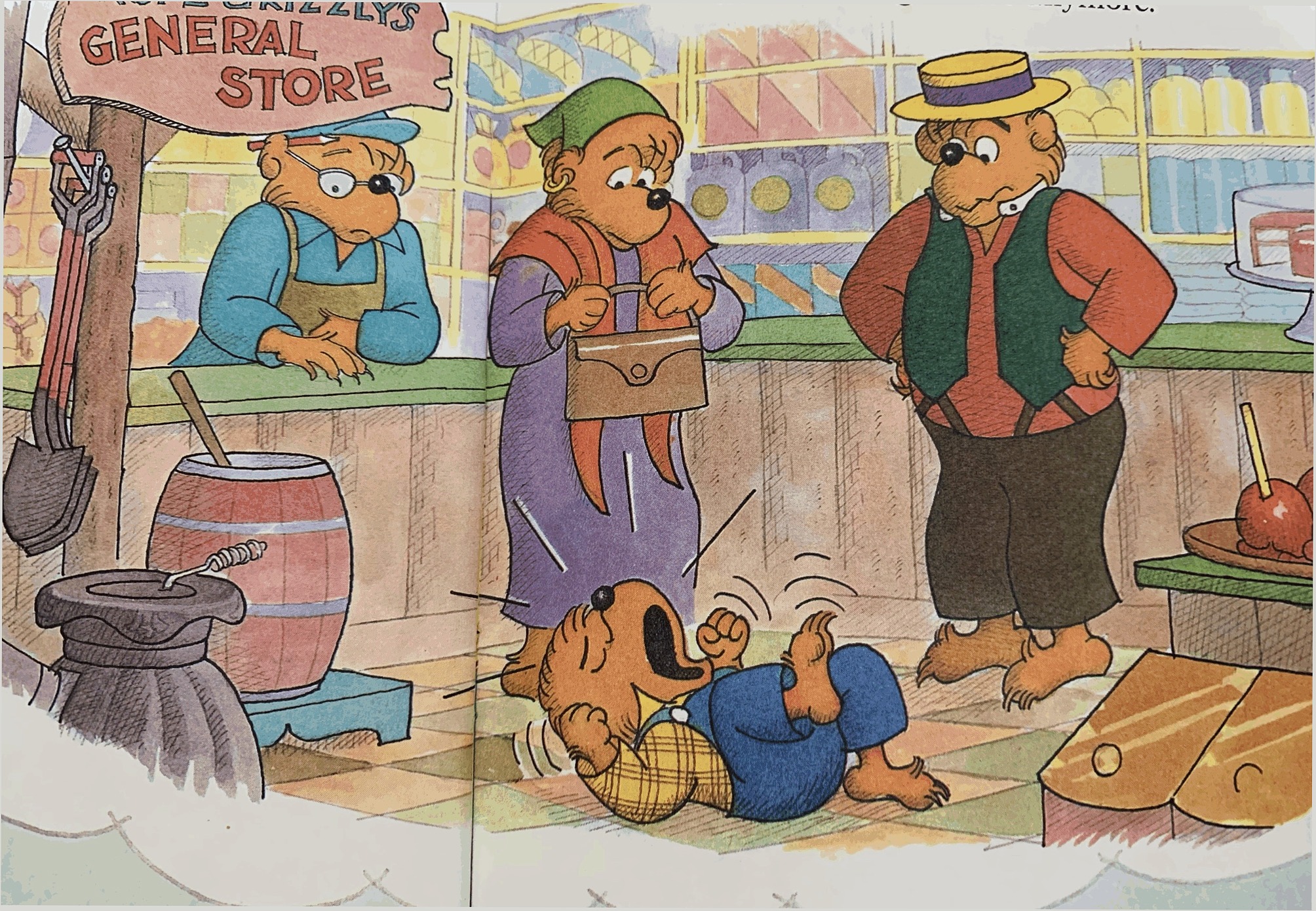
Papa Bear looking awfully like Sister Bear in the previous image. Also Molasses apples, not caramel apples? I might need to try that.
Even the flashback gets one, with young Papa mid-meltdown and Rufe Grizzly looking on with disappointment from behind the counter of his wonderful general store. I think these onlookers become really useful when talking with kids about the gimmies: hey, look at how these bears look here. Would you be embarrassed? It gives kids a chance to reflect that this actually isn't a great look. Not that they're aware of it in the moment, obviously. The passions of the galloping greedy gimmies will sometimes take over.
Beyond that, every page has multiple images on it. Papa goes from enabling to the maddest of them all. Mama gives a Kermit-sipping-tea, I-told-you-so type of look, and honestly maybe that's what the Kermit meme was based on. And at the end the cubs have this satisfied, look-at-us pride with their crayons and dinosaur book, right before the exasperated faces at the other cub's meltdown.
The nameless cub having a meltdown at the end. I promise you I will find out who this bear is.
Side note: "the galloping greedy gimmies" is an amazing phrase. They're not just calling it being greedy; it's got flavor, and it is now a term we use constantly in our household whenever we see a good case of it. I'm sure my kids immediately picture Brother and Sister on their backs in the parking lot, kicking their legs. Whether that makes them stop is another matter.
The gimmies start with the parents, and The Berenstain Bears Get the Gimmies by Stan & Jan Berenstain (1988) knows it. In about 10½ minutes of read-aloud time, this picture book for ages 3-8 traces the enabling from gummy gumballs to squeaky rubber cats bought just to stop a scene. Papa caves first, until Mama and Gramps point the finger back at him. A 5/5 Dad's Pick for any family fresh off a checkout-line meltdown, meaning every family.