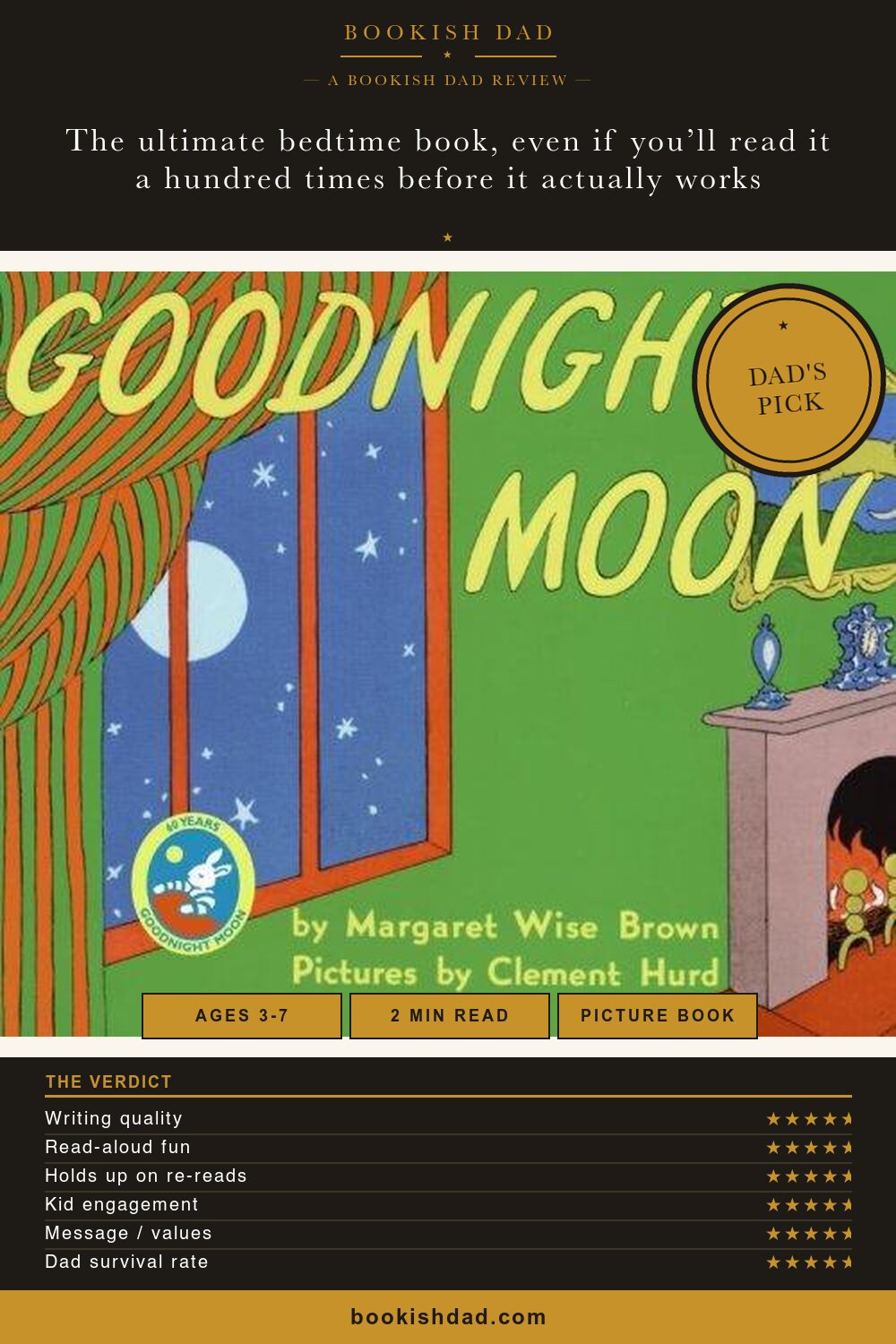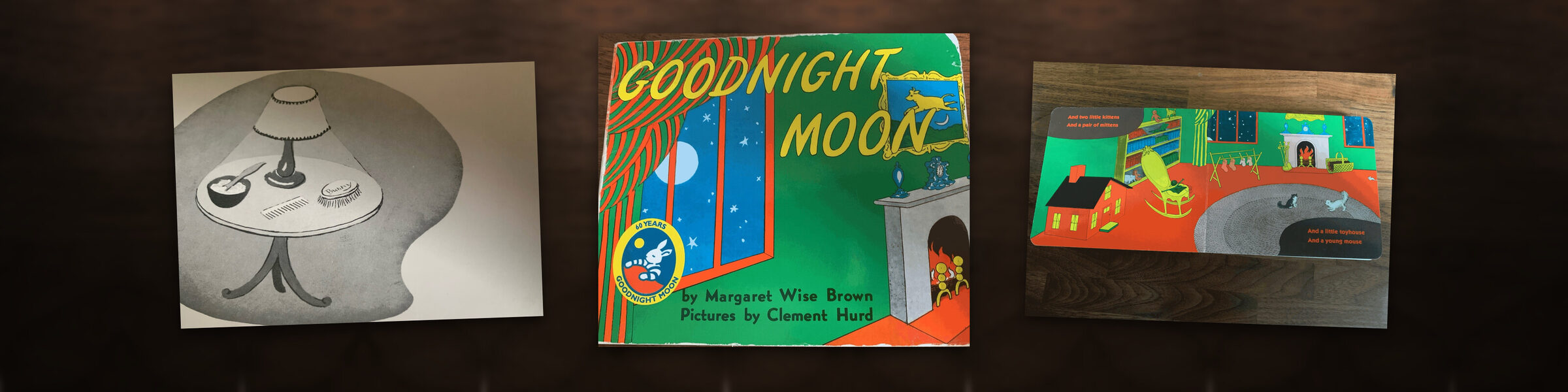

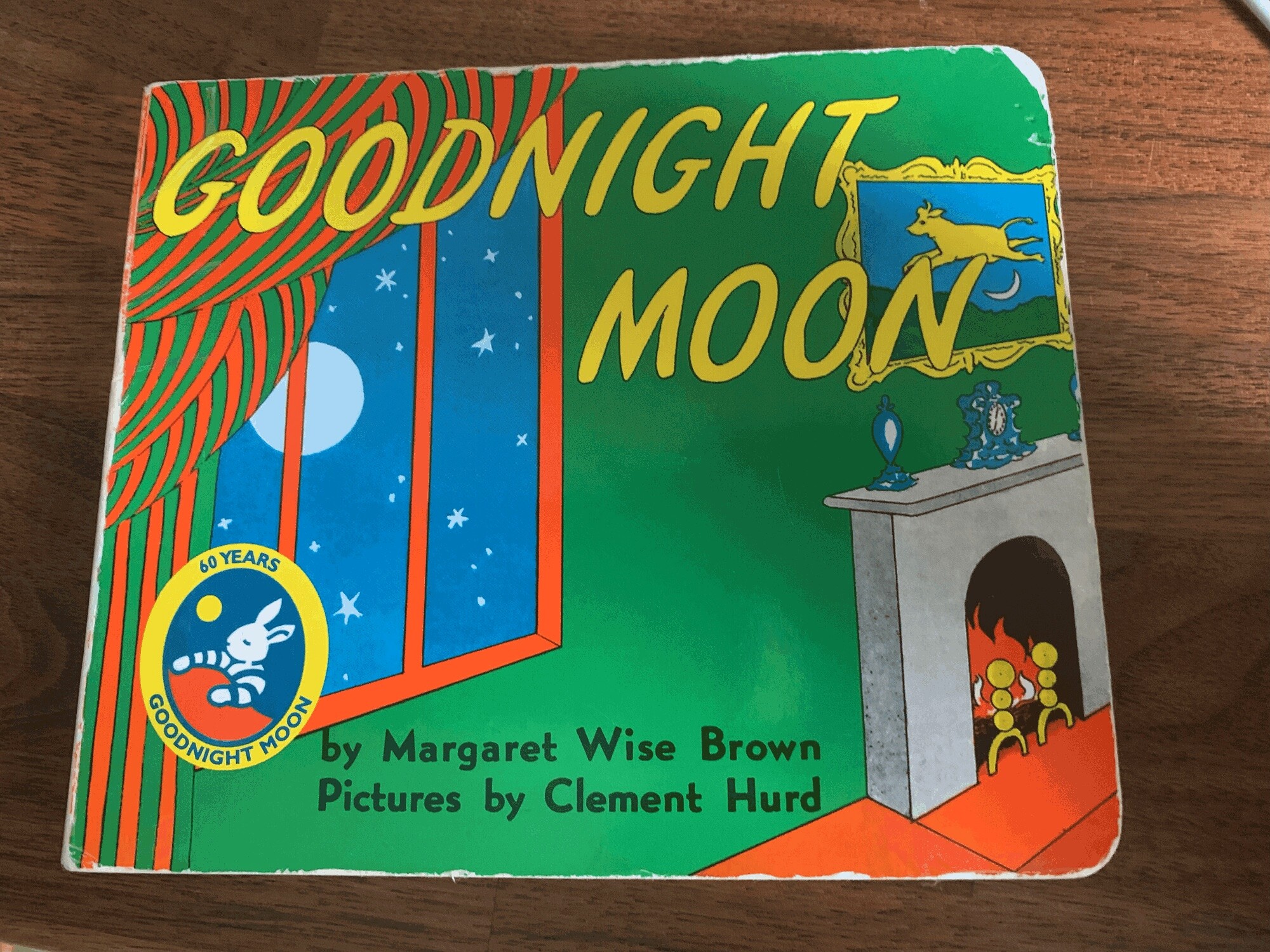
Goodnight Moon is such a classic that it's possibly the book that got me so interested in children's books in general. It's one of those books where you read it for the first time and it doesn't make a lot of sense. But there's something that happens when you read this book over and over and over again. You really come to appreciate the overall art that is creating a children's book. It's so enjoyable both for kids and for adults, and that seems to transcend more than just the words on the page or the illustrations, all of which are amazing. It's when you put everything together that you see why it has stood the test of time, why it comes out for nightly readings, why the kids always get into a tranquil sense of calmness when you read it, and why you find yourself enjoying it so much even though there's no super compelling story or illustrations you could stare at for hours. There's just something deeper there that Margaret Wise Brown really uncovered with children's books.
The only word that can come next
There's not really a plot here, and it's not standard sentence construction either. It's very much a poem. You could say it's just this run-on sentence of and this, and this, and this, goodnight this, goodnight that. But it fits. It's all very thoughtfully crafted together. There is a subtle rhyme in there, but it's not anchored on the rhyme; the rhyme doesn't have to exist for it to work, and a lot of it doesn't necessarily even stick. There's kittens and mittens, toy house and mouse, but then you get chairs and other things that don't fit neatly into a nice, typical child's rhyming box.
It's almost hard to talk about the language without connecting in the illustrations, but for me it's just so enjoyable to read. The words flow off the tongue, there's nothing you would ever trip over, and when you get to the next word it feels as if there really can't be another word there. She chose the perfect word, the only word that can come next, throughout the whole story. You read a page and it leads you directly into the next page. I could read it in my sleep, not because I have it memorized, but because each word is chosen so carefully it has to be that next word.
And what parent doesn't love saying "Goodnight nobody" to a blank page? Or the very end, when the rabbit is probably right in that middle ground between consciousness and sleep. Goodnight stars, goodnight air. Then the next page they cross over and they're fully asleep. I love, love reading it. I really do think it's probably the initial cause of me asking, hey, why do I like this book? It's not the story. Why do my kids always pull it off the shelf? There's something a little deeper there.
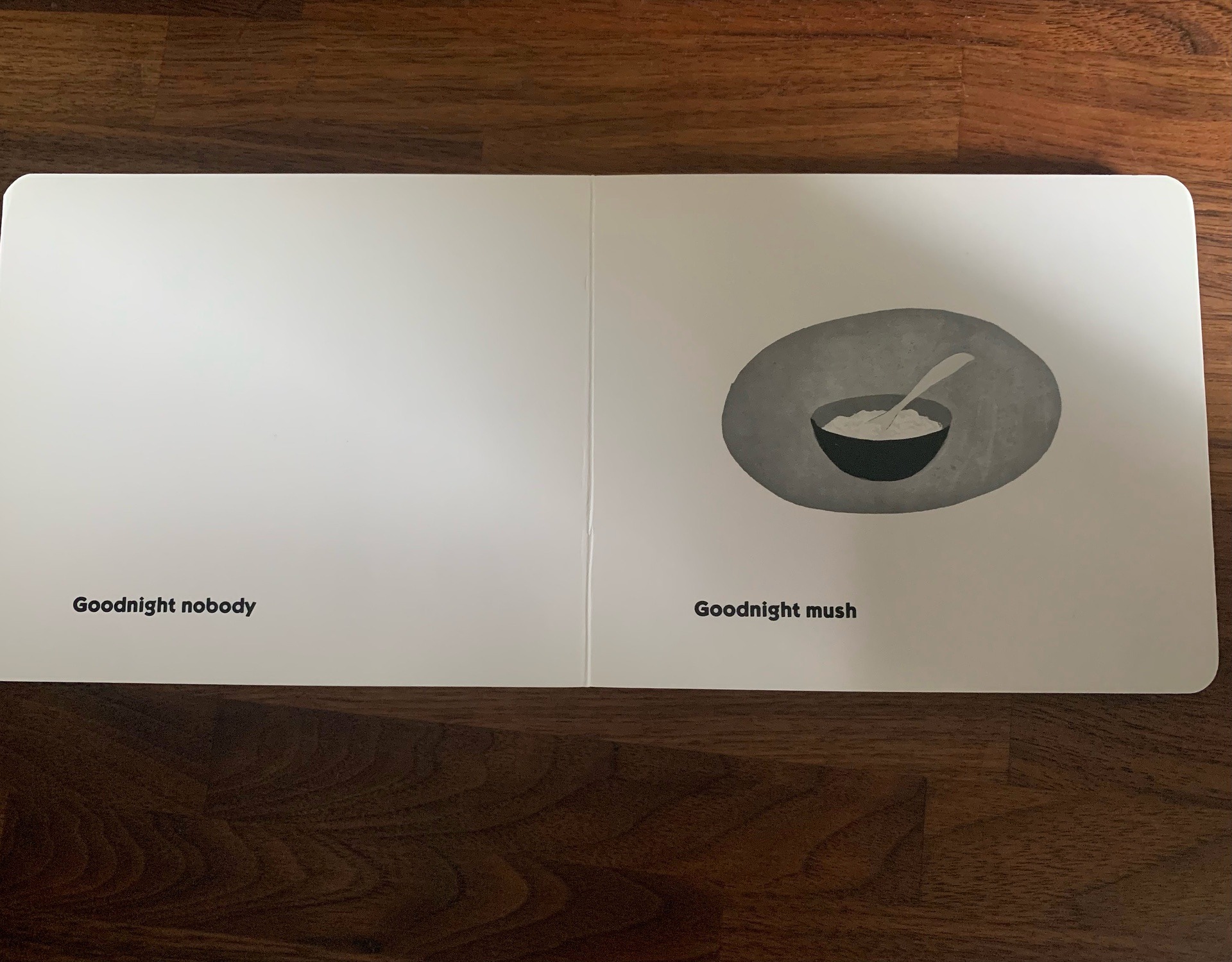
The greatest illustration of all time that is just a blank page.
I'm no literary genius by any means, and I don't think I have any qualifications to say what is art and what is not art. But I can say I've read so many children's books, and I can tell you the ones that are so enjoyable to read and become even more enjoyable the more you read them, and then on the other end of the spectrum, the ones that are clunky and wordy, where you dread turning the page to another wall of text with long awkward sentences and words that seem disconnected. If I were to stack rank all of the books, Goodnight Moon is right at the top of the most enjoyable ones to read, probably alongside some Dr. Seuss classics. Those are really the two that stand out to me as something special when it comes to the words on the page.
A room that slowly changes
The illustrations are the perfect fit for this story. They're this blend of busy simplicity. We're given the setting of a room with all of these different objects in it, and then one by one each of them is mentioned throughout the story. Random objects like mittens and socks hanging to dry, an odd balloon just hanging from the ceiling. Then you have the people of the story: the old woman whispering hush as she knits (presumably the mom or the grandma, maybe the nanny, trying to get the bunny to sleep), and a mouse, which the cats generally don't seem to notice, luckily for the mouse.
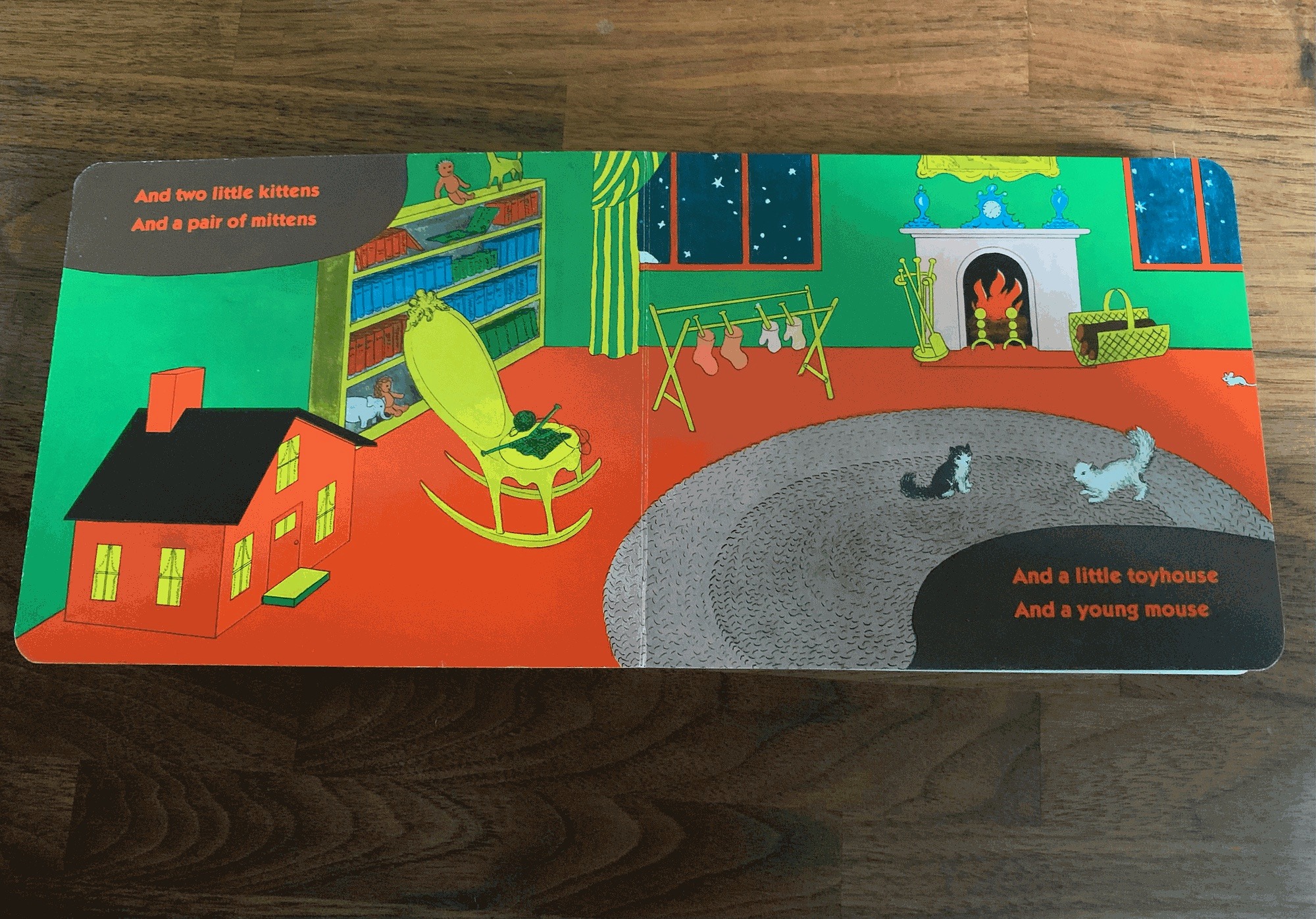
The Room at the beginning of the bedtime routine. No old lady whisper hush just yet.
If you're really perceptive, you can see each picture slowly changing over time. The first time we're shown the full spread of the room, the moon is still pretty low in the sky, the room is still relatively bright, and the old lady isn't even there yet. Then over time it changes. The moon slowly rises, the room gets a little darker, everybody's slightly changing positions. The kittens who were playing with the yarn start going to sleep. The mouse moves around the room, eventually working his way up to the windowsill to look out at the moon (he also sits in front of the fire in one picture). By the end the bunny who had been rustling around in bed saying goodnight to things is asleep, the cats are asleep in the chair, and the old lady has left the room, probably closing the door quietly. We get this progression of a room that is mostly static but slowly changing as bedtime changes, and it's really well done.
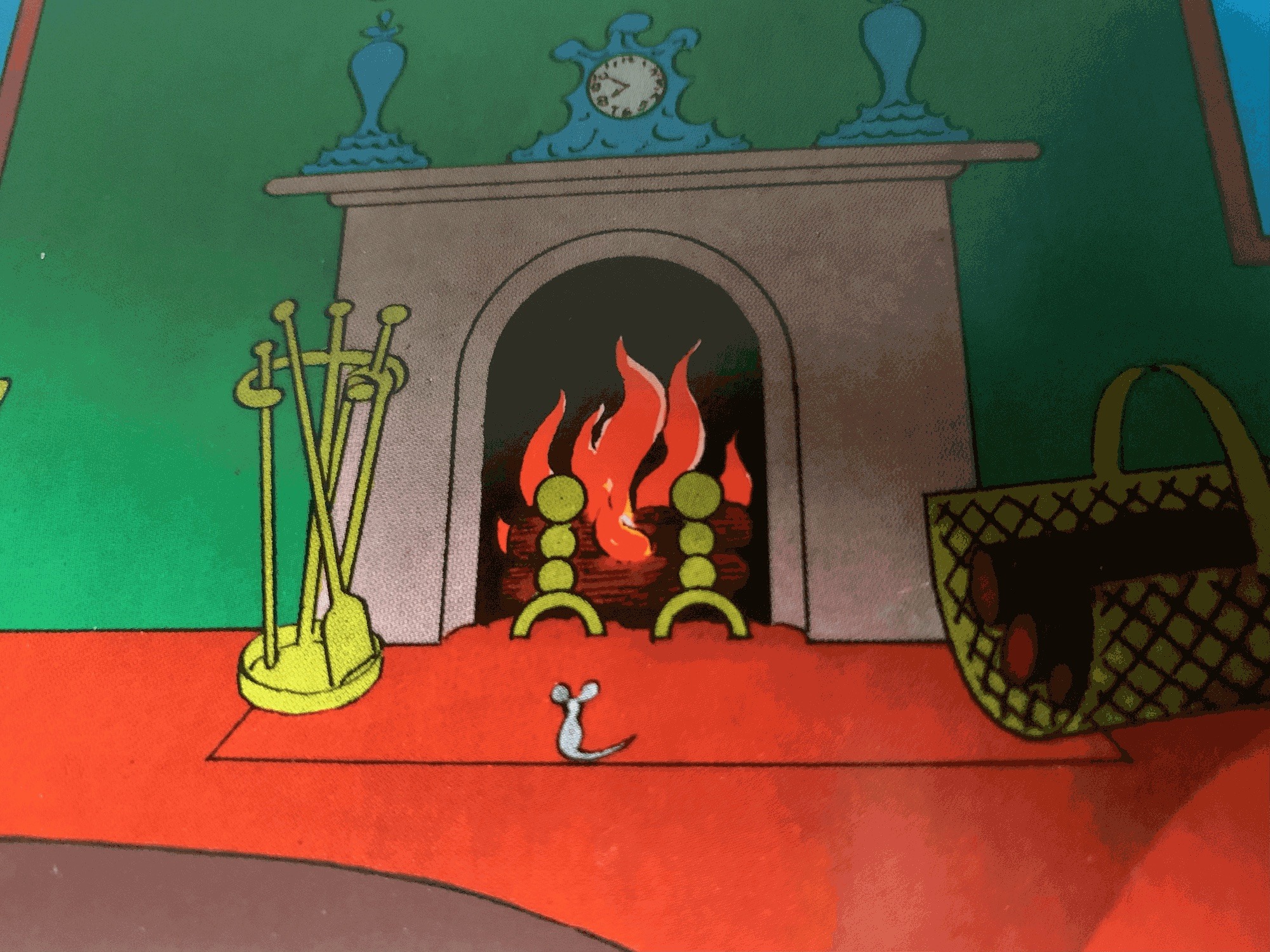
I wish I was this mouse right here. That looks darn comfy.
My kids also really like the contrast between the pages that have a lot of color and the pages that have none. You flip the page and it goes grayscale to color, color to grayscale, back and forth. It's very intentional, and I can't tell you exactly what the purpose is, but there's something about the back and forthness where you're given the full spread of the room and then the more detailed goodnight little house, goodnight mouse, just those things called out specifically. The drawings catch both a kid's eye with the subtle changes and a parent's.
What my kids do during it
Kid engagement here is exactly what you'd want from this book. The whole point of a bedtime routine is to get them sleepy and ready for bed, and there is no better book up for this task than Goodnight Moon. Both my daughter and my son, almost the second I pull this book out, cuddle up against my shoulder, their constantly moving bodies finally calm, and they quietly listen. Never once have I been stopped to answer a question on this book. Even though it's a bit esoteric, they never feel the need to fill in the gaps. Are they dying to pull it off the shelf or asking for a reread? No, it's not that type of book. But it's a book designed with a purpose in mind and it does that perfectly, and my kids never complain (despite almost always complaining about bedtime as a concept).
As for a message, it's really difficult to find any point to the book other than something to read a child before bed to get them sleepy, and I think that's actually the interesting part. I've read deeper discussions about the evolution of children's stories over time and how they started out very moralistic. Hans Christian Andersen style stuff, kids who do something they shouldn't and get punished severely for it as a cautionary tale, or really anything Grimm's fairy tale ish. Around the time Margaret Wise Brown started writing, and maybe she was a big leader in changing this, books didn't need that tidy moral anymore. They could just be something that exists on its own, thought provoking or calming, something that resonates with the way a child's mind works. A child's book written for children, as opposed to adults writing what they want children to read. That's what Goodnight Moon really is. It's a book designed with kids in mind first.
Dad survival is not even a question. I've read this book over and over and each time I read it I like it even more and can appreciate it even more. I want to pull it off the shelf because it makes my kids sleepy, but also because it makes my tongue and eyes happy. It's the book I would always give somebody as a gift if they're having a young child, even though they probably already have it. It might get read so much they need two copies, because the first copy will get worn out.
The Nerd Out Section
You have to wonder why the balloon is there. Did the little bunny come home from a birthday party? It's floating on the ceiling, so there's helium in it, so it's not just your random parent blowing up a balloon. If you were to really analyze the book deeply, I always wonder where that balloon came from.
They also don't seem too concerned with pests. Maybe when this was written the mouse was a pet, just not in a cage or anything like that. And a few funny observations: there is a brush that says the word "bunny" on it, which I always find hilarious. I think you can assume this bunny's name is Bunny and he has his own named brush.
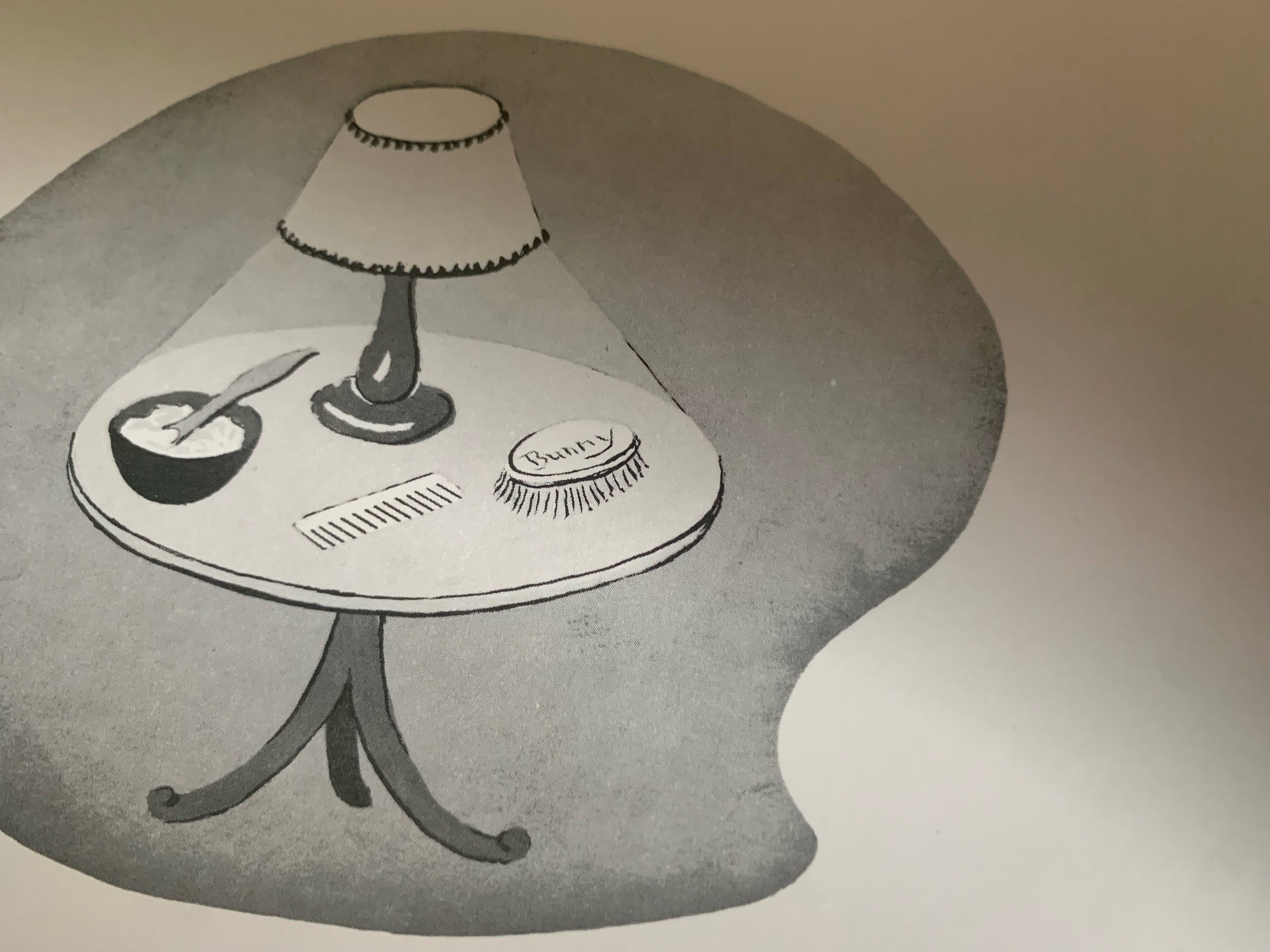
Our protagonist will never get confused about which brush is theirs.
If I had one critique, it's that they left the bowl of mush out. It looks like the mouse probably snuck a few little bites at some point, but as a parent of children who like their night snack, I would probably be the parent who grabs that bowl of mush and brings it down to the sink. Not to wash it, necessarily. I'd probably just put it in the sink for somebody to do later.