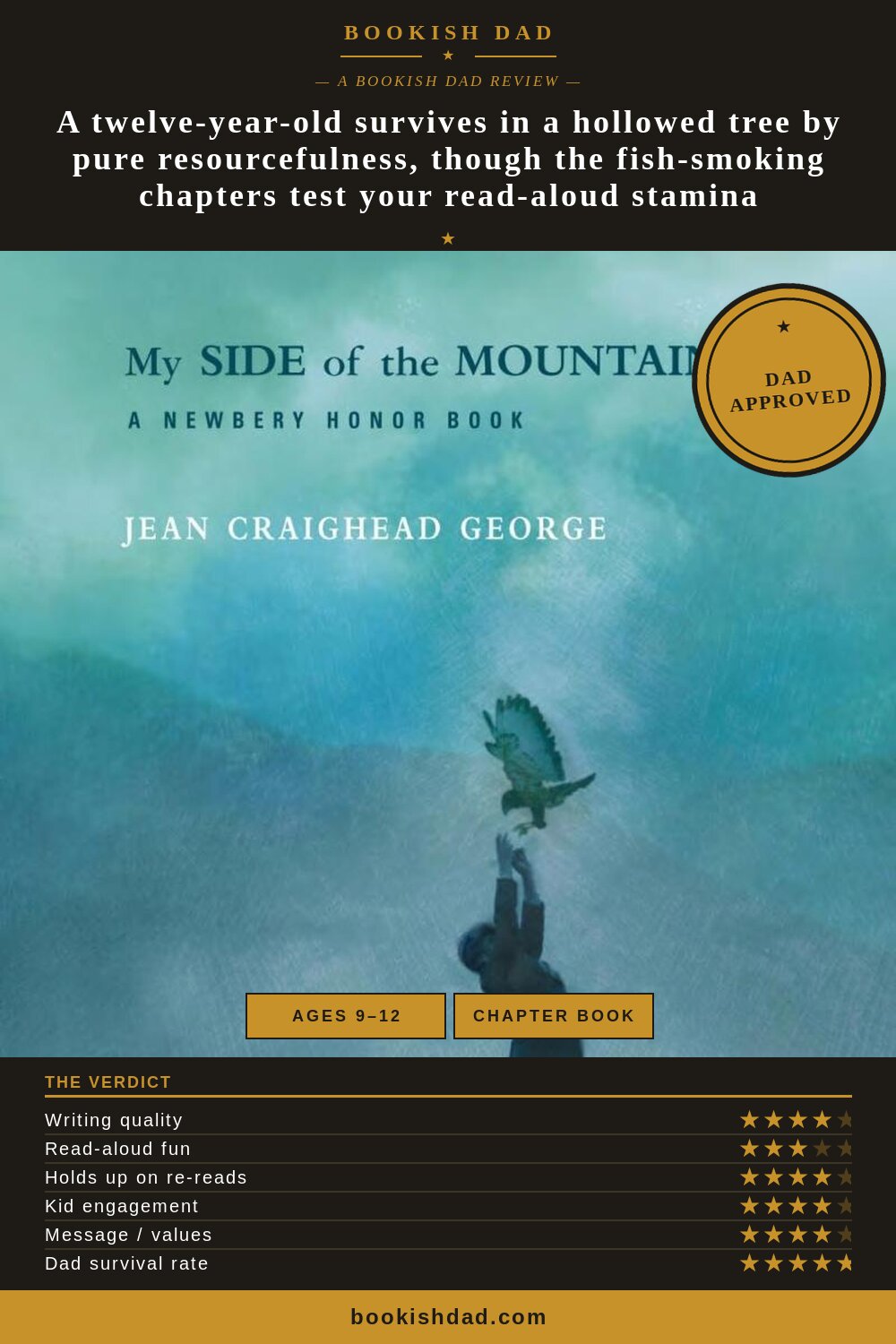

Sometime around 1994 I paced off the distance from our back door to the big maple at the edge of the yard, decided it was far enough from parental oversight, and spent most of a July mentally furnishing it. I had a list. Sleeping bag, jackknife, a coffee can for reasons I no longer remember. I never moved in, obviously, because I liked dinner and cable television, but the planning phase was one of the great pleasures of my childhood, and this book is where that planning phase comes from. Not for me specifically (I got there through Gary Paulsen), but for American children generally. A boy runs away to live in a hollowed-out tree in the Catskills. That's the whole pitch, and it has been closing the sale since 1959.
The blueprint every tree-fort kid was working from
Sam Gribley is twelve, one of nine kids in a cramped New York City apartment, and he leaves. He heads for his great-grandfather's abandoned farm near Delhi, New York, having learned his survival skills the most 1959 way possible: by reading a book at the public library. He burns out the inside of a hollow tree to make a house. He steals a peregrine falcon chick from a nest, names her Frightful, and trains her to hunt. He accidentally traps a weasel and names him The Baron. He makes deerskin clothes from deer that poachers killed illegally, forages, smokes fish, and at one point insulates his tree so well he nearly dies of carbon monoxide poisoning, which is the kind of detail that tells you George was not messing around. This is not a fantasy of the woods. It's a fantasy with a materials list.
And the writing holds it up. George (who also did the illustrations herself, which I respect enormously as a flex) writes in a plain, specific first person that never talks down and never gets purple. When Sam tells you what something tasted like or how long something took, you believe him. The famous claim that cattails taste like potato if you chew them long enough is exactly the register of the whole book: practical, slightly suspicious, weirdly convincing. There are slower stretches, mostly in the middle where the food preparation gets thorough, and a kid who isn't already sold on the premise might drift there. Mine did not drift.
My daughter reviews the parenting decisions of 1959
We came to this straight off Hatchet, which we finished in the spring, and when she asked if there were more books where a kid has to survive things, I had this one off the shelf before she finished the sentence. She stayed locked in for the run, but her real engagement showed up as cross-examination. The moment that stopped her cold wasn't a bear or a blizzard. It was Sam's father letting him go. She sat up against the headboard and wanted to know if the dad even told anybody, and I had to explain that he basically said good luck, and if you make it, tell someone in town. She thought about that for a while. Then, days later, when Sam starts taking deer off the poachers, she delivered a ruling on her way under the covers: you can't steal something that was already stolen. She has a whole body of case law on theft in children's literature at this point and I believe this one is now precedent.
My son is four and mostly sat this one out, but he surfaced during the falcon material, listened to about two pages of Frightful learning to hunt, and asked if we could get a weasel instead. I said no. He looked at the cat for a long, evaluating moment. The cat left the room. That was the extent of his involvement, which for a book with no pictures on most pages is about right for him.
Voices, logistics, and the ending nobody warns you about
As a read-aloud it's solid but not a performance piece. It's first-person Sam almost the whole way, so you're doing one earnest twelve-year-old for two weeks, with a break when Bando shows up. Bando is a lost English professor Sam initially assumes is a criminal, and he got a warm, slightly distracted academic voice from me that my daughter accepted without comment, which is her version of a signed contract. Dad survival is high here; it's a one-pass chapter book, not a nightly loop, and the only real hazard is that you will be asked to identify edible plants on walks for the rest of the summer. I have already disappointed her twice.
On message: yes, it's a book about a kid running away, and no, I'm not worried, because my daughter's core values include indoor plumbing. What the book is actually teaching is competence, patience, and reading your way out of problems, and then the ending complicates the whole fantasy in a way I didn't remember. Reporters find Sam. Then his family finds Sam. And the book lands on the honest note that total self-sufficiency was never really what he wanted, which is a lot for a kid to chew on, longer even than a cattail. Four stars instead of five only because the middle sags a little for a kid who isn't already all in. If your kid is all in, round up.