
I made it 41 years without reading The Cricket in Times Square, which I can only assume was a filing error, because this book was sitting in every library I ever walked into as a kid and nobody handed it to me. I was busy with Dahl and Choose Your Own Adventure, and somewhere in a parallel timeline there's a seven-year-old me who found this instead and grew up wanting to live in a drainpipe. The premise sounds like the setup to a joke (a cricket, a mouse, and a cat share real estate in the Times Square subway station), and Selden just plays it completely straight, and it works. It is charming beyond reason. I kept waiting for the reason and it never showed up.
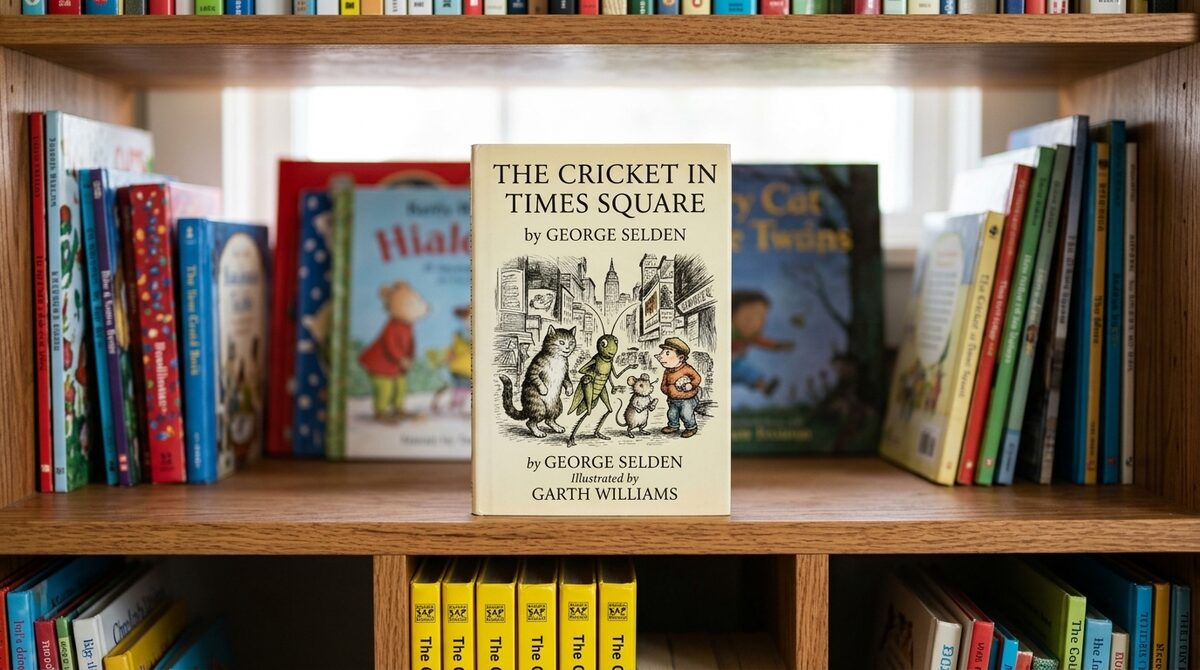
The bones: a boy named Mario, whose parents run a struggling newsstand in the subway, finds a cricket named Chester who got shipped in from Connecticut inside somebody's picnic basket. Chester falls in with Tucker Mouse and Harry Cat, who live in an abandoned drainpipe nearby, and the three of them plus Mario proceed to have the kind of low-stakes, high-warmth adventures that 1960 chapter books were unreasonably good at. The writing is clean and unhurried, the sentences read aloud without tripping you, and Garth Williams (yes, the Charlotte's Web guy) drops one or two illustrations into each chapter that my daughter examined like evidence. Also worth flagging for modern parents: Mario has a level of freedom in this city that will make you check your own front door lock. He runs the newsstand alone at night. He rides the subway to Chinatown by himself. My daughter registered this and said nothing, which worried me more than a question would have.
A mouse with a savings account
Tucker Mouse is the character. He's a fast-talking Broadway type who has spent his life scrounging loose change off the subway floor, and my daughter spent the first stretch of the book referring to him as "the mouse who's going to steal something." Then Chester, in his sleep, eats half of a two-dollar bill, the Bellinis confine him to his cage until the debt gets repaid, and Tucker hands over his entire life's savings to bail out a cricket he's known for about a week. My daughter sat with that for a second and said "huh." From her, that is a full editorial. My son's contribution came from the other direction: he wanted to know WHERE DOES THE MOUSE KEEP IT, and I did not have a good answer, and we lost about four minutes of bedtime to drainpipe logistics.
The voice situation, which is now permanent
This book is a gift if you do voices and a decent time even if you don't. Tucker came out of me sounding like a cab dispatcher crossed with my uncle, Harry got a low unbothered rumble, and Chester got earnest small-town sincerity, and I regret none of it, though I know the rules of this house and I know I'll be doing dispatcher-uncle until my son leaves for college. Speaking of my son: he's four, so a chapter book about a musical cricket held him in patches, but the concept of chirping owned him completely. He spent most of a Saturday trying to produce a chirp, first by rubbing his forearms together, then his legs, and finally settled on a wet squeak through his front teeth, which he now deploys from the back seat of the car without warning.
The back half of the book is where it lifts off. Chester turns out to have an ear for music, starts imitating songs off the radio, and a music-teacher customer named Mr. Smedley writes a letter to the New York Times about him. Crowds show up. Chester ends up giving concerts twice a day at a subway newsstand, gets exhausted inside a week, and decides to retire at the absolute peak of his fame, closing with a farewell performance that stops the whole city in its tracks. My daughter's ruling, delivered flat on the way to brush her teeth: "he stopped because it turned into a job." She's eight. Selden took a whole book to build that idea and she invoiced it in seven words.
One thing to know before you start
The copyright page says 1960 and mostly you'd never know it, except in the Chinatown chapters, where Mario buys Chester's cage from a shopkeeper named Sai Fong. The character is treated with real affection, but he's written through a 1960 lens, and how that reads on the page is about what you'd guess for the era. We did the same pause-and-talk we did with Pippi. Preview those chapters and decide how you want to handle them; it's a speed bump, not a wall.
The ending, and whether I'd do it all again
The last chapter got me. Chester heads home to Connecticut, Mario wakes up, understands immediately, and feels glad for him, and I finished that page at 8:52 on a school night with my voice sitting about a half octave above where it started. Nobody in my family commented, which I appreciated. As for re-reads: this one will survive them. The Tucker material gets funnier once you know where he's headed, the middle chapters are short enough that "one more" is always a reasonable request, and I'd genuinely start it over tonight, though the dispatcher voice does a number on my throat by chapter four. The message underneath it all (be generous, do the thing you love on your own terms, go home when it's time) is the kind kids absorb without noticing they've been handed anything, which is the only delivery method that works at this age. Or at least the only one that works in my house.