
My daughter waited a full day after we read the school chapter, and then at dinner on a Wednesday, over noodles, she asked whether anyone can actually make Pippi go to school. I said the town gives it a shot. She said "but they can't make her," nodded once like a judge entering a ruling, and went back to her noodles. My wife looked at me across the table the way you look at someone who has brought something into the house that cannot be returned.
Which, fair. Pippi Longstocking is a nine-year-old redhead who lives alone in a big house called Villa Villekulla with a monkey named Mr. Nilsson, a horse, and a suitcase full of gold. Her mother died when she was a baby and her father, a sea captain, vanished at sea, and Lindgren delivers both of these facts with about the emotional weight most books would give a character's shoe size, then moves on to the good stuff. There are no guardians. She's strong enough to lift her horse, which is not presented as a metaphor for anything; she just can. She befriends Tommy and Annika, two normal kids from the village, and the book runs as a series of episodes where Pippi collides with some fixture of ordinary childhood (school, the circus, a coffee party at Tommy and Annika's house) and, having spent her whole life at sea, knows exactly none of the rules. That gap is where all the comedy lives, and there is a lot of it.
Eighty years old and still moving faster than books published last Tuesday
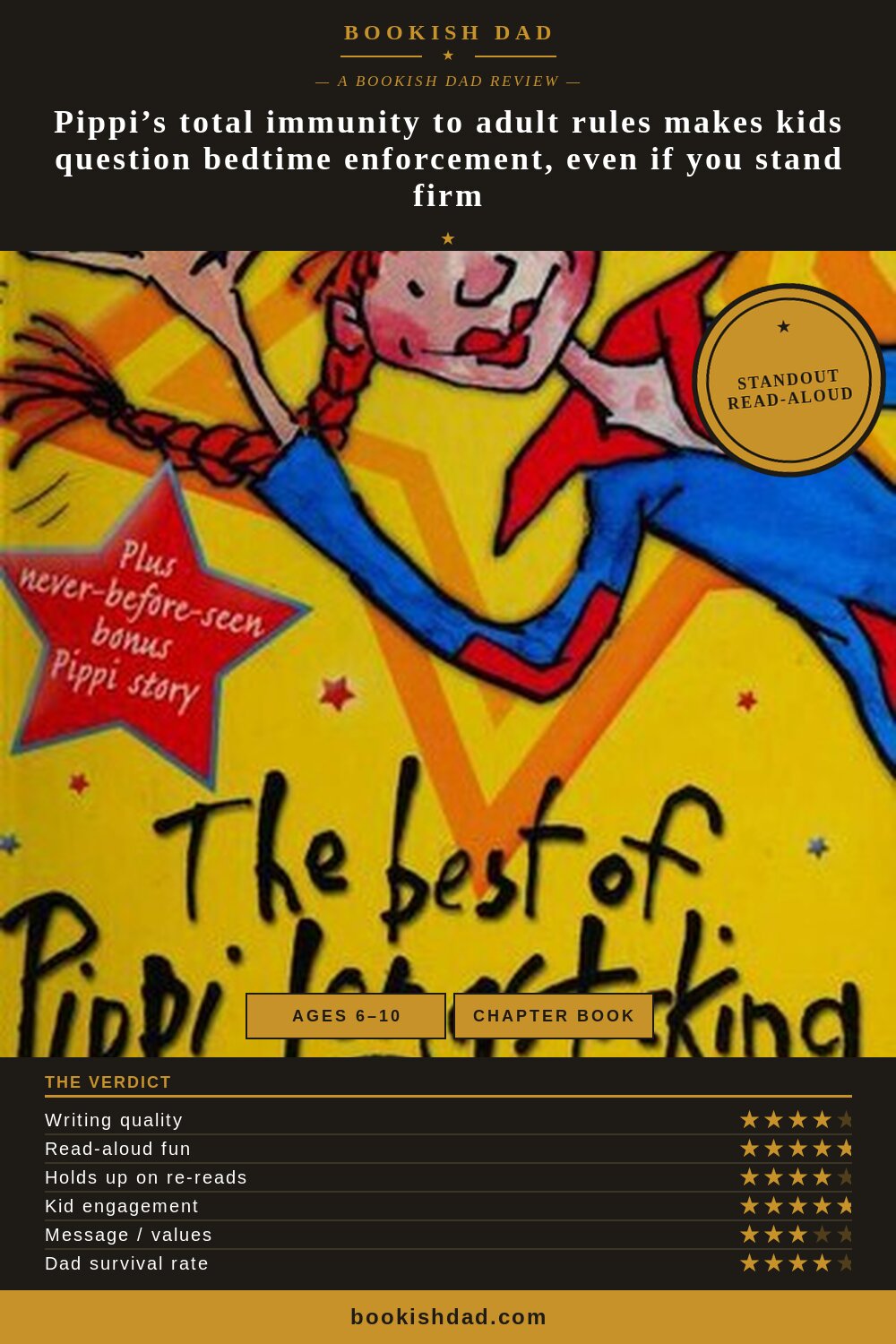
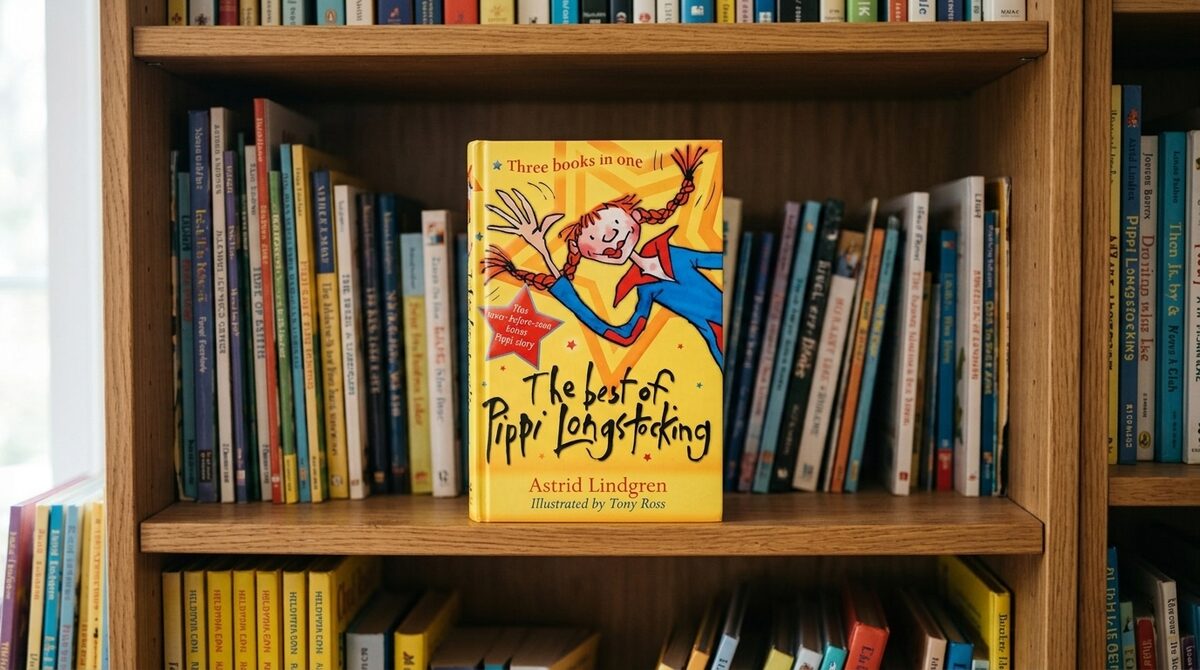
What surprised me on this read (my first since roughly the Reagan administration, and honestly I may only remember the TV show) is how tight the writing is. Every chapter is built like its own short story, complete with setup and payoff, so you never hit that saggy middle stretch that kills chapter books at bedtime. Lindgren writes Pippi's nonsense completely straight, no winking, no nudging the reader in the ribs, and that deadpan delivery is exactly why it works. The edition we read has an updated translation and Lauren Child's illustrations, which are genuinely funny in their own right; my daughter spent real time on them, which she does not do for art she considers filler.
The Pippi voice, which I now own forever
For read-aloud purposes I gave Pippi the voice of a game-show host who has never once been contradicted in her life. Loud, cheerful, sailing straight through objections. I knew within two pages I'd be doing it for the rest of the book, and probably at Thanksgiving. It's a fantastic performance text, though, because Pippi says outrageous things in the tone of someone reporting the weather, and the bigger the gap between what she's saying and how calmly your voice says it, the harder the kids go down. Tommy and Annika get my reasonable-citizen voices, which exist purely to be steamrolled.
Furniture was moved during the production of this review
My son caught maybe forty percent of this book, which is a solid number for a four-year-old sitting through a chapter book, but the forty percent he caught included the part about Pippi lifting her horse, and that information changed him. At 7:48 the next morning I found him with one corner of the ottoman off the rug, face purple, announcing I AM STRONGER THAN A HORSE. The cat left the room in a manner suggesting she'd read the situation correctly. My daughter, meanwhile, has proposed that our house should have a name like Villa Villekulla. She has one picked out. She declines to share it with me, which I believe is the point.
The 1945 of it all
You should know going in that the storyline around Pippi's missing father involves a dated and genuinely offensive stereotype about Indigenous islanders. Older translations handle it worse; the updated one we read softens the language, but it doesn't vanish, and if your kid is old enough for this book she's old enough to notice. We paused and talked about it, the same conversation we've had with other books from other decades, and my daughter processed it with her usual courtroom efficiency. Plan for it. Beyond that, the book isn't teaching much of anything, and I mean that as a compliment. It's a pure autonomy fantasy: no bedtime, a diet built substantially on cookies and pancakes, adults who exist mostly to be baffled. Lindgren is entirely on the kid's side, and kids can smell that from across the room. My daughter listens to this book the way I'd listen to someone describe a life I wasn't brave enough to attempt.
Survival-wise, this is one of the easier chapter books I've done. The episodes are compact, they land, and because each one stands alone you can re-read a single chapter without re-litigating the whole book. We've already done the circus chapter twice by request, and the Pippi voice costs me some vocal cords at full volume, but I could run this rotation for a long while before cracking. The only real casualty so far is the ottoman, and possibly my authority on the subject of bedtimes, which my daughter now regards as a regional custom.