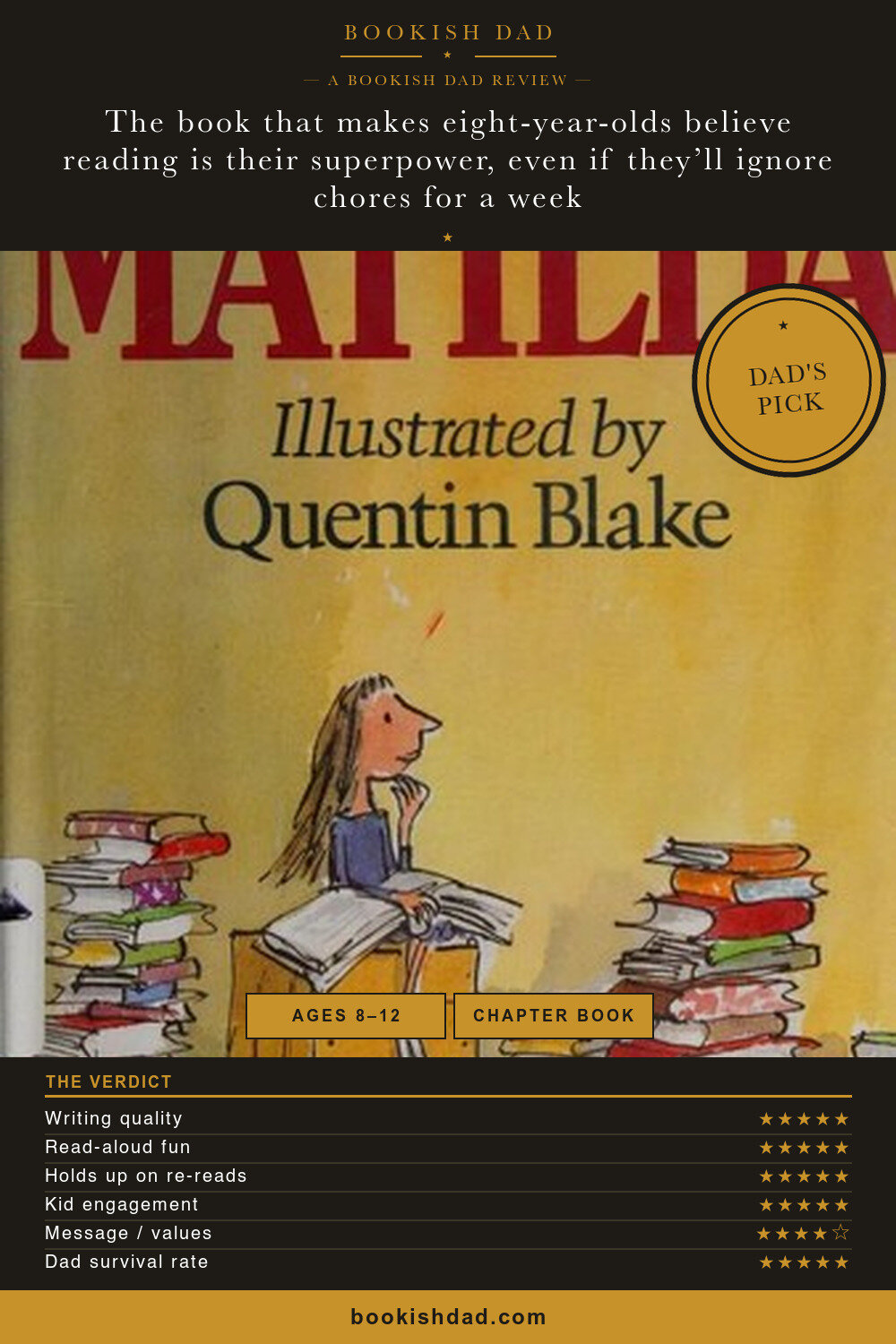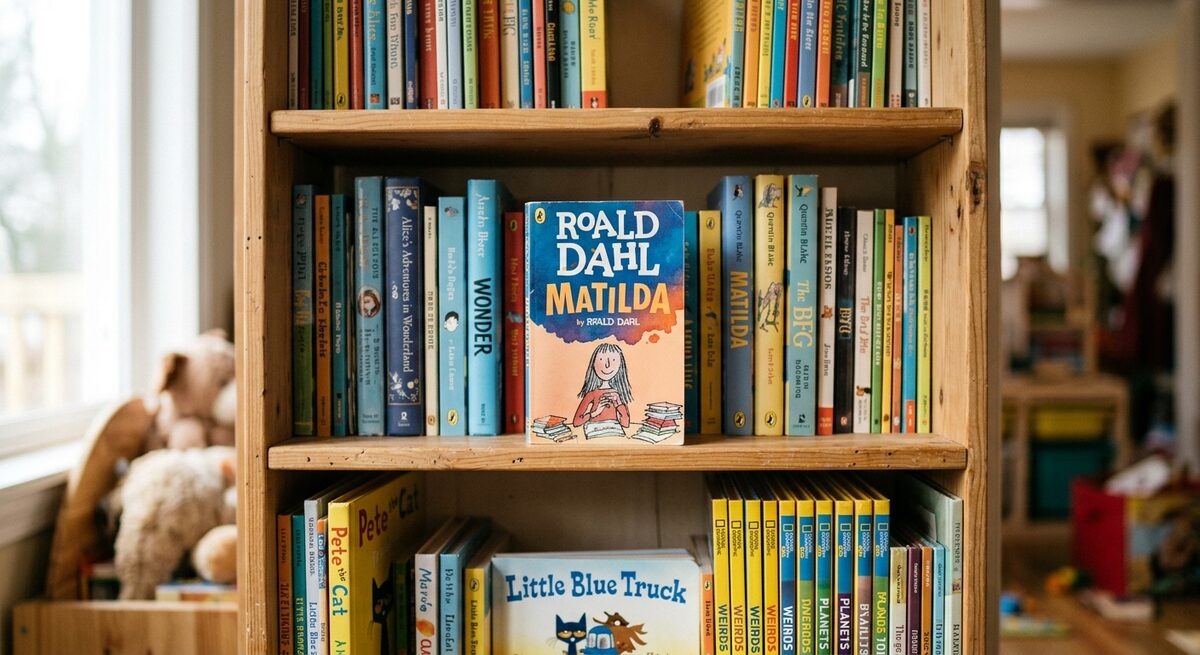

I read Matilda for the first time in 1991. I was seven, sitting on a brown carpet in a house that smelled like my mom's coffee, and I remember finishing the last page and just sitting there for a while because I did not know what to do with myself. It was the first book that made me feel like an author was on my side against the adults in his own story. Thirty-five years later I read it to my eight-year-old daughter and watched her have a version of the same experience, and I have been emotionally compromised about it ever since.
So this is going to be a biased review. I'm telling you that upfront. I'm going to do my honest best to talk about the book and not the seven-year-old version of me, but they share a brain and I can't fully separate them. Fair warning.
Dahl just writes better sentences than most people writing for kids
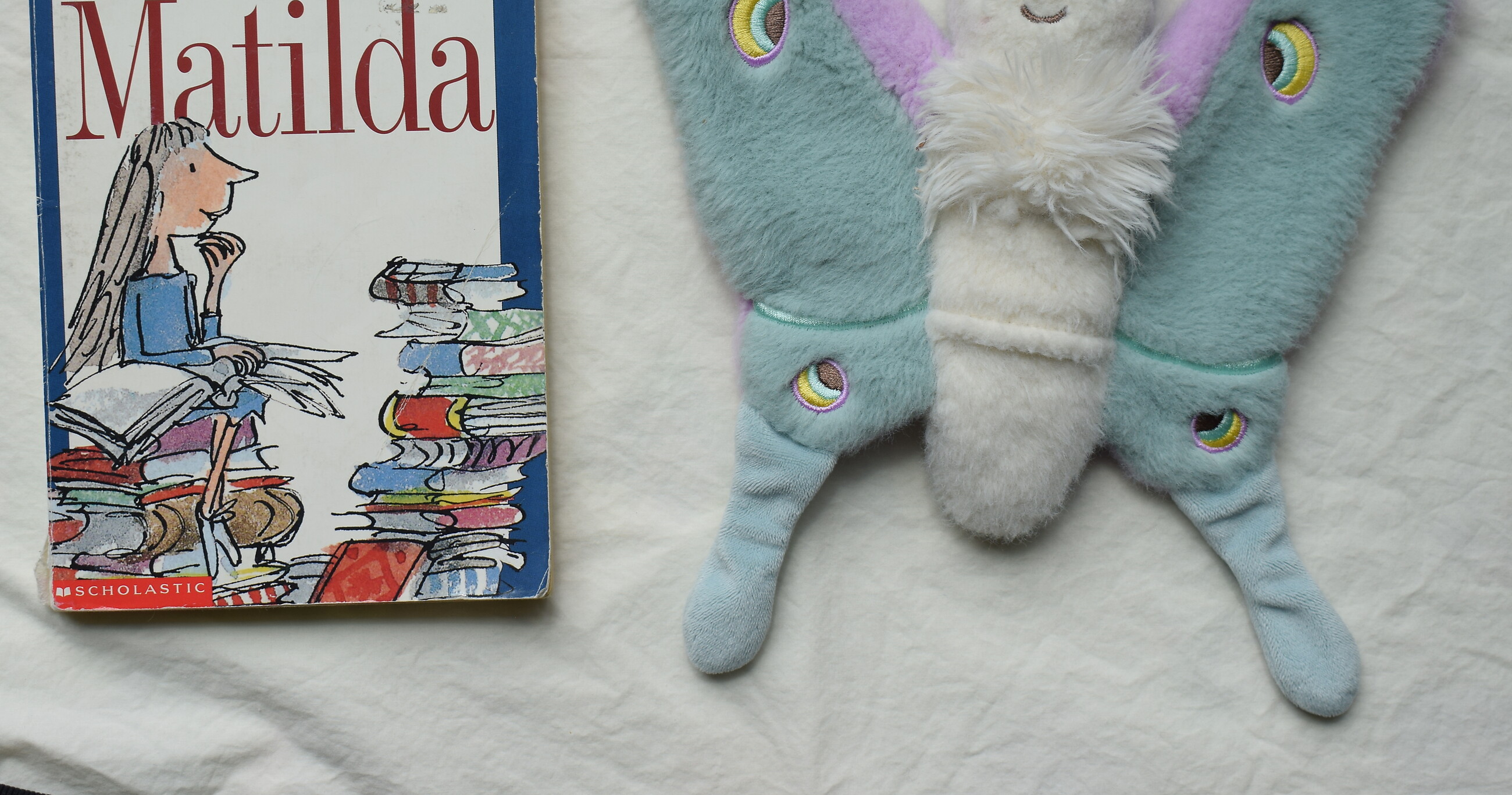
Moth respects the ambition but suspects a girl who reads this much probably has better things to do than befriend a plush insect.
What I noticed reading it aloud as an adult that I could not have noticed as a kid: the prose is quietly precise. Dahl writes sentences that sound conversational but are actually engineered. He'll drop a vocabulary word a grade or two above where you'd expect and trust the kid to catch it from context. He'll let a paragraph build and build and then end it on a flat little line that knocks the wind out of you. He's not afraid of long sentences and he's not afraid of three-word sentences. The rhythm is the whole game, and the rhythm is great.
Quentin Blake's illustrations are part of why the book works, too. They look like they were sketched in about forty seconds and they communicate more character than most fully rendered illustrations manage. There is a scratchy, slightly-too-fast quality to Blake's lines that matches Dahl's prose perfectly. They're the right pair. You can't really imagine the book illustrated by anyone else, and people have tried.
Read-aloud is where it really wakes up
Dahl is built for performance. The Wormwoods practically demand a voice. Miss Trunchbull demands a different, worse voice. Miss Honey requires restraint, which is harder. I went through the whole book doing voices that would have embarrassed me in any other context, and my daughter, normally a very stoic audience, actually started leaning forward during certain chapters, which from her might as well be a marching band. At one point she said "keep going" when I tried to close the book at a chapter break. She does not say "keep going." She says "okay, goodnight." So that was a moment.
My four-year-old son sat in for some of it, and was mostly too young, but he caught some of the broader physical comedy and laughed in the way he laughs when he doesn't fully understand a joke but trusts that it's funny. We'll do this one again with him in three years and I'll get the real reaction then.
Does it hold up on re-reads? Yes. Annoyingly yes.
This is the test that kills most of the books I loved as a kid. You read them again at forty and the seams show, the pacing drags, the jokes that killed you at eight feel like they're trying too hard. Matilda does not do that. The pacing is tight. The chapters are short and end on something. Dahl never lingers, which is the single biggest mistake most children's authors make. He gets in, makes his point, and gets out, and then the next chapter starts with something interesting happening already.
I have read it three times now in my life and I expect to read it at least twice more, once with my son and once when I am old and want to remember being seven. It is one of maybe six chapter books I'd put in that category.
The values question
This is where Matilda gets interesting and where I expect some parents to part ways with me. The book is morally clear in a way that modern children's literature is sometimes squeamish about. Bad adults are bad. Good adults are good. The bad adults get what's coming to them, and the kids cheer, and the narrator cheers along with them. There is no nuance about whether the villain has a backstory that explains her cruelty. She is just cruel and she is defeated and the world is better.
I think this is correct, actually, for an eight-year-old. Kids need stories where injustice gets answered. They get enough complication from real life. Dahl gives them a moral universe with edges, and within those edges he tells them: you are allowed to be smart, you are allowed to read, you are allowed to notice when adults are wrong, and you are allowed to do something about it. That is not a small message. That is the message I needed at seven and it's the message my daughter needs at eight, and I will die on this hill.
Will the 8:45 read-aloud parent make it out alive?
High. Genuinely high. There are books I have read to my kids that I would not read again if you paid me in cash, and there are books like this one where I was actually a little sad when we finished it. Dahl respects the adult reading aloud. He puts jokes in there for you. He gives you sentences that are fun to say. The chapters are paced for a tired parent at 8:45 PM. Whatever black magic he used to engineer that, it works on the thousandth reading, and I have not even hit my thousandth yet.
The only honest reservation I have is that Matilda's parents are drawn with such broad contempt that a kid in a complicated family situation might find it a lot. Dahl does not do subtle on parents. If that's something you're navigating, just know it's in there. Otherwise, this book is one of the great ones and I will be handing it to my son the second he can sit still for it.