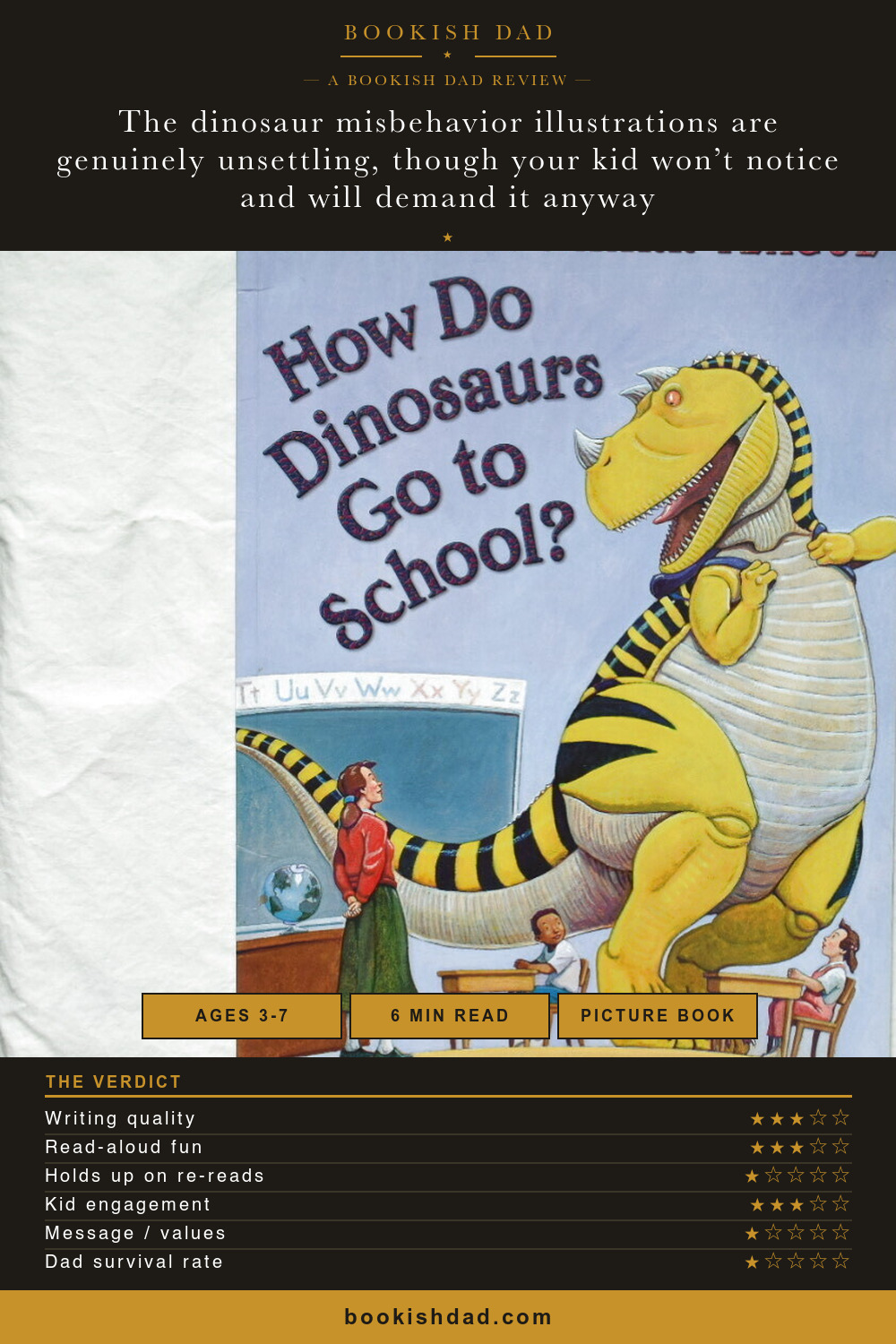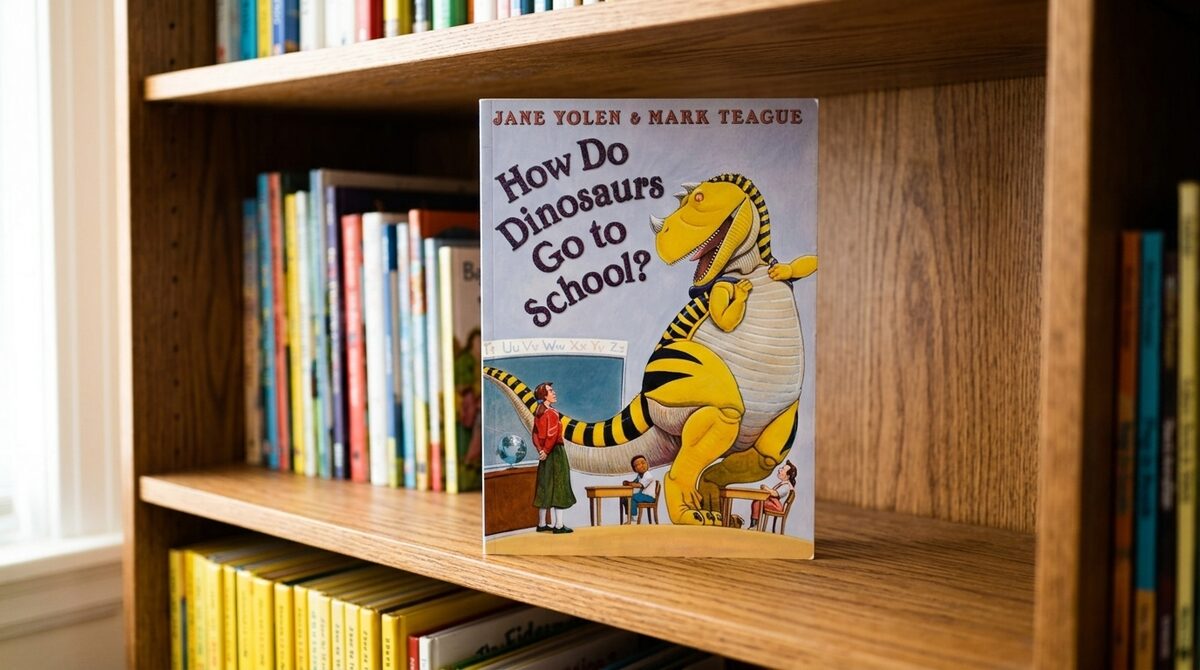

I want to talk about the art first because I cannot move past the art. Mark Teague's dinosaurs do something to my brain that I do not like. They are too realistic to be cartoons and too cartoonish to be realistic, and they exist in this little uncanny pocket where I find myself wanting to look away from the page. My son does not share this problem. My son thinks they're hilarious. My daughter, when I asked her, shrugged and said they were "fine," which from her is a review somewhere between lukewarm and indifferent. So it's just me. I'm aware it's just me. I have made peace with the fact that millions of children love these books and I am the broken adult in the equation. But every time I open one I get a little frisson of "no thank you" and then I read it anyway because I am a professional.
Now. The actual structural problem with this book, which is my real complaint and not just an aesthetic grievance about giant pebble-textured reptiles in human clothes. The premise is: how do dinosaurs go to school? And the book asks, basically, do dinosaurs misbehave in all these elaborate, specific, hilarious ways? And then, on the back half, it says: no, of course not, they behave nicely. They are good students. Good for them.
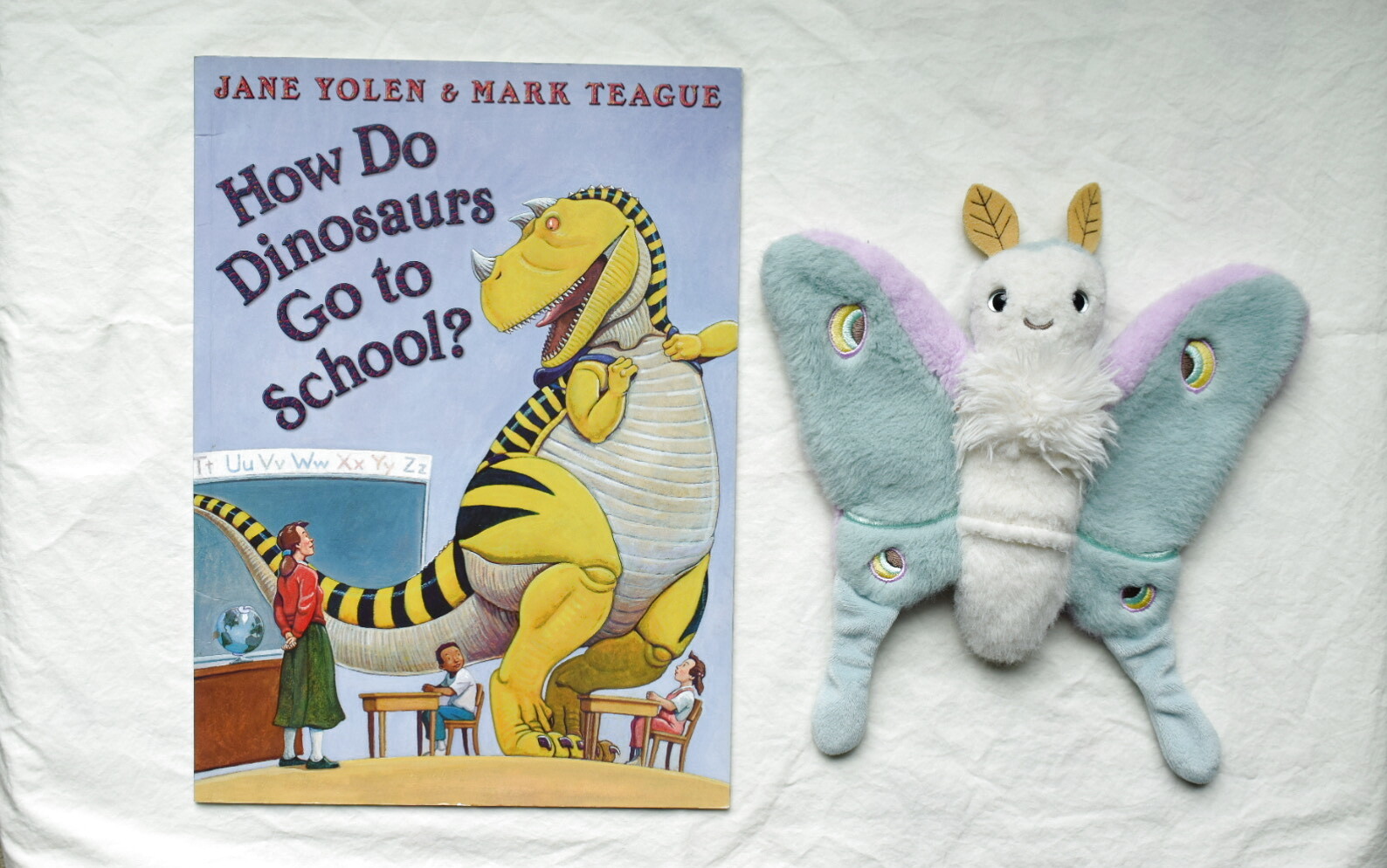
Reference Moth is genuinely concerned about sharing classroom space with that dinosaur, and honestly, fair.
Nobody on the editorial team apparently flagged the obvious problem. You cannot spend most of a book illustrating spectacular misbehavior in full color, drawn by a guy who clearly had a blast drawing it, and then expect a four-year-old to absorb the moral at the end. My son does not register the turn. My son registers the dinosaurs. The dinosaurs are doing rad stuff. The dinosaurs are doing the stuff he has been told repeatedly not to do, and they are doing it as enormous prehistoric celebrities in a classroom setting. The "but they don't really do that" pivot at the end of the book has roughly the same impact as a surgeon general's warning on a candy commercial.
So we read it. And then my son (he's four) immediately wanted to know if he could try a few of the things the dinosaurs were not supposed to be doing. Thanks, Jane Yolen. I love you for Owl Moon. I love you generally. But this one created homework for me.
On its actual merits, the writing is solid. Yolen writes in rhyme, and her rhymes scan. They do not limp. They are not the kind of forced rhyming where you can hear the author searching for a word that ends in -ation. The rhythm works when you read it aloud, which is more than I can say for about half of the rhyming picture books in our house. I will give her that. The read-aloud goes down easy. There's a bounce to it. If you're doing voices, the dinosaur misbehavior pages are where you ham it up, and the well-behaved pages are where you sound resigned and slightly disappointed, which is also how I sound at most parent-teacher conferences.
The re-read situation is where things really come apart for me. There is no hidden depth here. There is no payoff on read fifteen that wasn't there on read one. It is a one-joke book, and the joke is "what if dinosaurs but at school." Once you've got it, you've got it. My son requested it for a couple of weeks and then drifted, which is honestly merciful because I was running out of patience for both the art and the moral. My daughter never had any use for it; she's eight and she correctly identified it as a book for younger kids and moved on with her life.
As for the dinosaur-naming gimmick, where the species name is tucked into each illustration, that's actually a nice touch for the right kid. My son does not care. He calls them all "the green one" and "the spiky one" and once memorably "the bad guy" for reasons he could not explain. A dinosaur-obsessed kid would probably get more mileage out of this layer than mine did.
The Dad Survival Rate is poor, and I'll tell you exactly why. It's not that the book is long. It's that every reading ends with me having to do parental cleanup. "Buddy, remember, the dinosaurs don't actually do those things." "But they're cool." "They're not cool, they're cautionary." "What's cautionary?" And so on, until bedtime collapses into a philosophical discussion about whether something can be funny and bad at the same time, which, yes, but I'd rather not litigate it at 8:15 PM. By read four or five I'm narrating with all the enthusiasm of a man reading the terms of service.
The message is well-intentioned (I am not disputing that part). Yolen and Teague are going for a specific move: "model good behavior by showing the absurdity of bad behavior." It's a classic move. It works in some books. It doesn't work here because the bad behavior is too fun and the good behavior is too rote. The scales aren't balanced. If you're going to do this kind of contrast book, the well-behaved half has to be at least as visually interesting as the misbehavior half, and it just isn't.
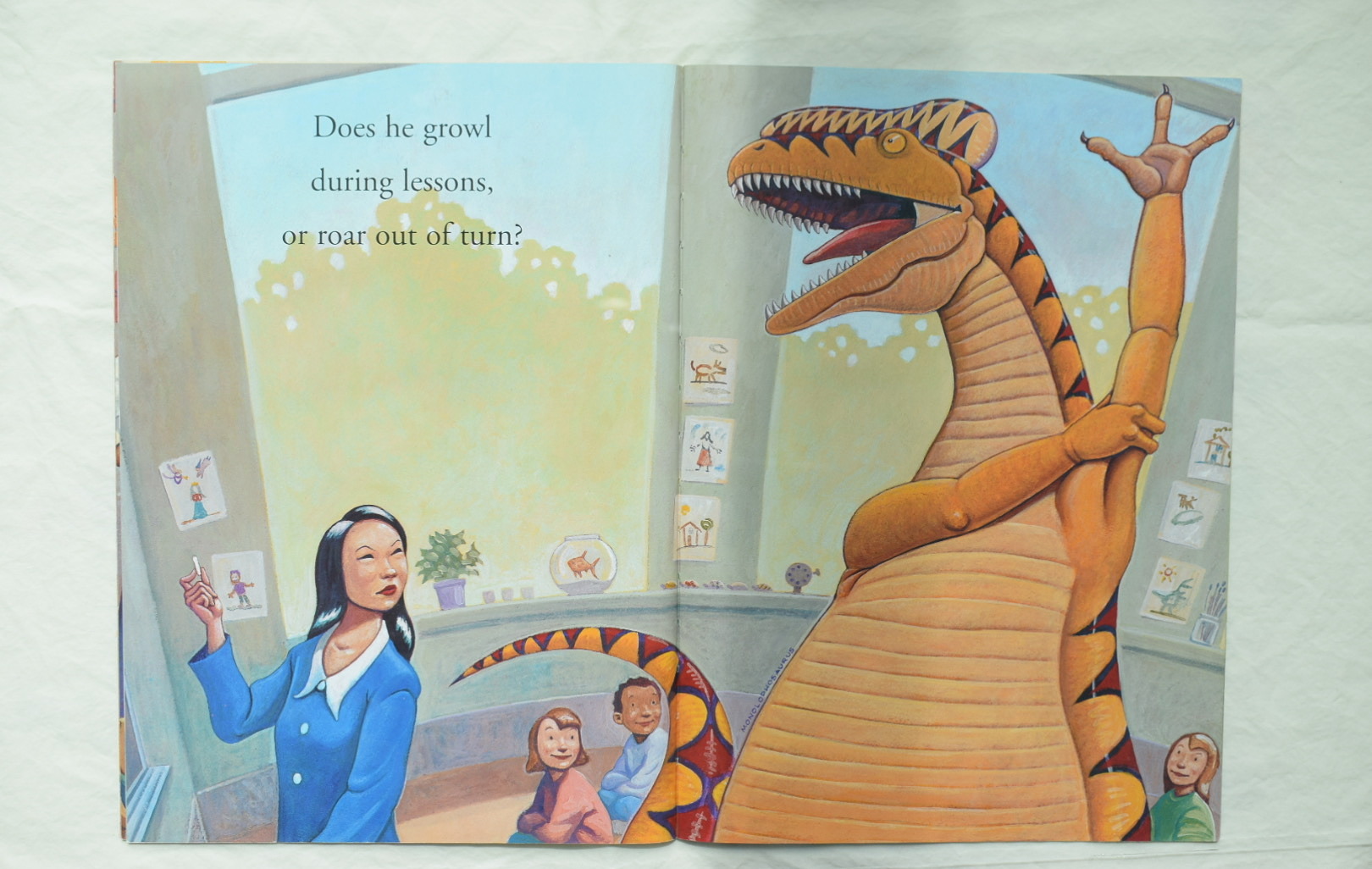
The hand raise. That claw going up, all the urgency, none of the technique, is exactly what my son looks like when he has something very important to say. It gets me every single read.
Two stars. One for the rhyme scheme, which is genuinely well-built, and one because I'm willing to admit my dislike of the art is a me problem and the kids of America have spoken. If your kid is naturally a rule-follower and loves dinosaurs, add a star. If your kid is my son, subtract one.