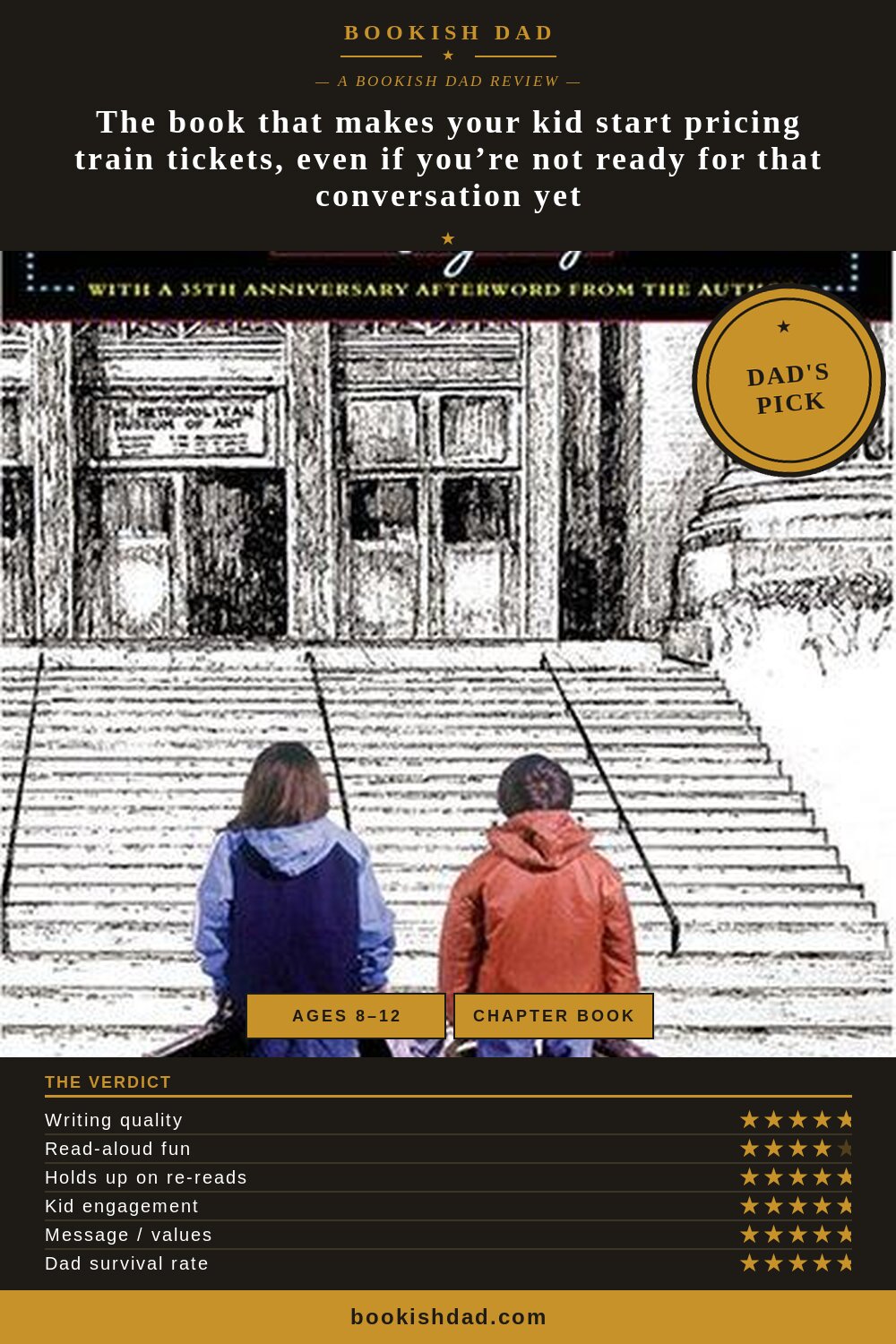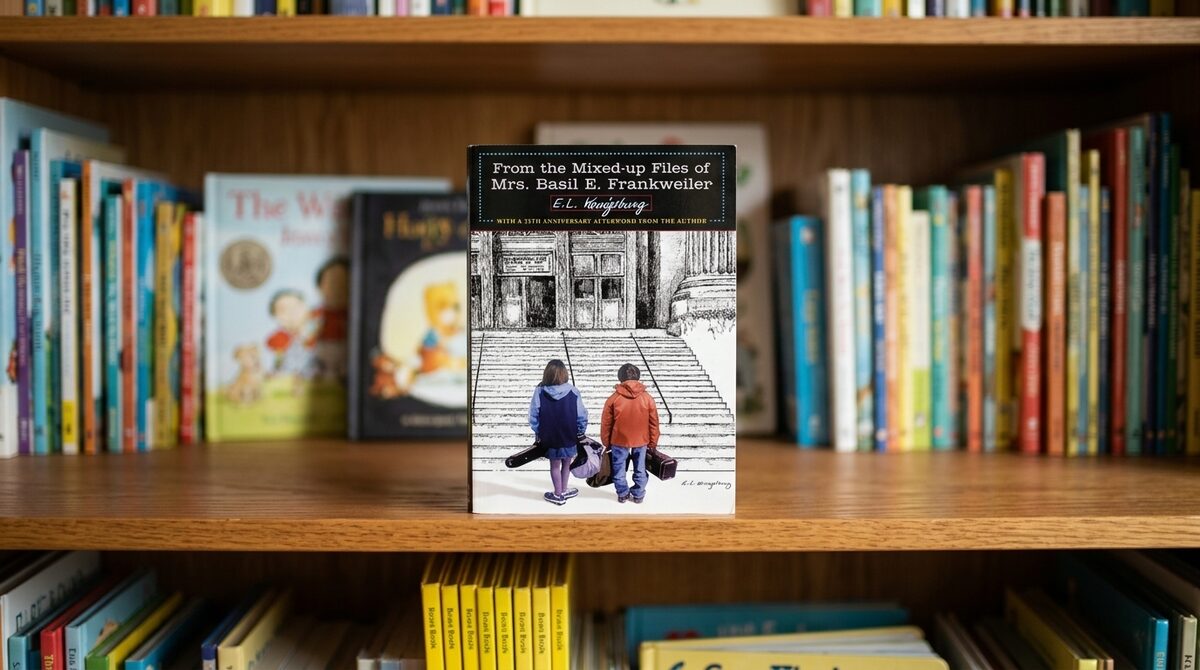

Somewhere around the third bedtime, my daughter stopped me mid-sentence and asked how much a train ticket to New York costs now. Not in a dreamy way. In a way that wanted a number. When I said I didn't know, maybe forty bucks, she asked a follow-up about whether kids ride for less, and I realized she was not listening to a story. She was auditing a plan for feasibility. This book has been doing that to children since 1967 and apparently the effect has not weakened at all.
The premise, if you somehow missed this one: Claudia Kincaid, eleven, oldest of four, the only girl, tired of setting the table AND emptying the dishwasher, decides her family does not appreciate her and runs away. But because she is Claudia, she does not run away in a huff with a bindle. She picks a destination with class (the Metropolitan Museum of Art), and she recruits her nine-year-old brother Jamie, not because she likes him best but because he has saved $24.43, which in 1967 made him basically a hedge fund. They hide in the restrooms at closing time, blend in with school tours, bathe in the fountain and fund themselves with the wishing coins, and sleep in a centuries-old antique bed. Then a marble angel shows up, possibly carved by Michelangelo, bought at auction for a couple hundred dollars from an eccentric old collector named Mrs. Basil E. Frankweiler, and the runaway story becomes a mystery, and eventually the two of them end up at Mrs. Frankweiler's estate digging through her enormous wall of file cabinets.
The cranky old lady narrating the whole thing is the secret weapon
The entire book is framed as a letter from 82-year-old Mrs. Frankweiler to her lawyer, Saxonberg, explaining why she's changing her will. Some critics have called that a structural flaw, since she doesn't show up in her own story until near the end. Those critics are wrong and I will not be doing voices for them. Her commentary is dry and fussy and slightly mean in the way your favorite great-aunt is slightly mean, and it gives you, the exhausted parent, an adult to be while you read. I gave her a voice best described as "wealthy woman who has fired several gardeners" and my daughter approved of it by not objecting, which for her is a signed affidavit. And the letter frame pays off. There is a reveal about Saxonberg in the final stretch that made my daughter close her eyes for a second and say "he knew the whole entire time," in the tone of someone filing a formal complaint with the state.
As a read-aloud it moves. Claudia corrects Jamie's grammar; Jamie hounds Claudia about money; Jamie also cheats at cards, which the book presents without much hand-wringing, and which delighted everyone in my house who is eight. Sibling bickering is the easiest dialogue in the world to perform because you have heard the melody in your own kitchen. Konigsburg's sentences are clean and exact and never once talk down, which is why kids trust her. The book takes kid logistics seriously (where do you sleep, what do you eat, how long does $24.43 last), and it turns out that taking the logistics seriously is the whole reason the fantasy works.
My daughter is now aware of her net worth
Engagement report: total lockdown. My daughter asked for extra chapters twice, and one morning I found her at the kitchen table counting her actual money (piggy bank, tooth fairy earnings, one suspicious five) before announcing she had $11.85 and that Jamie was "rich for a nine-year-old." My wife asked me later, in a neutral voice, whether the book we were reading was teaching our daughter to case museums. Sort of? My son, four, is well outside the age range and mostly stayed clear, though he caught the part about kids collecting coins out of the fountain, and at his next bath he threw a nickel into the water and refused to explain himself to anyone.
On values: the ending gets at something true. Claudia's real reason for chasing the mystery is that she wants a secret that belongs only to her. Kids own almost nothing. Their schedules, their bedtimes, their vegetables, all managed by other people. A secret is the one thing nobody can confiscate, and Konigsburg understood that better than most parenting books I've been handed. The book is also, on paper, about two children committing light truancy and museum fraud, and I have no notes, because it never pretends they aren't naïve, and the naïveté catches up with them before the end.
The 1967 problem (there mostly isn't one)
Full disclosure: I read this in fifth grade and spent about two weeks afterward evaluating our public library as a residence, so nostalgia is on the field here. But I re-checked myself on this read and the book holds. The dated details (transistor radios, a fortune of twenty-four dollars, the general absence of security cameras) don't break it for kids; they just make it a period piece, and my daughter processed the prices the way she processes dinosaurs, as interesting facts about a lost world. Dad survival rate is excellent, because it's a one-chapter-a-night book rather than a 40-reads-of-the-same-spread book, and the narrator is fun enough that I would have kept going without an audience. I expect it back in rotation in a year or two when my daughter rereads it herself, probably at 6-something a.m., probably with the door closed, possibly while updating her budget.