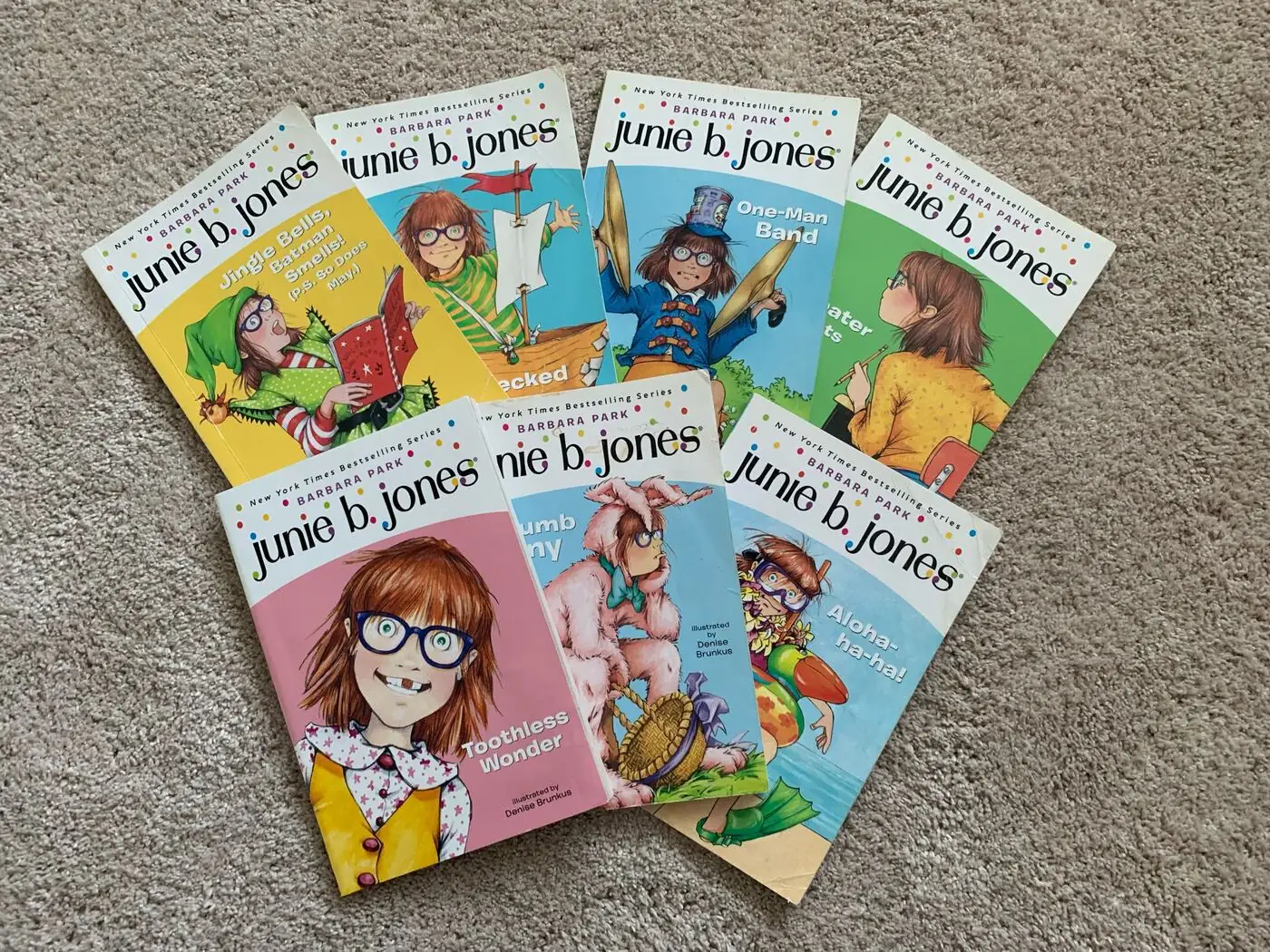
"Oh I would never read Junie B. Jones to my kids, she's such a bad influence!" If you are a parent of a 5+ child you've probably heard this before. Luckily I didn't hear it before I first started reading the Junie B. Jones series to my kids, otherwise I might have just blindly accepted the advice and avoided it. In my own personal opinion those books are great, and not only do my kids get a kick out of them, I do as well. Is Junie B. a good influence? Absolutely not. But is she an actual real character in that she acts exactly as most kids do? Yes! To me that's what makes these books so good: the characters are real, which includes their (many) flaws. The parents are exhausted and short with her, she makes bad choice after bad choice, but it's great reading. Both of my kids blow up with laughter when Junie B. takes a first bite of that fruitcake. I can't stop laughing when the parents lose their minds after Junie B. wakes up Ollie during a nap for the 100th time.
Before you think I'm crazy, no, I do not want my kids acting like Junie B. I'd prefer not to be called a "Dumb Bunny" (although it definitely would beat some other alternatives that may or may not have happened before). But I also don't want them to live in some bubble where they aren't exposed to people making mistakes, being mean, or getting bullied. Now I'm definitely not some type of child psychologist, and I only pretend to be one when I'm trying out a new strategy to get them to do their chores. But I do have kids and know they possess this mysterious ability to be both extremely smart and, well, er, not so smart simultaneously. They can tell good behavior from bad, and in the cases where it's a bit more grey area, it's an opportunity to talk with them. "Do you think Junie B. made a good choice pitting her friends against each other in a bidding war to see her monkey baby?" makes for some great bedtime conversation.
Does this apply to all kids though? Absolutely not. I know my kids super well. I'm around them a lot, I know what they can handle and what they can't. That's what I think is most important in knowing what type of content in books you can expose your kids to. Here are some of the top "non-wholesome" content types that I am aware of when reading books, and how I handle them when reading aloud to my kids.
Behaviors
I've already covered this one a bit. I'm totally fine reading about "bad" kids to my kids. Do I want them using Greg Heffley from Diary of a Wimpy Kid as a role model? Oh please no. But let's just say that pretty much every single page of that book offers a good opportunity to talk about things such as "what is it to be a good friend?" (poor Rowley). Honestly, my daughter usually beats me to it anyway. I'll be gearing up for some big teaching moment and she'll already be giving me a look like she filed the verdict on Greg two chapters ago and doesn't need my help. Case closed, and I didn't even have to do anything. The bad behavior is the whole point of these books, and kids figure that out immediately.
Violence
Luckily most authors of children's books know violence is a bit of a no-no for most parents. Where I run across it most as a parent is actually in non-fiction natural science books, like the Discovery Kids books about animals. The animal kingdom can be quite violent. To the point where honestly I'd rather not see or hear about it (maybe I should be a vegetarian). My kids have been sensitive to some of the topics: "why do snakes eat bunnies??? They are so cute, they should just eat yucky bugs!" I feel for them. Bunnies are pretty darned cute. However, I also want my kids to have a real understanding of the world around them. I end up doing no editing of what I read, but I will maybe thumb through some pages of a book beforehand just to make sure there isn't an image that is going to cause some nightmares or trigger a new phobia (hasn't happened yet). Light violence, things like pushing or getting "beat up," I won't censor at all. The BFG spends a solid stretch of that book discussing which countries' children taste the best to giants, and I read every word of it in the giant voice, and my 4-year-old thinks it's the greatest material ever written. The only violence I would censor would be anything with high levels of gore or where it's just a bit too graphic. I haven't run across that in any children's book yet though. I have a feeling that once I finally break out the Harry Potter series for my oldest, I'll just read it as is.
Romance
Again, not a big issue when it comes to children's books. I haven't had to do any impromptu "the birds and the bees" discussions. We've read a few with some childhood "crushes" though, and I'm generally fine with it. It's usually somebody being too nervous to talk to somebody else for 40 pages, which is about the speed I can handle. Love is a lot of things, and I want my kids to get exposure to it, as long as it doesn't involve me giving them detailed anatomy lessons until they are like 40 years old or something.
Language
Oh Roald Dahl. How I love you. But you do like to throw some pretty intense insults into your books in addition to just some plain foul language. Outright swear words like "you ass" I have filtered out for my 4 and 8 year old. It feels like one of those "this book was written 40+ years ago and kids were different back then" type of things, so I don't feel like I'm really changing the story much by leaving it out. Some of the more creative insults we leave in of course, that's half the fun. Nobody in my house is getting cheated out of a full Trunchbull rant.
Other "Adult Themes"
This would be the catchall for anything else that I would think a bit about before reading to my kids. Does it handle mature topics like death, mental and physical health issues like depression, difficult environments? Does it seem to share opinionated views on things like politics? Again, these aren't very common in children's books. But speaking of Roald Dahl, Matilda honestly deals with a terrible situation both at home and at school. Kids may not necessarily see it the same way (given Roald Dahl's way of making it all a bit whacky as opposed to depressing), but it's the kind of thing you'll want to know about before you're the one reading it out loud. For what it's worth, I read Matilda when I was 7, and what I mostly took away from it was that the Trunchbull was terrifyingly funny and Miss Honey deserved better. I turned out fine. Probably.
Lastly, on "Judging"
This probably all comes across as judgemental, but I promise you I don't judge at all? Like I said earlier, this all comes down to understanding your kids, the content you want to expose them to, and what they can handle. That'll be different for every family. This is just one dad's perspective on how I handle it with my kids, but I hope the main takeaway here is just about thinking critically about what makes the most sense for your own kids. I'm sure some of you are reading all of this right now thinking "What a wimp, he can't even say 'ass' in front of his kids," and to that I say, touché.